The Army is seeking new, sophisticated UAVs that do not require a runway and weigh a minimum of 1,320 pounds
As drones continue to rise in popularity, state and non-state actors alike are seeking to upgrade their existing unmanned aerial vehicle (UAV) fleets. Over the summer, the US Army indicated its plans to pause acquisitions of the MQ-1C “Gray Eagle” drone series in order to make room for newer and more advanced successors. According to a joint memo released by the Army chief of staff and Army secretary, the tried and trusted drone series is not expected to be able to contend with a rapidly expanding UAV environment. “We will cancel procurement of outdated crewed attack aircraft such as the AH-64D … and obsolete UAVs like the Gray Eagle,” the pair stated. “Our Army must transform now to a leaner, more lethal force by infusing technology, cutting obsolete systems, and reducing overhead to defeat any adversary on an ever-changing battlefield.”
Since this announcement was made back in May, the Army has kicked off its official search to field the Gray Eagle’s replacement. Specifically, the service is seeking new, sophisticated UAVs that do not require a runway and weigh a minimum of 1,320 pounds. As detailed by the Army’s request for information to industry, “In alignment with the Army’s Continuous Transformation, there is a pressing need for reducing runway dependency, allowing critical weapon systems to meet the challenges of an evolving battlefield. Division formations require an organic, runway-independent Uncrewed Aircraft System (UAS) that offers increased Size, Weight, Power, and Cost (SWaP-C), modularity, and interoperability.”
The Gray Eagle’s Specifications
- Year Introduced: 2009
- Number Built: Roughly 200-plus
- Length: 28 feet
- Wingspan: 56 feet
- Weight: Max takeoff weight (standard) 3,600 pounds, max takeoff weight (er) 4,200 pounds
- Engines: Thielert Centurion 1.7 Heavy-Fuel Engine
- Top Speed: 167 knots max speed
- Range: Over 2,500 nautical miles
- Service Ceiling: 29,000 feet
- Loadout: Payload capacity roughly 575 pounds, including AGM-114 Hellfire missiles and GBU-44/B Viper Strike bombs
- Aircrew: Zero, autonomous
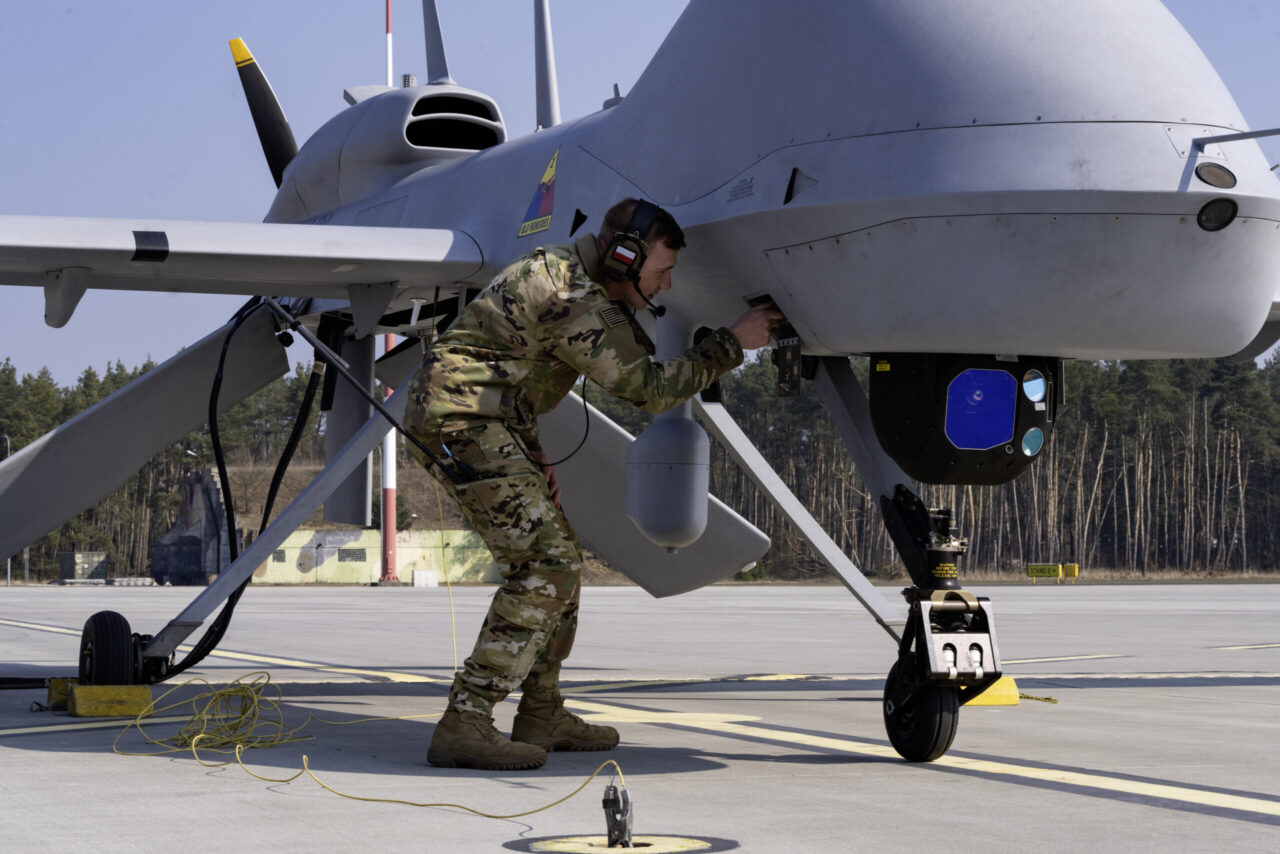
The General Atomics-designed Gray Eagle was initially conceptualized as a replacement for the manufacturer’s older MQ-1 Predator drone series. As a medium-altitude, long-endurance UAV, the MQ-1C features greater fuel capacity and a longer range than the Predator. While the platform suffered some setbacks early on in its initial days in service, improved variants have proved to be solid aerial weapons for the service. Specifically, the Gray Eagle today hosts wide-area intelligence, surveillance, and reconnaissance capability; close air support; improvised explosive device detection; and other key capabilities.
Although the Gray Eagle has remained in service for 16 years, the Army’s desire to field enhanced drones falls in line with the growing prominence of UAV warfare across the globe. In November, US Army official Maj. Gen. Bartholomees reiterated the service’s requirement for advanced drones, noting that the US Indo-Pacific Command was “learning from what is happening in Ukraine.” Both Kyiv and Moscow have deployed a vast range of lethal UAVs throughout the last few years, including deadly new platforms fielded by Iran and Turkey.
About the Author: Maya Carlin
Maya Carlin, national security writer with The National Interest, is an analyst with the Center for Security Policy and a former Anna Sobol Levy Fellow at IDC Herzliya in Israel. She has over 1,000 articles published over the last several years on various defense issues. Carlin has bylines in many publications, including The National Interest, Jerusalem Post, and Times of Israel. You can follow her on Twitter: @MayaCarlin.
Image: DVIDS.