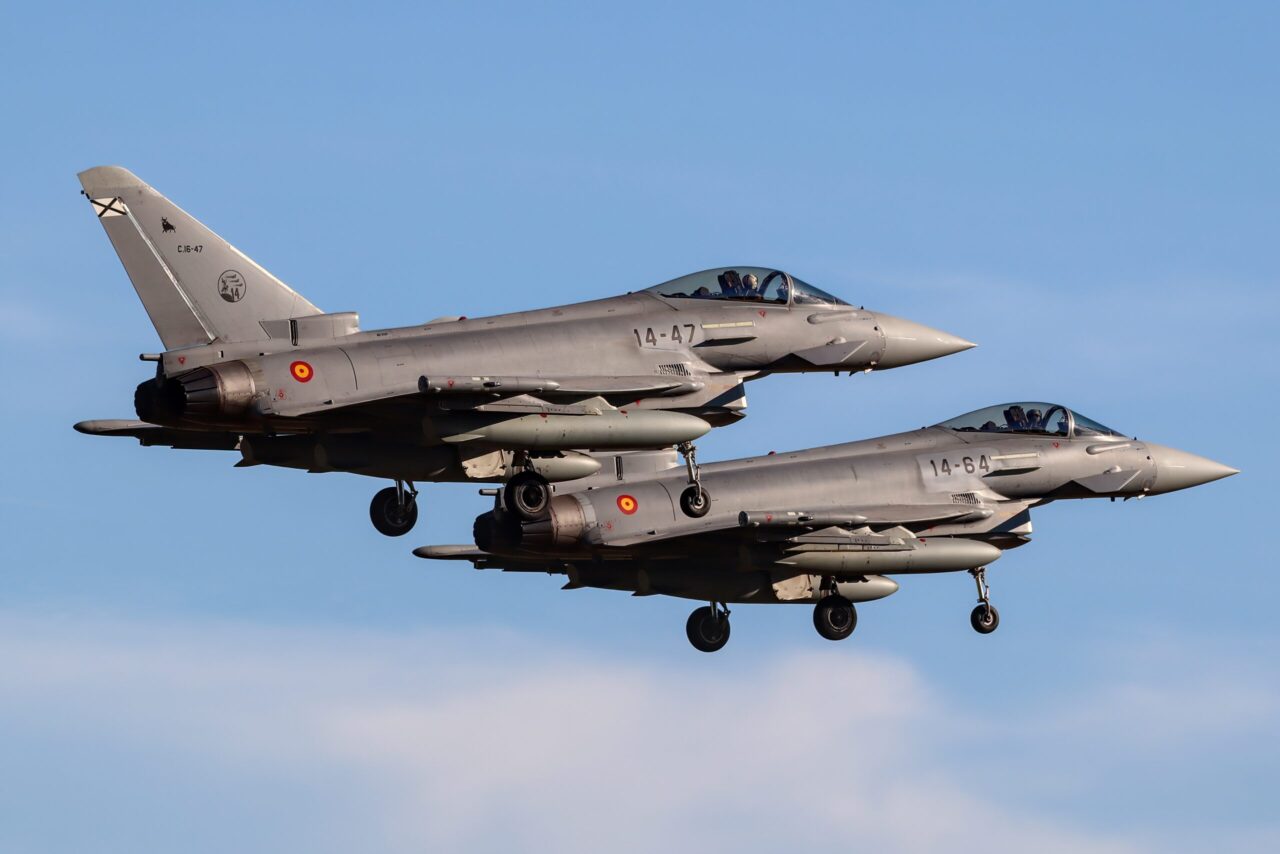
Bangladesh flies a combination of Soviet Union-era Mikoyan MiG-29s and Chinese-designed Chengdu F-7s, making the Eurofighter a real upgrade.
Bangladesh is the latest nation to take steps to procure the Eurofighter Typhoon fighter jet series. Last week, officials representing the Bangladesh Air Force penned a letter of intent to purchase these famous jets from Italian manufacturer Leonardo. As part of a Multi-Role Combat Aircraft requirement, Dhaka is expected to receive roughly a dozen Eurofighters.
While details surrounding the potential timeline for such a delivery have not been disclosed, Bangladesh has been eyeing the Eurofighter platform for quite some time. In fact, a contingent from the Bangladesh Air Force visited Leonard’s Italian facility earlier this year to test out the Typhoon. Since the South Asian nation currently does not field a more advanced combat aircraft in its fleet, the Eurofighter would certainly elevate its aerial prowess. Bangladesh flies a combination of Soviet Union-era Mikoyan MiG-29s and Chinese-designed Chengdu F-7s.
If this deal comes to fruition, the Eurofighter will again prove its worth on the export market. Nearly 770 of these fighters have been ordered by more than 10 nations to date, including the UK, Italy, Spain, Germany, Austria, Kuwait, Saudi Arabia, Qatar, and Oman.
The Eurofighter Typhoon Is an Upgrade Over the Mikoyan MiG-29 and the Chengdu F-7
| Aircraft | Mikoyan MiG-29 | Chengdu F-7 | Eurofighter Typhoon |
| Year Introduced | 1983 | Late 1970s/early 1980s | 2003 |
| Number Built | Over 1,600 | Over 2,400 | 609 (+7 prototypes) |
| Length | ~17 m | ~15 m | 15.96 m (52 ft, 4 in) |
| Wingspan | ~11.4 m | 7.15 m | 10.95 m (35 ft, 11 in) |
| Weight (MTOW) | 11-15 tons empty/loaded | Empty weight roughly 5,280 kg, and a maximum takeoff weight off ~9,000 kg | 23,500 kg (35,274 lb) |
| Engine(s) | Twin Klimov RD-33 turbofan engines | WP-7 series | Two Eurojet EJ200 afterburning turbofan engines, 60kN (13,500 lbf) thrust each dry |
| Top Speed | Mach 2.0 | Mach 2.0 | 2,495 km/h (1,550 mph/Mach 2.35) |
| Combat Radius | Typically 400-500 nautical miles | ~450-650 km | 1,389 km (863 mi) |
| Service Ceiling | 59,100 m | 17,500 to 18,000 m | 16,764 m (55,000 ft) |
| Loadout | Two R-27 (AA-10 Alamo) medium-range AAMs and four short-range R-60 (AA-8 Aphid) or R-73 (AA-11 Archer) IR guided missiles. | A range of armament including PL-5, PL-8 PL-9 missiles, bombs, and rockets | * One 27mm Mauser BK-27 revolver cannon* 13 hardpoints (8 under wing, 5 under-fuselage pylon stations)* 9,000 kg (19,800 lb) total payload capacity |
| Aircrew | 1 or 2, depending on variant | 1 | 1-2, depending on variant |
The multinational, supersonic, multirole fighter Eurofighter Typhoon platform is constructed by a consortium of companies representing Germany, the UK, Italy, and Spain. The collaborative effort was first put together as a means to field an unparalleled air-superiority fighter. While the Typhoon may not technically be a stealth platform, its low-observable qualities make it a near-peer product to its fifth-generation counterparts.
Considering the Typhoon’s top-tier specs and capabilities, its popularity across the globe makes sense. In October, Germany opted to purchase an additional 20 Eurofighters to boost its aerial power. According to a statement released by the German Ministry of Defense at the time, the upgraded jets would be decked out with E-scan radars and other cutting-edge capabilities upon delivery. The statement detailed, “‘The Eurofighter is the mainstay of the German combat aircraft fleet. The procurement of Tranche 5 [aircraft] serves to gradually transfer the capabilities of the aging Tornado fighter jet in the area of Electronic Combat and Reconnaissance (ECR) into a future-proof platform with which Germany will continue to’ honour its NATO objectives.” The specific electronic attack variant Berlin will acquire will also be armed with the AGM-88E AARGM (advanced anti-radiation guided missile) to replace the SEAD (suppression of enemy air defenses) and DEAD (destruction of enemy air defense) roles currently managed by the Panavia Tornado.
About the Author: Maya Carlin
Maya Carlin, national security writer with The National Interest, is an analyst with the Center for Security Policy and a former Anna Sobol Levy Fellow at IDC Herzliya in Israel. She has over 1,000 articles published over the last several years on various defense issues. Carlin has bylines in many publications, including The National Interest, Jerusalem Post, and Times of Israel. You can follow her on Twitter: @MayaCarlin.
Image: Shutterstock.