Australia is understandably concerned about Chinese adventurism in the Indo-Pacific’s Second Island Chain—but there is little that it can do to stop it.
China has reached the stage of its economic and industrial development where it is pouring gobs of cash into a massive military modernization program. As a result of this push, it now has the world’s largest navy in numbers of ships, though not yet in overall tonnage. Beijing has been advancing in the naval domain at a breakneck pace.
Recently, China lashed out at their Japanese neighbors after the government of the new Japanese prime minister insinuated that her country would militarily defend Taiwan against any potential Chinese attack. This began a very nasty war of words and historical recriminations of epic proportions between the two Asian states. Threats were bandied about. Beijing circulated maps of Japan with missile targets on them.
Tokyo looked to Washington for support…and was greeted by silence.
China Is Calling America’s Bluff in the Indo-Pacific
China understands the limits of US military support for its proxies nearest to Chinese territory. Accordingly, it is signaling to the whole region that its military, not the American military, is the dominant regional force. The message is clear: we are running things now, and the Americans will only passively watch us take what we want.
Toward that end, Canberra awoke to a frightening reality when they detected a four-ship People’s Liberation Army Navy (PLAN) task force operating south in the Philippine Sea.
For years, Beijing has battled with Manila for dominance in the South China Sea and the territorial waters around the Philippines. But this was something more than a threat directed against the Philippines. Australia’s military feared that the Chinese were plotting to move beyond the limits of the Philippine Sea.
Beijing Moves to Take the Second Island Chain
After all, Chinese warships have been moving farther beyond what’s known as the First Island Chain (the territories extending from the Kamchatka Peninsula through Japan and Taiwan down to the Philippines) and have already started meddling in the affairs of the Second Island Chain (which includes Japan’s Bonin Islands, Mariana Islands as well as Guam, Palau, and the Caroline Islands which incorporates the Federates States of Micronesia and the Marshall Islands).
If those areas sound familiar to you, it’s because many of those islands were fought over between the Imperial Japanese Army and the United States Marine Corps in the Pacific Theater of World War II, during the Americans’ island-hopping campaign against the Empire of Japan. Once again, the Americans and their allies are finding themselves locked into competition with a rising Asian power for control over these tiny, outlying islands.
Australia Is Concerned—but Powerless to Stop Beijing
For Australia, this is an especially disconcerting reality, seeing as the outlying territories around Australia are now also vulnerable to Chinese influence and growing naval reach.
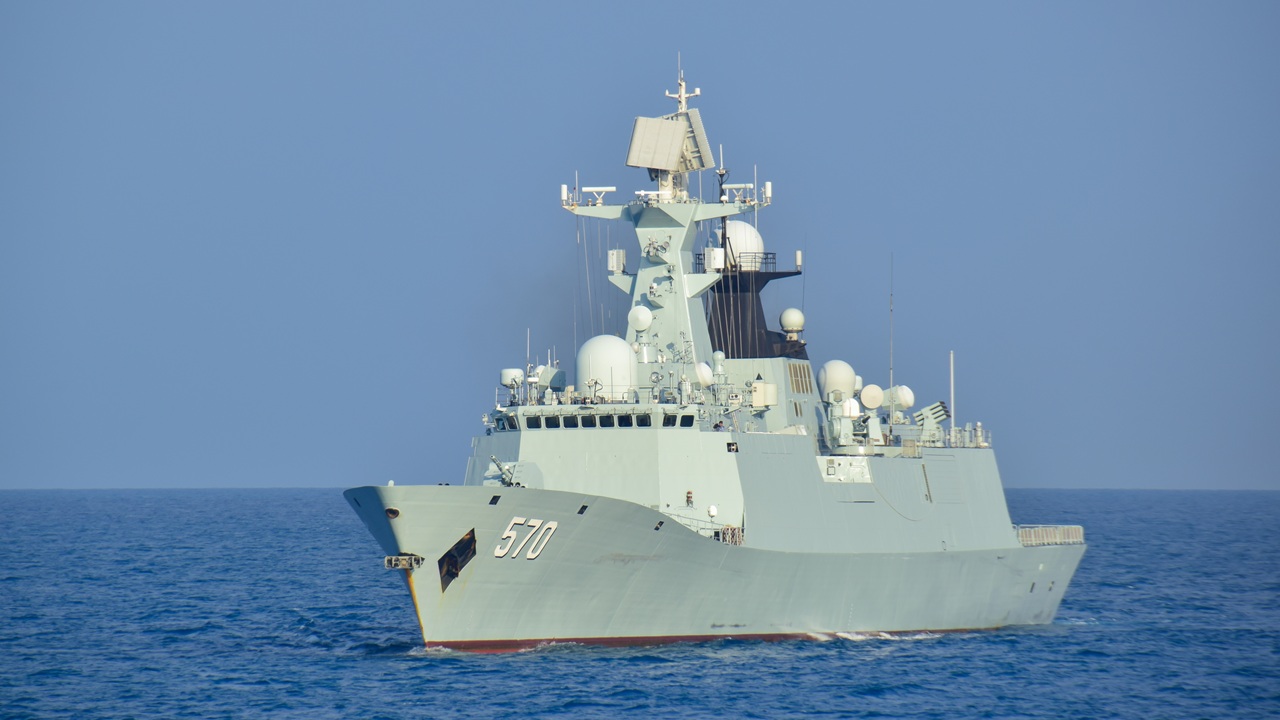
The PLAN task force consisted of four ships, including a Yushen landing helicopter dock assault, a Renhai-class cruiser, a Jiangkai-class frigate, and Fuchi-class replenishment vessel. The Australians deployed one of their P-8 Poseidon surveillance planes to keep a close eye on the PLAN task force on the evening of December 2 in the Philippine Sea.
These Chinese warships were 500 nautical miles north of Palau, a strategic area of the Second Island Chain.
Adm. David Johnson, the chief of Australia’s defense force, explained to Australia’s Senate after the incident that he was concerned China’s task force could enter Australia’s territorial waters, especially given the history of such task forces deployed to the Philippine Sea by China.
Often, China sends their ships from the Philippine Sea out to the Western Pacific, Southwest Pacific, or very near Australia. And this possibility of Chinese warships showing up in Australian territorial waters, so far from China’s usual naval area of operations, is what is keeping Australian policymakers up at night. This is especially the case at the current moment, seeing as the Australians and Chinese have become adversarial since the COVID-19 pandemic.
Most troublingly from Canberra’s perspective, China’s military has expanded and grown in capabilities (and reach), while Australia’s military has been enduring a decrease in size, capabilities, and even willpower to resist China’s rise. In fact, without the US military’s complete backing, the Australians can in no way roll back whatever long-term gains the Chinese are planning to make in the Second Island Chain and in Australia’s outermost territorial waters.
Does Anyone Really Care About China’s Rise?
Beyond the military domain, there are a multiplicity of factors behind why Canberra’s clamoring against China’s rise is falling on deaf ears. One of the biggest reasons why China neither fears nor cares about whatever Australia huffs about is due to the fact that the economies of the two nations are intertwined.
Then, there’s the much-ballyhooed Australia-United Kingdom-United States (AUKUS) submarine building alliance that is explicitly meant to balance against China. The only problem is that it exists only on paper, despite having years to get this system up-and-running.
Neither Liberal nor Labor politicians in Australia actually want to fight China. Nor do they want to become entirely dependent on Uncle Sam, viewing Washington as an unreliable and, at times, unwanted partner in their part of the world.
Ultimately, Australia is going to engage in a complex balancing act, but will not rile the dragon too much. In the meantime, China continues to aggressively construct the world’s largest navy. They keep sending their forces farther from China’s shores, too. All as no Western power does anything other than kvetch about it in the international media. And the longer that the West complains about China’s growing influence and military capability while doing nearly nothing substantive to stop it, the more empowered Beijing becomes.
So, the recent deployment of the PLAN’s task force and the growing Chinese presence in the Second Island Chain is not going away, no matter what the Australians, Americans, Japanese, et al., say. The only thing that will roll China’s influence back would be an economic and/or political collapse in China—and that has yet to occur.
About the Author: Brandon J. Weichert
Brandon J. Weichert is a senior national security editor at The National Interest. Recently, Weichert became the host of The National Security Hour on America Outloud News and iHeartRadio, where he discusses national security policy every Wednesday at 8pm Eastern. Weichert hosts a companion book talk series on Rumble entitled “National Security Talk.” He is also a contributor at Popular Mechanics and has consulted regularly with various government institutions and private organizations on geopolitical issues. Weichert’s writings have appeared in multiple publications, including The Washington Times, National Review, The American Spectator, MSN, and the Asia Times. His books include Winning Space: How America Remains a Superpower, Biohacked: China’s Race to Control Life, and The Shadow War: Iran’s Quest for Supremacy. His newest book, A Disaster of Our Own Making: How the West Lost Ukraine is available for purchase wherever books are sold. He can be followed via Twitter @WeTheBrandon.
Image: Shutterstock / pichitchai.