“Muddle Instead of Music” was the title of an anonymous review of Dmitri Shostakovich’s Lady Macbeth of Mtsensk, published in Pravda a few days after a Moscow performance of the opera in January 1936. The critic attacked the plot, a dark tale of murder and adultery, as well as the vulgar sexuality that he felt Shostakovich’s score expressed. Rumor had it that the reviewer was Stalin himself, who was seen leaving in the middle of the performance, but recent archival research has convincingly demonstrated that the author was actually the Soviet critic David Zaslavsky. Following the official denunciation, Lady Macbeth went off the Soviet stage for almost thirty years, until Shostakovich revised and toned down the opera, renaming it Katerina Izmailova (after its murderous protagonist) in 1962.
For its opening night this season, Milan’s Teatro alla Scala departed from the usual Italian classics to present a new production of Lady Macbeth by the young Russian director Vasily Barkhatov. Russian works are not totally unknown at La Scala—Mussorgsky’s Boris Godunov opened the 2022 season—but Lady Macbeth has a particularly close connection with the theater: La Scala produced the international premiere of the revised opera in a short run of five Italian-language performances in 1963. The collapse of the Soviet Union allowed Lady Macbeth to return in its original form, and here too La Scala seized upon the opportunity. In 1992, it presented the unrevised version under the baton of the South Korean conductor Myung-Whun Chung, who, coincidentally, will succeed Riccardo Chailly as La Scala’s music director late next year.
Chailly has had a strong record at La Scala since he took over in 2017. In his final opening-night appearance, he led the most energetic premiere of his tenure and successfully delivered Shostakovich’s jarring soundscape, which borrows from Russian folk songs, circus music, and the avant-garde European dissonance that revolutionary Russia was eager to embrace. Chailly particularly emphasized his orchestra’s superb brass section, some of which appeared on stage as part of the searing climactic scenes.
The musical brilliance benefited in no small way from Barkhatov’s production, which captured Lady Macbeth’s original conception as a social satire, even if some misleading media commentary has tried to present it as a tale of women’s empowerment. The libretto is based on Nikolai Leskov’s 1865 novella of the same name and follows Katerina, the bored and abused housewife of Zinovy, a prosperous but feckless merchant. After being ravished by the workman Sergei, she embarks on an affair with him and then proceeds to murder her cruel father-in-law Boris by feeding him mushrooms laced with rat poison. Discovered by Zinovy, the new couple then dispatch him as well, in Barkhatov’s production delivering the final blow with the blade of an ice skate. A local drunk discovers the stinking corpse and leads the police to the scene just as Katerina and Sergei get married. The couple is sentenced to Siberian exile, and Sergei soon sets his eyes on their fellow convict Sonyetka, for whom he procures Katerina’s stockings. The enraged and humiliated Katerina kills Sonyetka in an impulsive murder-suicide, though instead of the traditional death by drowning in an icy river, in this production Katya douses herself and Sonyetka with gasoline and the two women then run around the stage engulfed in flames.
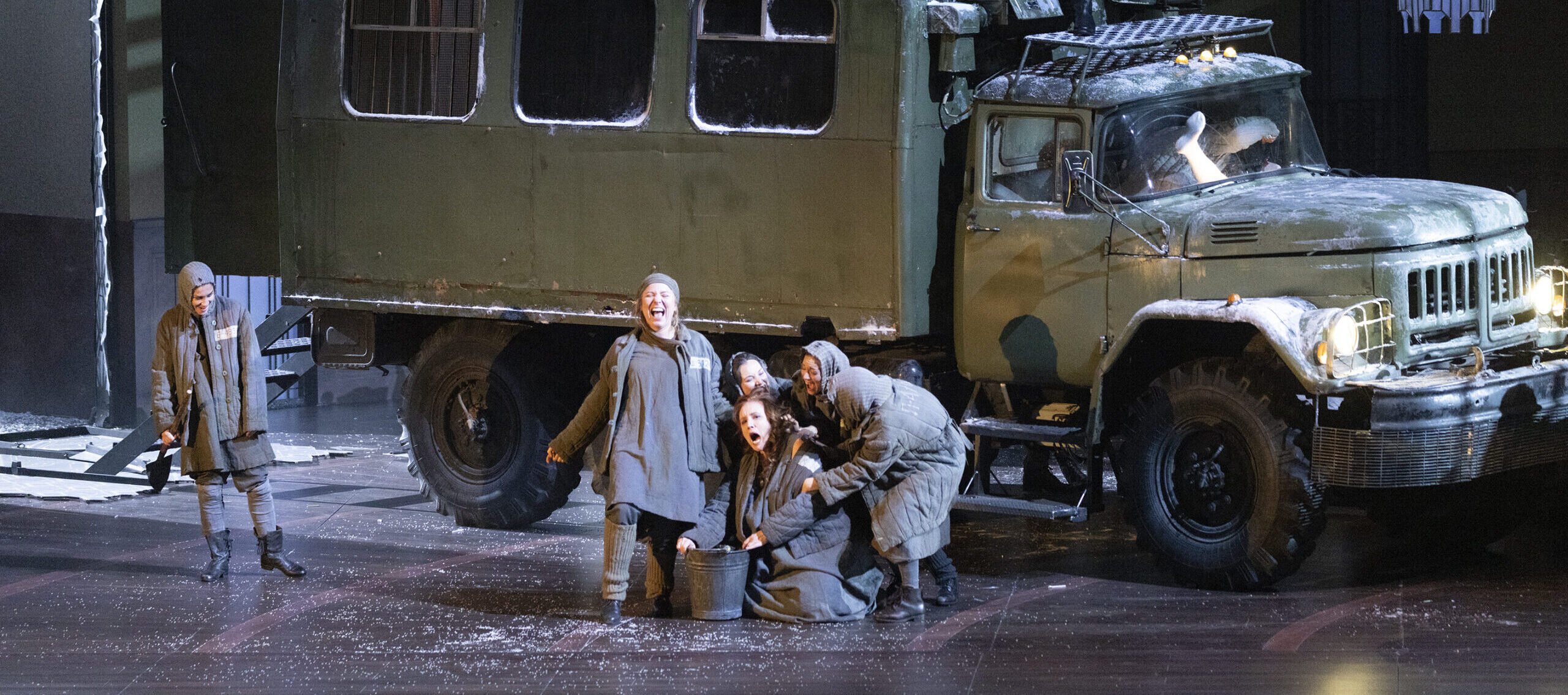
Barkhatov’s directorial choices only made the production more engaging. Set in the late Stalin era rather than in the tsarist period, the Izmailovs run a restaurant with a rolling two-level stage that features a backscene kitchen and a squalid living space below. The opera opens with Katerina narrating her fate not to the audience but to a police official, whom a stage elevator reintroduces at crucial moments to document her crimes. The effect reinforces the cold-bloodedness of the opera’s characters. Even the seduction scene takes place under the watchful eye of the police, who take notes and photograph Katerina and Sergei as they simulate sex acts on stage. The prison convoy to Siberia is replaced by a sturdy truck that bursts through the walls of the set.
The performance was anchored by the American soprano Sara Jakubiak, a Michigan native, who here made an intense La Scala debut. Her voice had dark elements that drew out Katerina’s baser instincts but also possessed a warmth that made clear the extent of her passion for Sergei. One could hardly have asked for a better ensemble cast to accompany her, even in roles as unpromisingly billed as “Seedy Lout” (the comprimario tenor Alexander Kravets), “Drunken Guest” (the exuberant tenor Massimiliano Di Fino), and “Old Convict” (the Georgian bass Goderdzi Janelidze). The Uzbek tenor Najmiddin Mavlyanov, who sings starring tenore di forza roles internationally, was a powerful and insistent Sergei. The Mariinsky Theatre veteran Yevgeny Akimov sounded pinched and petulant sound as Zinovy. The bass Alexander Roslavets sang Boris with unforgiving but well-pitched brutality. Elena Maximova, a mezzo-soprano, was a strong Sonyetka in her brief but memorable appearance in the final scene. Alberto Malazzi’s superb direction elevated La Scala’s chorus.
La Scala’s season always opens on December 7, the feast day of Saint Ambrose, Milan’s patron saint. The performance is followed by a sumptuous reception and dinner given a short distance away at the city’s venerable Società del Giardino. This year the chef Davide Oldani devised a splendid menu. No mushrooms were served.