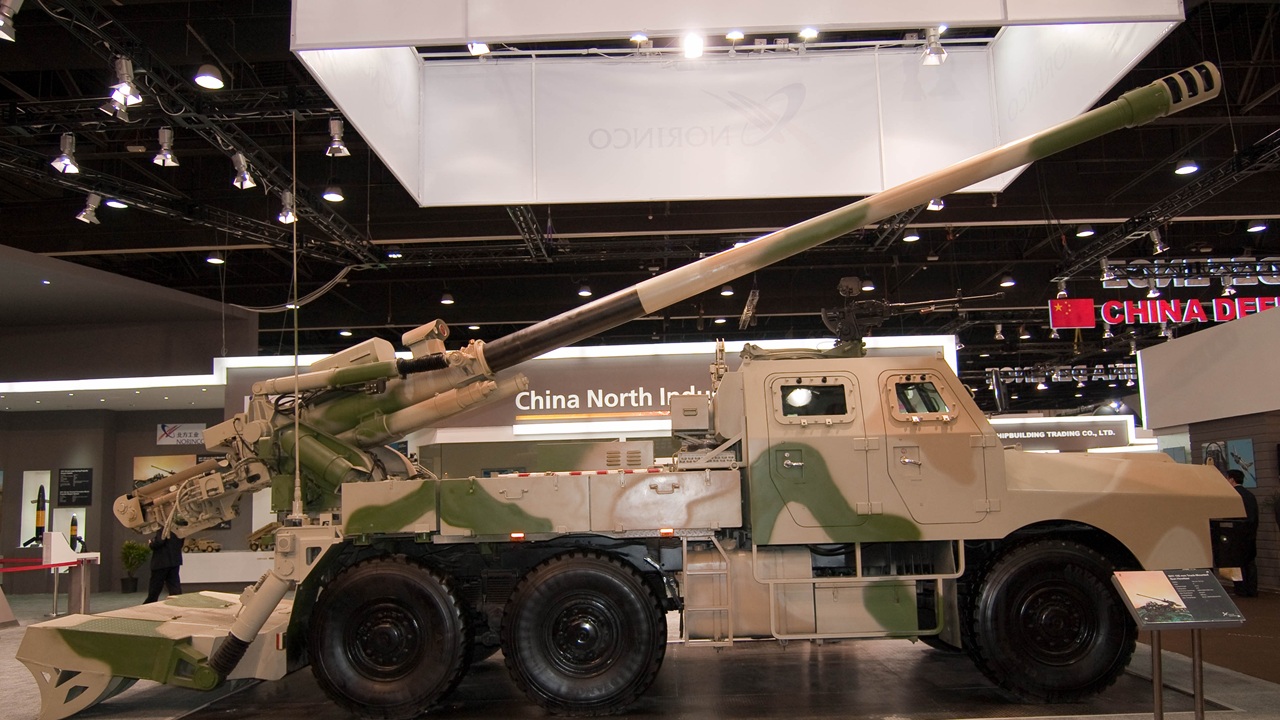
The AH4 is far cheaper than comparable Western systems—but can fire the NATO standard 155mm artillery shell, with an eye toward eventual purchase by cash-strapped NATO nations.
China is intent on becoming a competitive player in the global arms export industry. It already has the mass production capacity that most Western nations can only dream of. And it is now marrying that mass production to increasingly advanced products.
China’s mass production capacity has the capacity to collapse global prices and make the world dependent on cheap, mass-produced Chinese products. In this case, China is diligently developing a highly mobile, lightweight 155mm towed howitzer that can easily be transported around the battlefield via helicopters or planes.
About China’s AH4 Howitzer
Known as the AH4, the new lightweight artillery pieces have increasingly turned up in conflict zones across the Global South, including Sudan and Yemen. These weapons, produced by Chinese state-owned arms manufacturer Norinco, weigh a relatively lightweight 4.5 tons. (The US-made M777 howitzer, the AH4’s rough equivalent, weighs around 4.2 tons due to the use of more advanced materials in its construction, but has a much higher price point as well.) The difference in weight is not significant, and the AH4 can be transported aboard CH-47 or Mi-26 helicopters and C-130 or Y-8 military cargo planes.
This system possesses extended range, thanks to the 40-kilometer (25 miles) range with rocket-assisted projectiles, giving this platform significant reach—essential on the modern battlefield. In the age of long-range warfare, the greater the range and accuracy, the more rapid the firepower, and the longer the distance a weapon can attack from, the more effective (and desired) it is. That’s what the Chinese are counting on with the AH4 Howitzer.
China’s Dream Scenario: Get the AH4 into NATO Arsenals
Get this: Beijing claims they designed the AH4 to fire a variety of ammunition—not just Chinese or Soviet-derived ammo. In fact, it can fire NATO-standard 155mm rounds, including precision-guided munitions (PGMs).
China wants to sell these systems to the Global South. But a far more lucrative customer would be NATO or NATO-adjacent nations, which could then more easily integrate the weapons into the NATO defense architecture. Given how desperate has become in the face of the resurgent Russian threat and the incredibly shrinking American military commitment to Europe, the European countries that are rapidly trying to rearm might be tempted to purchase such relatively cheap, easy to maneuver, interoperable Chinese systems.
Of course, that would come with its own set of problems for NATO. After all, China is notorious for rigging the gear they export with all manner of spy gear and kill switches. But that has not stopped the rest of the world from being made dependent on relatively cheap Chinese goods.
For now, the AH4 system is relegated to places like Yemen and Sudan. But one can envision this being purchased by other militaries hard up for cheap systems with reach.
We don’t yet know how the AH4 will perform in a modern battlefield in which near-peer competitors are waging war. What’s more, in the age of drones, as we’ve seen in Ukraine, the AH4 is likely a tempting target for unmanned aerial vehicles (UAVs).
Like so many Chinese weapons, the AH4 is relatively untested. But it has had a decent, albeit limited, run in places like Sudan. At some point, it will become more ubiquitous throughout the world’s hotspots simply because of its low price point, and the world will gather more operational data on its performance.
About the Author: Brandon J. Weichert
Brandon J. Weichert is a senior national security editor at The National Interest. Recently, Weichert became the host of The National Security Hour on America Outloud News and iHeartRadio, where he discusses national security policy every Wednesday at 8pm Eastern. Weichert hosts a companion book talk series on Rumble entitled “National Security Talk.” He is also a contributor at Popular Mechanics and has consulted regularly with various government institutions and private organizations on geopolitical issues. Weichert’s writings have appeared in multiple publications, including The Washington Times, National Review, The American Spectator, MSN, and the Asia Times. His books include Winning Space: How America Remains a Superpower, Biohacked: China’s Race to Control Life, and The Shadow War: Iran’s Quest for Supremacy. His newest book, A Disaster of Our Own Making: How the West Lost Ukraine is available for purchase wherever books are sold. He can be followed via Twitter @WeTheBrandon.
Image: Shutterstock / Flying Camera.