When we are experiencing a difficult relationship in our lives, one which overwhelms our capacity for Christian charity, it often happens that the Lord will intervene. The person with whom we struggle will be unexpectedly removed from our daily lives; for example, by suddenly moving away. A friend once suggested to me, “When that happens, the only conclusion we can draw is that it is the Lord.”
My friend’s words gave me a lot to chew on. I began to ponder: what if the person were to move back? If the Lord gives us “the grace we need when we need it,” why allow us a circumstance that we do not have the grace to handle, intervene by removing the circumstance from our lives, only to allow that circumstance to return, but this time giving us the grace to handle it? Why withhold that grace to begin with, when we initially struggled with our trial? Why not douse us with a heavy dose of grace from the beginning—especially if the intended plan was to do so later, when the trial would come back?
The LORD binds up the wounds of his people and heals the bruises left by his blows. (Is. 30:26)
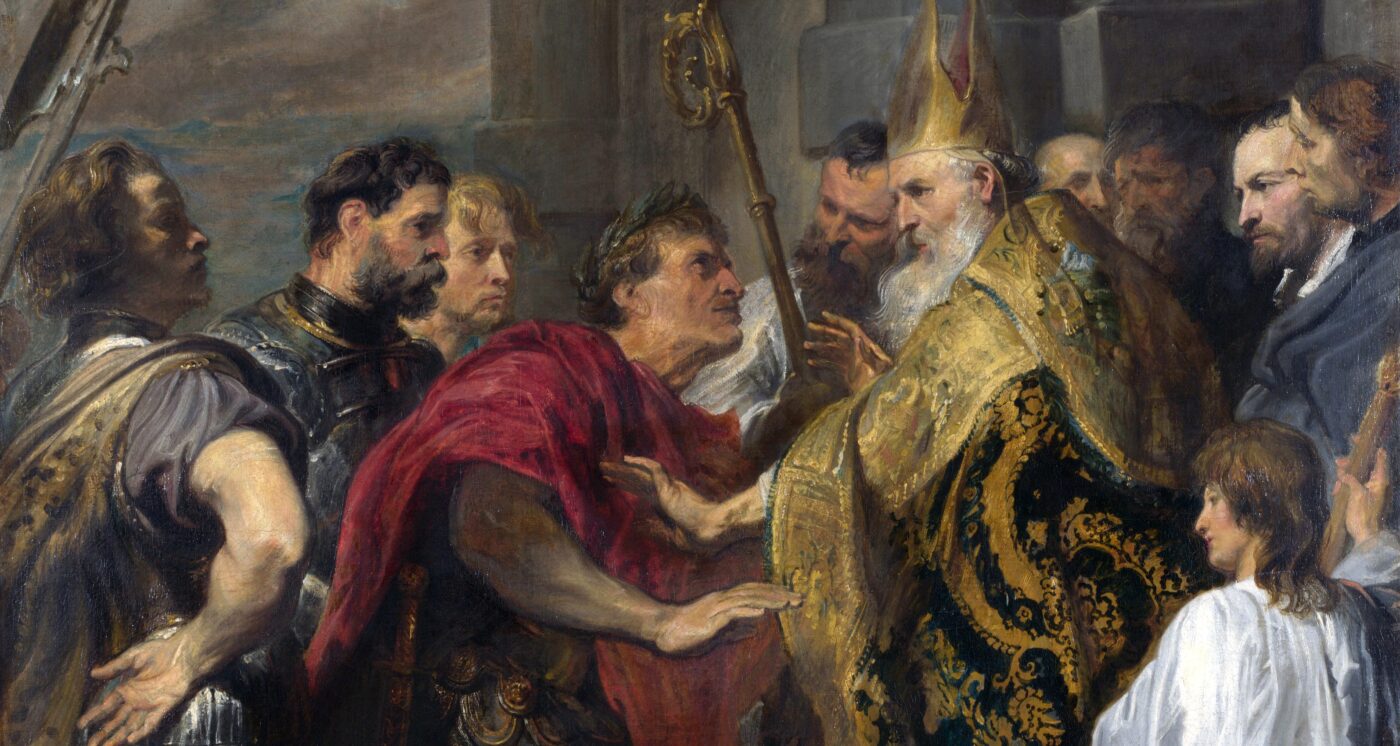
Ambrose of Milan is perhaps the saint best known for being responsible for the conversion and baptism of St. Augustine of Hippo. Because of this, many of us ask for his intercession in the lives of those whose hearts are turned from God. After fifteen years of Augustine’s mother Monica praying and shedding tears for her son, it was St. Ambrose who, by the grace of God, ultimately got the job done.
We too long for the Lord to send a “St. Ambrose” into the lives of those who have not left behind their “old” lives of sin and embraced a new life in Christ. And while for Monica, Ambrose’s intervention in the life of her son would have been her greatest joy, this is not Ambrose’s only accomplishment which changed the trajectory of salvation history.
As Bishop of Milan, St. Ambrose was the man responsible for introducing “Lectio Divina” to the Latin Church, the practice of prayerfully meditating on the Scriptures. His faithfulness to this exercise is what shaped his writing, his preaching, his teaching—and no doubt was the reason that Ambrose was able to speak just the right words that would touch the heart of Augustine and procure his conversion of heart.
Although Ambrose undoubtedly saw something spiritually unique about Augustine—perhaps his fiery zeal or his inquisitive mind—it is also possible that part of his motivation in taking such an interest in Augustine is simply that Ambrose took pity on his mother. “It cannot be that the son of those tears should perish,” Ambrose had prophetically spoken to Monica.
One thing is certain. There is no way that Ambrose, who once referred to Augustine as “still unteachable,” could ever have foreseen the great conversion that would one day take place in him—nor the ensuing impact that this transformation would have upon the worldwide Church. Today, the average Christian perhaps has a vague familiarity with the great St. Ambrose, while St. Augustine is a household name.
Can we imagine if the one that we ourselves currently “shed tears” over because of their sin and rejection of Christ would one day be responsible for the conversion of countless souls in the worldwide Church?
Let’s understand, Augustine did not come to have such enormous influence on the Church because he was born holy, lived holy, and died holy. Nor did St. Monica become a beloved intercessor for countless parents across the globe by living a problem-free life. If that had been the case, Monica would have provided the parents who worry about their own children with little inspiration, and offered those who indeed have sorrowful problems, no model to follow.
Without the very anguish that Monica endured, the rest of us would not have her example of steadfast hope. In sending Monica a “blow” which he intended to “heal,” we begin to understand why God might send us a blow of our own. It is the blows in life that lead us—and others—to the Lord’s merciful love.
It is true, Monica suffered terribly over the sins of her son. The temptation to ask “why” must have assaulted her relentlessly, and if she shed tears for fifteen years, certainly those tears would have been shed most ardently at night, as she struggled to sleep in a peace that evaded her. But it was precisely her relentless sorrow that kept her relentlessly clinging to the Lord in prayer.
It was from the depths of her desperation that Jesus transformed her heart-wrenching circumstances in grace. We can imagine that as she lay on her death bed, ready to draw her dying breath, St. Monica would not have looked back on her life and wished things had been different. She would not have taken back a thing—not a tear, not a moment of anguish, not even a single sin that her son had committed which caused all those tears of anguish to begin with. Because now, it would have all made sense. Now, Monica would have been able to see that her anguish had not been meaningless or without purpose at all.
The “blow” the Lord had sent her was for love. The Lord healed her heart, and for this, Monica would have had nothing but gratitude. She truly would have finally been able to rest in peace.
So what about us? If we’re still in the “blow” stage of God’s plan—or at least, not yet in the “healing” stage—let us trust that our tears, united to the Cross, are working to till the soil of the hearts of those for whom we pray, that they might be open to receiving the grace of God when it comes. Just as it was with St. Augustine, sometimes the graces needed by such souls will not come through the hands of the ones who love them most, but instead, through another—a St. Ambrose—who is able to intervene with detachment and peace.
So let’s not consider our efforts in prayer as synonymous with doing “nothing.” Though the effects of our prayer may be hidden from our view, it is our small acts of faith offered with great love in our hearts that have the power to welcome the grace of conversion in those who need it most.
When Jesus saw THEIR faith, he said to the paralytic, “Courage, child, your sins are forgiven.” (Mk. 9:2)
Image from Wikimedia Commons