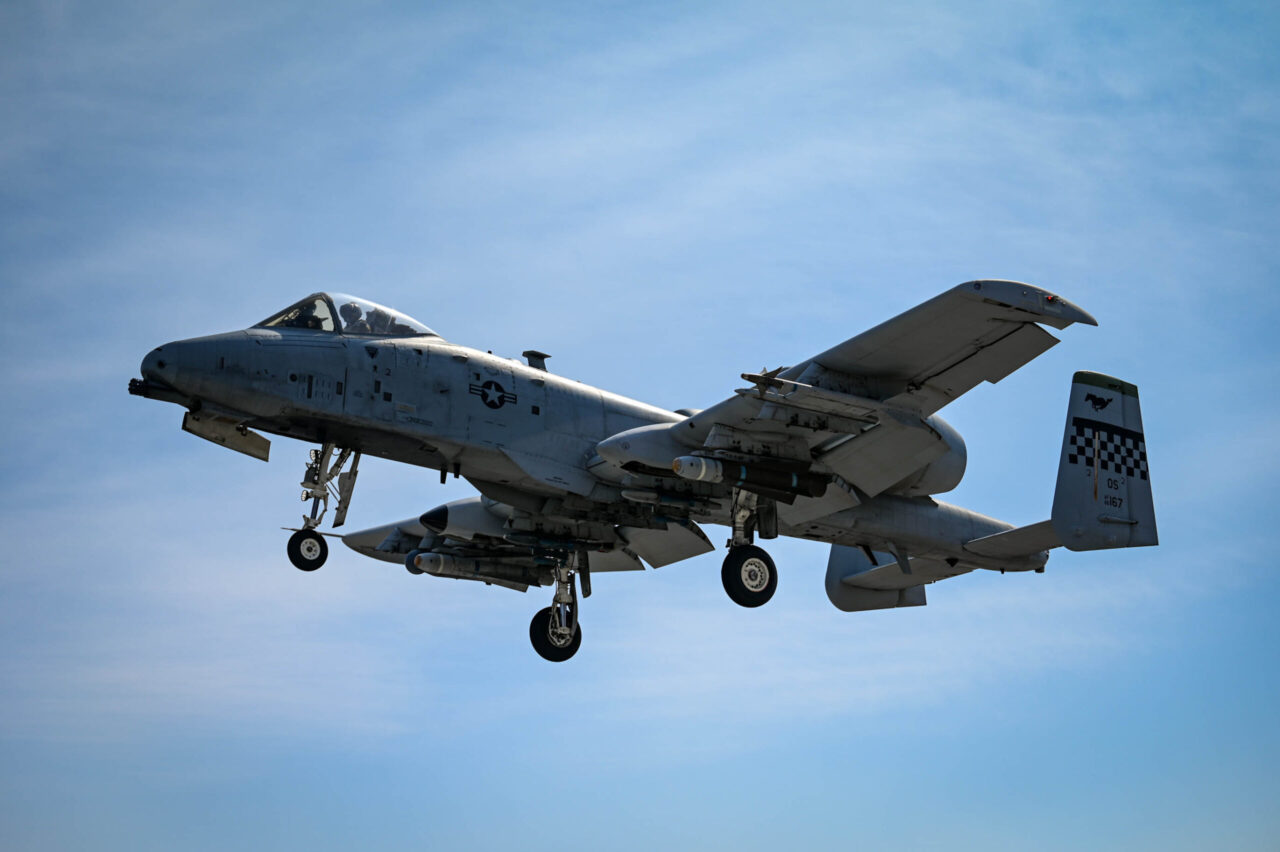
Supporters of the A-10 have argued that no other aircraft, notably the F-35 Lightning II, can fill the Thunderbolt II’s role.
It is the season of miracles, and there seems to be guardian angels watching over the Fairchild Republic A-10 Thunderbolt II, an aircraft that the United States Air Force has been trying to retire for years. The service’s Scrooge-like efforts were halted yet again by congressional lawmakers, who also saved F-15E Strike Eagles, KC-135 Stratotankers, and RQ-4 Global Hawks.
The US Air Force had sought to retire its remaining 162 A-10s along with 21 F-15Es in fiscal year 2026 (FY26), but the 2026 National Defense Authorization Act (NDAA) would limit it to just 59 A-10s and no F-15Es sent to retirement. The measure has yet to be passed by both Houses of Congress and signed by President Donald Trump. The NDAA also called for $250 million in F-35 Lightning II upgrades to be redirected to supplement spare parts.
“The annual defense measure authorizes spending, sets policy, and directs actions, including reports, studies, research, and more,” Air & Space Forces magazine explained, adding that the NDAA is “separate and distinct from the Defense Appropriations bill, which actually funds the department.”
The Fight Over the A-10 Warthog
Air Force officials have long called for the retirement of the A-10 Thunderbolt II, also known as the “Warthog” among pilots and maintainers. Lawmakers have pushed back on every occasion, arguing that the Cold War-era close air support (CAS) aircraft is still needed more than 60 years after it first entered service.
A previous compromise had allowed the oldest Warthogs to be retired, with plans for the entire fleet to fly off into the sunset by the end of 2029. However, the Air Force recently announced its intent to retire the remaining 162 A-10s in 2026, and lawmakers weren’t having it.
The NDAA now calls for at least 103 to remain in service, with 93 “categorized as primary mission aircraft,” Air & Space Forces magazine further reported. Moreover, the bill required the service to brief Congress by the end of Q1 calendar year 2026 on the 2027-29 forecasts for the A-10, including transition plans.
Supporters of the A-10 have argued that no other aircraft, notably the F-35 Lightning II, can fill the Thunderbolt II’s role. Critics have countered that the aircraft would be vulnerable to modern air defenses in a conflict with a near-peer adversary.
A-10 Warthog Specs
Production of the A-10 Thunderbolt II began in 1972, and the aircraft officially entered service with the United States Air Force in 1977. The A-10’s short takeoff and landing (STOL) capability permitted it to operate from airstrips close to front lines. Service at forward base areas with limited facilities is possible due to the A-10’s simple design.
It was first deployed during Operation Urgent Fury, the 1983 American invasion of Grenada, and provided air cover for the United States Marine Corps, but did not fire its weapons.
It wasn’t until the Gulf War in 1991 that the aircraft took part in combat operations. A-10s successfully shot down two Iraqi helicopters with the GAU-8 and took part in numerous sorties against Iraqi Republican Guard units. Surface-to-air missiles shot down several A-10s, while nearly a dozen were hit by anti-air artillery rounds—yet the aircraft performed well enough that the Air Force abandoned an idea to replace the A-10s with a close air support version of the F-16 Fighting Falcon.
- Year Introduced: 1979
- Number Built: 713
- Length: 53 ft, 4 in (16.16 m)
- Height: 14 ft, 8 in (4.42 m)
- Wingspan: 57 ft, 6 in (17.42 m)
- Weight:
- Maximum takeoff weight – 51,000 lbs. (22,950 kg)
- Engines: Two (2) General Electric TF34-GE-100 turbofans
- Top Speed: 420 mph (Mach 0.56)
- Range: 800 miles (695 nautical miles)
- Service Ceiling: 45,000 ft (13,636 m)
- Loadout: One 30mm GAU-8/A seven-barrel Gatling gun; up to 16,000 pounds (7,200 kilograms) of mixed ordnance on eight under-wing and three under-fuselage pylon stations
- Aircrew: 1
Other Aircraft Saved From Retirement
Under the NDAA, no F-15 Strike Eagles will be on the chopping block in 2026. Instead, up to 21 aircraft could be retired in 2027, with up to an additional 30 in 2028.
In addition, no RQ-4 Global Hawk Block 40 unmanned aerial systems (UAS) will be retired until the end of fiscal year 2030 on September 30, 2030, even as the Air Force has said that space-based intelligence, surveillance, and reconnaissance systems will assume the drone’s mission in the coming years.
Moreover, as the Boeing KC-46A Pegasus has been running behind schedule, Congress has called for the KC-135 Stratotanker to remain the Air Force’s primary aerial refueler.
About the Author: Peter Suciu
Peter Suciu has contributed over 3,200 published pieces to more than four dozen magazines and websites over a 30-year career in journalism. He regularly writes about military hardware, firearms history, cybersecurity, politics, and international affairs. Peter is also a contributing writer for Forbes and Clearance Jobs. He is based in Michigan. You can follow him on Twitter: @PeterSuciu. You can email the author: [email protected].
Image: DVIDS.