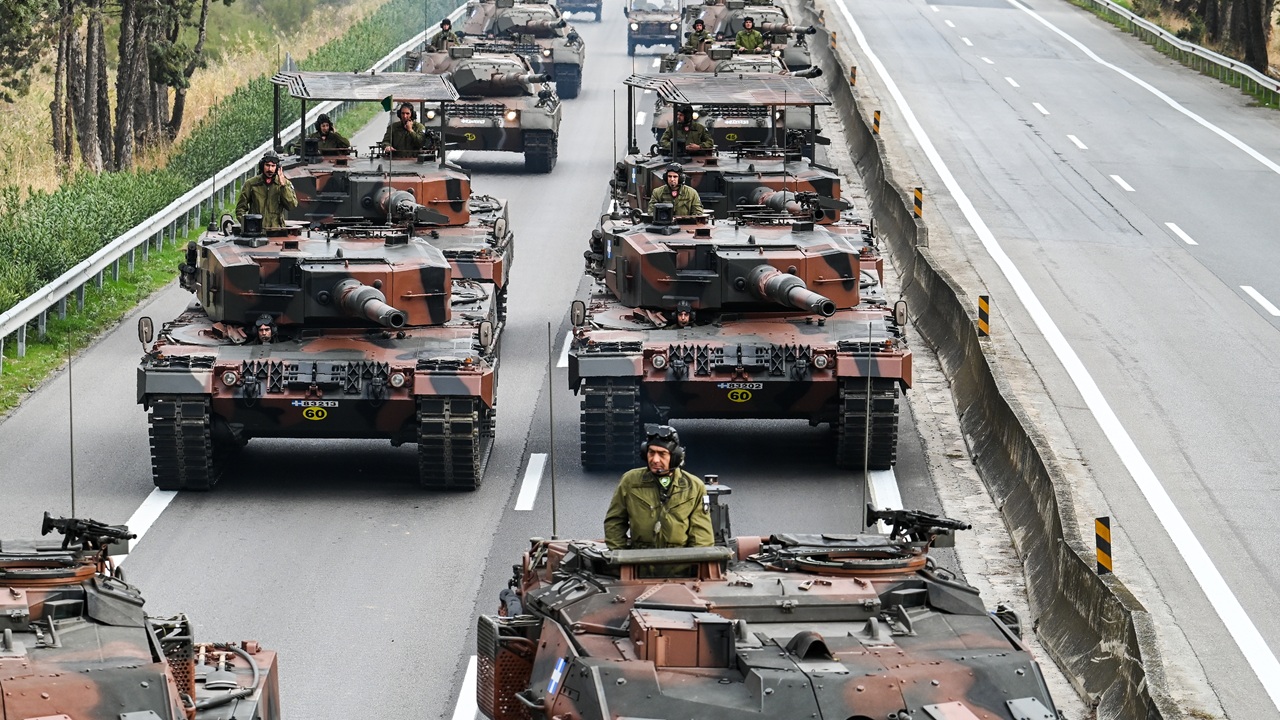
Greece has one of NATO’s largest tank forces, although many of its vehicles date back to the Cold War and would be of limited use on a modern battlefield.
Although Greek warriors fought from Egypt to India during the days of Alexander the Great, and later took part in conflicts against the Arabs while part of the Byzantine Empire, Greece has sent troops to fight in a distant land only once in the modern era. Some elements of the Greek Armed Forces joined the British in the Middle East and North Africa during World War II, but Athens directly contributed forces to a foreign conflict only once, when it supported the UN coalition in the Korean War.
Greece is now determined to demonstrate its commitment to NATO by deploying its 25th Armored Brigade, which operates German-made Leopard 2A6 main battle tanks (MBTs) and Marder infantry fighting vehicles (IFVs), to next month’s Orion 2026 military drills in northern France. The exercise is touted as one of the most extensive land-forces training operations scheduled for next year and will test NATO capabilities in a high-intensity conflict. Multiple alliance members are expected to take part.
Athens has sought to establish closer ties with Paris, which included a 2021 strategic defense agreement. In addition, the Hellenic Armed Forces are now in the process of acquiring French-made FDI frigates and Dassault Rafale omnirole jet fighters.
Greek Armor Is on the Move—Again
The tanks’ arduous journey—more than 2,000 km (1,242 miles) from Greece to France—is already in the planning stages. It is a monumental undertaking for Athens, not unlike Alexander the Great’s plans to move his army into the heart of the Persian Empire.
The undisclosed number of MBTs and IFVs will be loaded aboard landing ships, which will sail to a French port, most likely Le Havre in Normandy. The vehicles will then drive overland to the site of the Orion 2026 exercises, which will be held near the Mailly-Champagne training area. Approximately 300 members of the Hellenic Armed Forces will also travel to France—mercifully by air.
The French military undertook a similar deployment, but in reverse, when it sent 280 soldiers and a number of Leclerc MBTs to train with Hellenic forces in northern Greece in 2023.
Greece Has a Huge Tank Fleet—for One Good Reason
Unusually for a small coastal nation, Greece is one of the largest tank operators in NATO, with more than 1,300 believed to be in service. That includes approximately 170 modern Leopard 2A6 HEL, a variant manufactured domestically by Hellenic Vehicle Industry (ELBO in English), and 183 Leopard 2A4 models that could be updated to the HEL standard. Athens also operates around 500 German-made Leopard 1A5/GR MBTs, dating back to the 1970s, and hundreds of American-made M60s, including approximately 100 M60A3 TTS models.
Many of NATO’s Cold War-era M60s were transferred to Greece in the early 1990s and remain in storage as reserves. There has been speculation in recent years that Athens would sell or scrap the M60s due to their increasingly onerous maintenance and modernization needs, and could even retire the older Leopard 1A5/GR MBTs. Indeed, the poor showing of Russia’s antiquated tanks in Ukraine has led the Hellenic Armed Forces to conclude that such tanks have limited value on the modern battlefield.
Greece’s continued possession of a large tank arsenal is due in large part to its ages-old animosity with neighboring Turkey. Although both nations are members of NATO, persistent tensions between the two have led both to invest heavily in their militaries in preparation for armed conflict with one another.
Turkey also maintains a massive fleet of tanks of questionable value.
“Greece and Turkey share an ancient animosity stretching back to the 10th century, when nomadic Turkic tribes invaded the Byzantine Empire,” explained Stavros Atlamzoglou for The National Interest. “More than a thousand years later, the animosity is still strong, and the two countries have clashed, directly or indirectly, several times in the past 100 years. The legitimate concern of Turkish pugnacity has forced Greece to invest heavily in tanks.”
Given those facts, the M60s won’t be heading to the scrap yard anytime soon. But they won’t be heading to the upcoming wargames, either!
About the Author: Peter Suciu
Peter Suciu has contributed over 3,200 published pieces to more than four dozen magazines and websites over a 30-year career in journalism. He regularly writes about military hardware, firearms history, cybersecurity, politics, and international affairs. Peter is also a contributing writer for Forbes and Clearance Jobs. He is based in Michigan. You can follow him on Twitter: @PeterSuciu. You can email the author: [email protected].
Image: Shutterstock / Giannis Papanikos.