Do just one-third of American Catholics believe that Jesus is truly present in the Eucharist, as was reported in this 2019 study? Or do two-thirds believe Church teaching on the Eucharist, if you question them more carefully as was done in this 2023 study?
Either way, faithful Catholics who attend Mass regularly didn’t need surveys to tell them that many American Catholics don’t believe in the Real Presence. Those who don’t believe make it obvious enough in the way they arrive late, leave early, and simply fail to show up for Sunday Mass. Our bishops’ call for a Eucharistic Revival, culminating in a National Eucharistic Congress in July, 2024, was certainly an attempt to remind Catholics that Jesus Christ is truly present, not merely symbolically present, in the Blessed Sacrament.
But there’s more than one way to communicate supernatural truths to disbelieving people than to hold a meeting or post a website. In 1531, God’s way involved sending the Blessed Mother to Mexico—through an apparition, of course.
In 1531, ten years had passed since the Spanish forces under Hernán Cortés conquered the Aztec empire. Catholic missionaries had been trying to evangelize the native people for seven years. A small number, like Juan Diego and his wife, had accepted baptism and embraced the Gospel, but they were by far the minority. Most of the Aztec people were demoralized by their recent defeat in battle, were afraid of the sicknesses caused by European diseases, and were justly resentful of mistreatment by the conquistadores. Their understanding of their world had been based on a pessimistic cosmology, complex rituals, and bloodthirsty gods who demanded endless human sacrifices. Their gods had now apparently failed them, and this rocked their world.
But all that changed in less than a week in December 1531. A peasant farmer claimed that a beautiful woman had appeared to him multiple times, asked him to tell the bishop to build a church, and miraculously imprinted her image on his cloak. There were other baffling events as well, such as his uncle’s recovery from near death and the blooming of Spanish roses on a hillside in December. But it was the image that inexplicably appeared on Saint Juan Diego’s cactus fiber tilma that proved to be a revelation to the Aztec people.
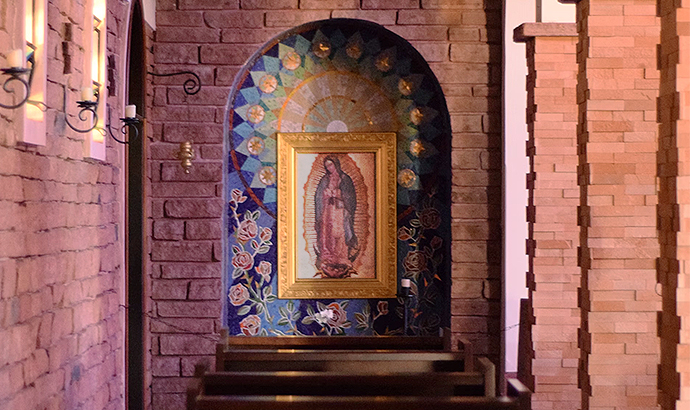
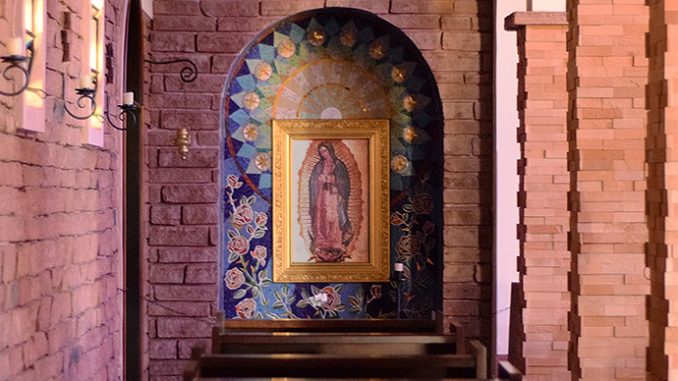
Almost five hundred years later, images of Our Lady of Guadalupe can be found everywhere, inside and outside Mexico. What was it about this image that caused families, villages, and entire tribes to travel to the capital city in the sixteenth century—not merely to see the tilma but to accept baptism—almost overnight?
There are many mysteries about that tilma, such as how something made of cactus fibers has survived for centuries. And how the image remained unharmed despite being handled by thousands of devotees in the many years before it was placed behind glass. And how it survived certain destruction from nitric acid and a bomb blast. And how the image could have been applied to the tilma in the first place. All of these mysteries continue to elude twenty-first century science, as described in Guadalupe Mysteries. But what was it that sixteenth-century Aztecs saw in that image that touched their souls so profoundly that nine million of them became Catholics in just six years?
The Aztecs’ writing system was not based on a phonetic alphabet but on pictograms. Ordinary people were familiar with these pictograms, which included images of physical items, as well as symbols, that made puns on the sounds from their oral language. The image of Our Lady of Guadalupe, which the Spaniards recognized as a Christian icon, is a treasure trove of pictograms which were easy for the Aztecs to decipher.
Mary is shown to be greater than the sun, the moon, the stars, and the other lesser gods of the Aztec religion. That is, in the image, she blots out the sun, she stands on the moon, she carries the stars on her cloak, and she is held up by an angel. She is wearing blue, the color of the heavens, as if she has just descended from there.
Mary’s eyes are downcast in humility, and her hands are folded in prayer, indicating that she prays to someone else. To a Christian, her demeanor indicates that she might be reciting Luke 1:38: “Behold, I am the handmaid of the Lord”. To an Aztec, her appearance shows that she is a woman and a virgin, not a goddess. After all, Aztec gods were depicted wearing masks, and she is not wearing a mask. Because she is wearing her hair loose, she signals that she is a virgin. On the other hand, the bow at her waist is a sign that she is a pregnant woman, and a kind of flower which indicated perfection (the quincunx) is located precisely over her womb.
Mary’s skin indicates that she is neither a Spaniard nor an Aztec. Instead, she is a mestizo, a woman of both races. In the Aztec culture, people wore symbols of the gods around their necks. The brooch at Mary’s neck has only one symbol: the cross.
Put all those pictograms together, and what do you get?
Behold a mere woman who is greater than all of your gods! This humble woman is a virgin, yet she is also the Mother of God. She is not a Spaniard or an Aztec, but she is a Spaniard and an Aztec. This mother loves you as if you were her own child, so much that she came down from heaven to ask for a church to be built so that you can worship her Son, the Son of God, who died on a cross for you.
How do you convince unbelieving people about supernatural truths? Sometimes God does the heavy lifting by performing signs and wonders. Perhaps the millions of miraculous conversions that occurred in Mexico were meant to humble the mighty, educated, and technologically superior, cradle Catholics from Europe and show how much God loves the poor, uneducated, and simple of heart.
Or perhaps there is a lesson in the image of Our Lady of Guadalupe for us today as we try to explain the supernatural mystery of the Eucharist to our skeptical family and friends. What false idols are keeping them enslaved to a pessimistic worldview, complicated and busy lives, and a willingness to sacrifice even human beings for the sake of their own pleasure? Are those of us who do believe too arrogant to share with them about our personal experiences of peace in God’s Presence at Mass? Are we afraid of appearing simple-minded by telling them that we believe God is really and truly present in the tabernacles and on the altars of every Catholic church, waiting for us?
God has already given us something far more powerful than a Marian apparition. By His grace, we have divine Revelation. God Himself has come among us to set us free from slavery to sin and death, and the story of His love is not just five hundred or two thousand years old; His steadfast love endures forever (see Ps 136), and His mercies are new every morning (Lam 3:23). His love for us is deeper than the love of our own mothers, it is more powerful than the sun, the moon, and the stars, and, believe it or not, it is as close to us as the nearest Catholic church.
(Editor’s note: This essay was posted originally on December 12, 2023, in slightly different form.)
If you value the news and views Catholic World Report provides, please consider donating to support our efforts. Your contribution will help us continue to make CWR available to all readers worldwide for free, without a subscription. Thank you for your generosity!
Click here for more information on donating to CWR. Click here to sign up for our newsletter.