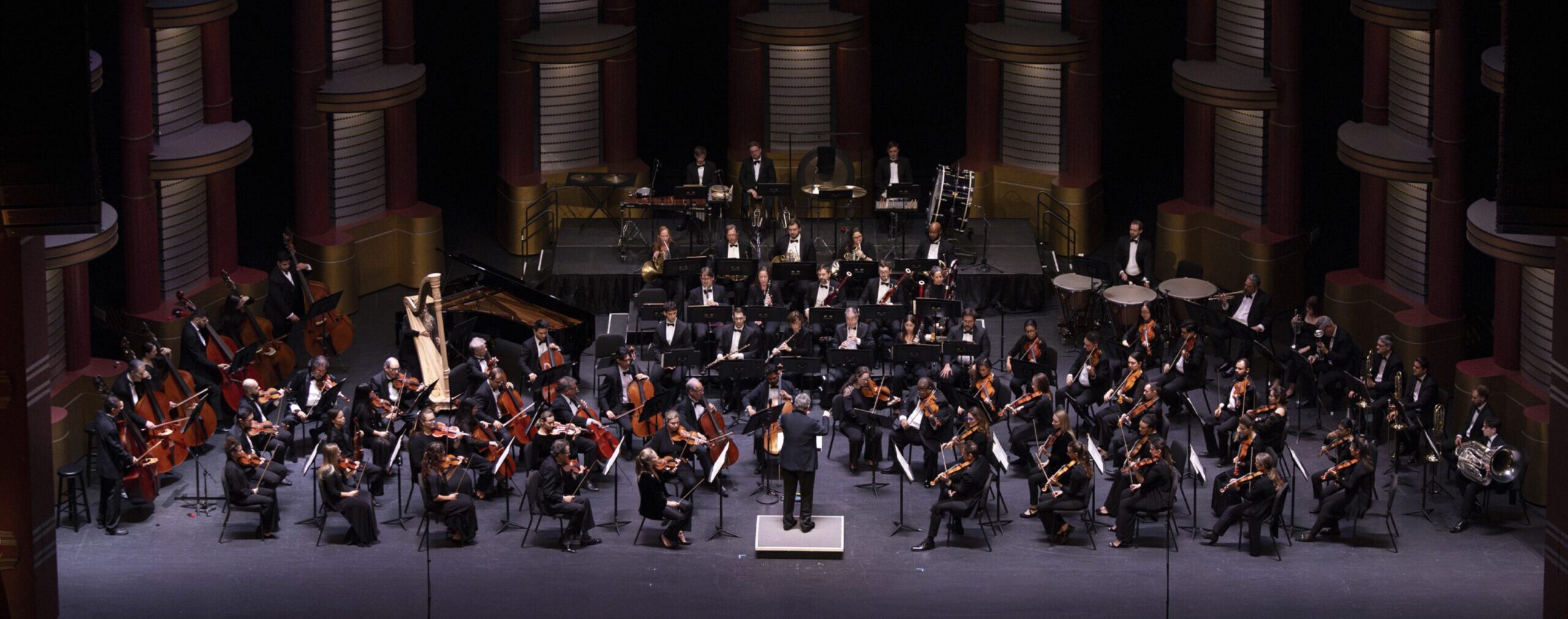
What is American music? When the New York Tribune posed that question in 1924, George Gershwin answered with his epochal Rhapsody in Blue. Now the Palm Beach Symphony is attempting to address that same question with its new season at the Raymond F. Kravis Center for the Performing Arts, which hosts the symphony, the Palm Beach Opera, and national and international residencies.
The program’s first half was dedicated to Gershwin, arguably America’s greatest homegrown composer. Palm Beach’s music director Gerard Schwarz began with An American in Paris, a jazzy tone poem widely popularized by Vincente Minnelli’s eponymous 1951 musical starring Gene Kelly and Leslie Caron. Seeking to convey the “French atmosphere” a tourist might feel in Paris, Gershwin described it as “a light, jolly piece, a series of impressions musically expressed.”
That does not mean it should be taken lightly: shortly after its 1928 premiere, Gershwin famously walked out of a performance because he felt Walter Damrosch’s conducting was too sluggish to give it its due. Nor had Gershwin been a casual visitor to Paris. Like many fellow aspiring musicians, he studied in the French capital and discussed music theory at such a high level with Maurice Ravel that Ravel sent him away, after asking the young American, “Why be a second-rate Ravel when you could be a first-rate Gershwin?” Nadia Boulanger, who taught generations of musicians from both the Old World and the New, came to a similar conclusion, pronouncing that she could teach Gershwin nothing he did not already know.
Schwarz’s rendition was jaunty without being insouciant. The first movement’s Allegretto grazioso theme was graced by a cheerful brio before the skillfully rendered urban cacophony—complete with horns meant to resemble the sound of rushing taxis—yielded to the famous Andante blues section, a meditation on homesickness that builds on a trumpet solo before integrating other themes. The grand finale rose to a fevered pitch.
After a brief interlude, the pianist Shelly Berg, the dean of the University of Miami’s Frost School of Music, took the stage for Gershwin’s Rhapsody in Blue. Quintessentially American and often regarded as a symphonic depiction of New York, it straddles the divide between classical and jazz. It was originally described as part of an “experiment in modern music.” The idea for it came from the bandleader Paul Whiteman, who asked Gershwin for a piece in classical piano-concerto form for a concert under that billing. Gershwin declined, saying he would not have sufficient time to complete the work. Whiteman would not take no for an answer, however, and, facing a competing concert organized by another bandleader, capitalized on fake news suggesting that Gershwin had in fact agreed. Gershwin called Whiteman for an explanation and suddenly found himself composing.
The rush may have contributed to Rhapsody in Blue’s greatest strength. With just five weeks before Whiteman’s concert, Gershwin did not have enough time to fully finish the piece and ended up personally performing the piano part as an improvisation at the premiere. The formal scoring that he later completed has been taken more as a suggestion, with pianists improvising the solo ever since. Berg, who is accomplished in jazz as well as in classical piano, either wrote or improvised clever, seductive cadenzas and made the piece sound fresh and new. Schwarz’s direction integrated the playing perfectly with the orchestra, which took the rest of the piece at full throttle. For an encore, Berg played a warm but not overly sentimental rendition of George and Ira Gershwin’s standard “Someone to Watch Over Me,” originally composed for the brothers’ 1926 musical Oh, Kay!
The American theme continued in the second half, which featured the Armenian American composer Alan Hovhaness’s rarely performed Prelude and Quadruple Fugue. Schwarz is a champion of Hovhaness, who, among other works, wrote sixty-seven symphonies, with more underway at the time of his death in 2000. The piece, which dates from 1936, represents the daring of the young composer, who was then just twenty-five. It features a sophisticated series of entrances leading to an immense crescendo and crashing finale. Schwarz handled this short but complex work perfectly.
The concert was rounded out by the Italian composer Ottorino Respighi’s majestic The Pines of Rome, the middle of his three symphonic tributes to his country’s capital (the others celebrate its fountains and festivals). All four movements are meant to recall quarters of Rome known for their pine trees and deal with the progression of time. The first two, handled with requisite subtlety by Schwarz, address extremes of age with simple melodies that suggest not only youth in the pine-rich garden of the Villa Borghese but also death in Rome’s catacombs, which have pines nearby. The third movement evokes the slow, shimmering tones of moonlight over the Eternal City as experienced in the Janiculum gardens. The abrupt march of the final movement, which recalls legions setting forth on the Appian Way, surrounded by pines, resounded in the impressive horns, reflecting the grandeur of Rome.