Like other aspects of Western civilization, classical music is under attack. In an academic paper published in 2023, five music librarians of the University of Toronto deplored the fact that in the university’s collection of hundreds of thousands of books, music scores, and periodicals, “ninety percent of the compositions are written by men, and the top twenty countries of origin are the U.S., Canada, and eighteen European countries.”
The attempt to cast away or sideline the extraordinary Western contribution to music represents a kind of cultural death wish. But the rage of the progressives betrays a willful blindness toward who is actually performing and appreciating classical music in the twenty-first century.
Masaaki Suzuki, from Japan, is one of the world’s leading conductors of J. S. Bach’s music. He has expressed a profound connection with Bach based on their common Christian faith:
Who can be said to approach more nearly to the spirit of Bach: a European who does not attend church and carries his Christian cultural heritage mostly on the subconscious level, or an Asian who is active in his faith although the influence of Christianity on his national culture is small?
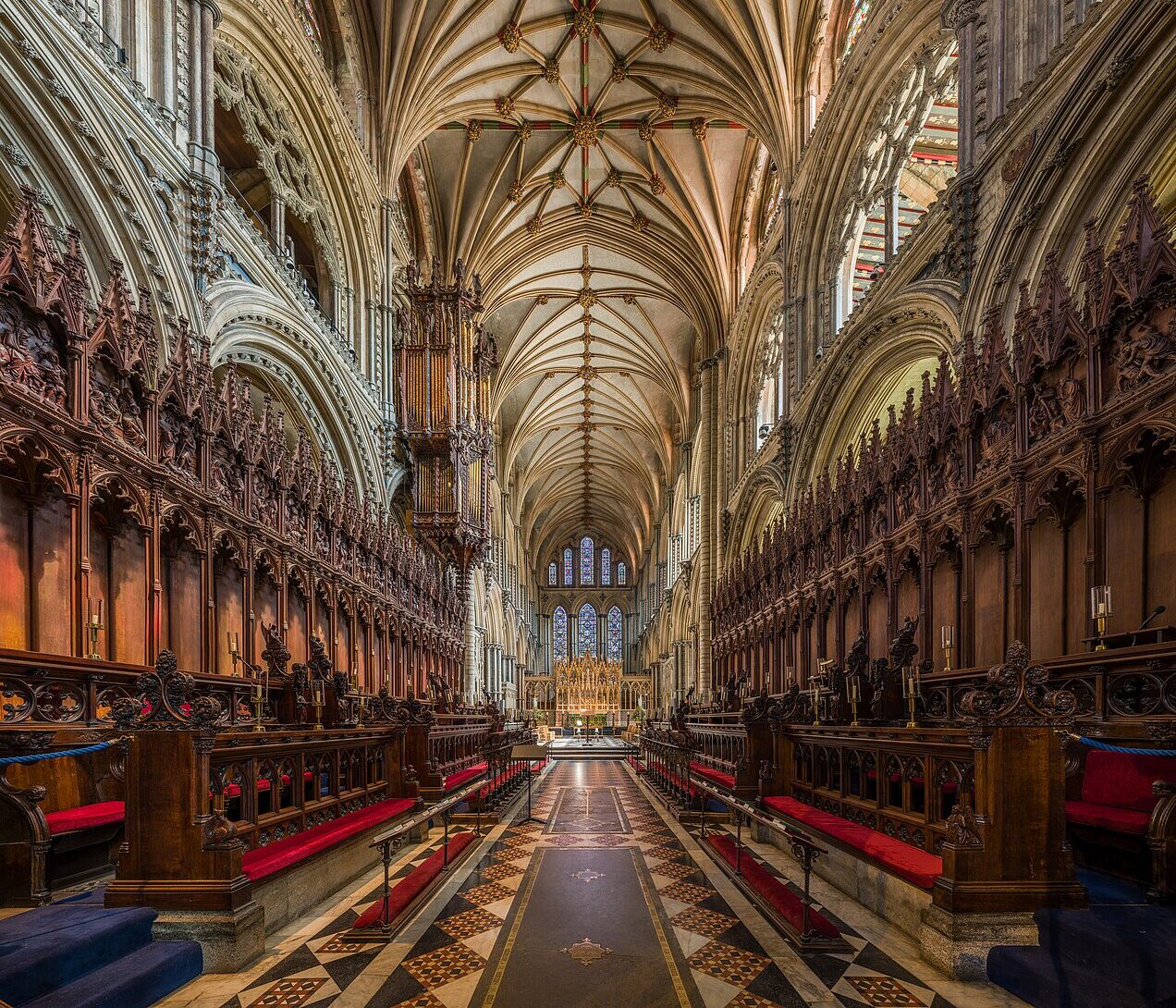
While Christianity was and still is at the core of the Western classical tradition, another way to consider music is through a different artistic discipline: architecture, which the German philosopher Friedrich Wilhelm Joseph von Schelling called “frozen music.” The Polish philosopher Wladyslaw Tatarkiewicz (1886–1980), describing the influential ancient idea that beauty consists in harmonious proportion between the parts and the whole, also compared music to architecture, “except that [in music] the relations are temporal and not spatial.” The distinguished conductor Sir John Eliot Gardiner picked up on the relationship between seeing and listening when he wrote of Bach’s St. John Passion:
I would suggest that the multi-layered structure underpinning Bach’s Passion can be “felt,” if not immediately seen or heard, by the listener in the same way that flying buttresses, invisible to the visitor when entering a Gothic church, are essential to the illusion of lightness, weightlessness and the impression of height. In fact, the longer you study them, the more numerous seem to be the geometric patterns of repetition, symmetry, and cross-referring, varying in the sharpness or thinness of their outlines.
As people from around the world travel to visit the beautiful palaces and cathedrals of Europe, so international musicians assemble to offer public performances of the great works of Western classical music. The same principles of beauty apply to both architecture and in music.
The Reformed theologian R. C. Sproul taught that Western civilization has recognized four transcendent norms of beauty: proportion, harmony, simplicity, and complexity. Applying these principles to music, we could consider if the different sections of a piece are proportionate; the same could be asked about the development of its themes, or the balance of the voice parts. As for harmony, it’s important to bear in mind that Western classical music flourished within the tonal system and to be alert to the pervasive discord that can threaten a piece’s harmonic integrity. Of the great works of classical music, the large-scale choral works of Bach, Handel, and Mendelssohn, and the symphonies or concertos of Brahms, Dvořák, and Sibelius display these objective standards of beauty to the greatest extent.
Can listening to ugly music do any harm? Christian theologians have taught that it is the soul that hears music through the ear. As Martin Luther warned, music has a mysterious power to shape man’s soul for good or ill, both through his mind and through the emotions. Sir Roger Scruton explored how popular forms of music are exercising a malign influence on man’s soul in his underappreciated work Aesthetics of Music. For my part, I have often reflected on Lorenzo’s words near the close of The Merchant of Venice:
The man that hath no music in himself,
Nor is not moved with concord of sweet sounds,
Is fit for treasons, stratagems and spoils;
The motions of his spirit are dull as night
And his affections dark as Erebus:
Let no such man be trusted. Mark the music.
Those of us who mark the music have a duty to share it with younger generations and take every opportunity to expose children to classical music, by playing recordings, taking them to live concerts, and encouraging them to persevere in the life-changing discipline of music-making.