Russia’s reliance on North Korea for troops and munitions has grown steadily throughout the nearly four-year war—raising questions about the Kremlin’s ability to wage war forever.
As a peace deal to end the war in Ukraine seems ever elusive, there are concerns that Kyiv may be able to carry on the fight for another year. However, it is worth noting that the war of attrition has taken an even greater toll on Russia—as evidenced by recent reports that show it is ever more dependent on North Korean ordnance and “vintage” military hardware.
Russia Relies Heavily on North Korea for Help in Ukraine
More than three years ago, it came as a geopolitical shock to many that Russia was turning to its Cold War ally North Korea for support in its still ongoing war in Ukraine. Reports first circulated in September 2022 that the Kremlin would buy millions of artillery shells and rockets from the Hermit Kingdom—an early sign that Moscow’s military stockpiles weren’t nearly as deep as pre-war estimates had suggested.
Russia’s dependence on North Korea has only increased. It has recruited North Korean “volunteers” who are now fighting on the front lines. As of this year, Pyongyang had sent 11,000 troops to aid Russia’s war efforts, and North Korean leader Kim Jong-un called it an “honor” to have an alliance with Moscow. Kim further described the troops as “heroes” engaged in a “sacred mission,” promising that a monument would be erected in the capital to commemorate their sacrifices.
The North Korean forces have seen high casualties, which hasn’t been surprising given that they have regularly employed human wave attacks. It is the same tactic that was commonly employed in the Korean War more than 70 years ago, where using superior numbers was the Communist force’s most significant advantage.
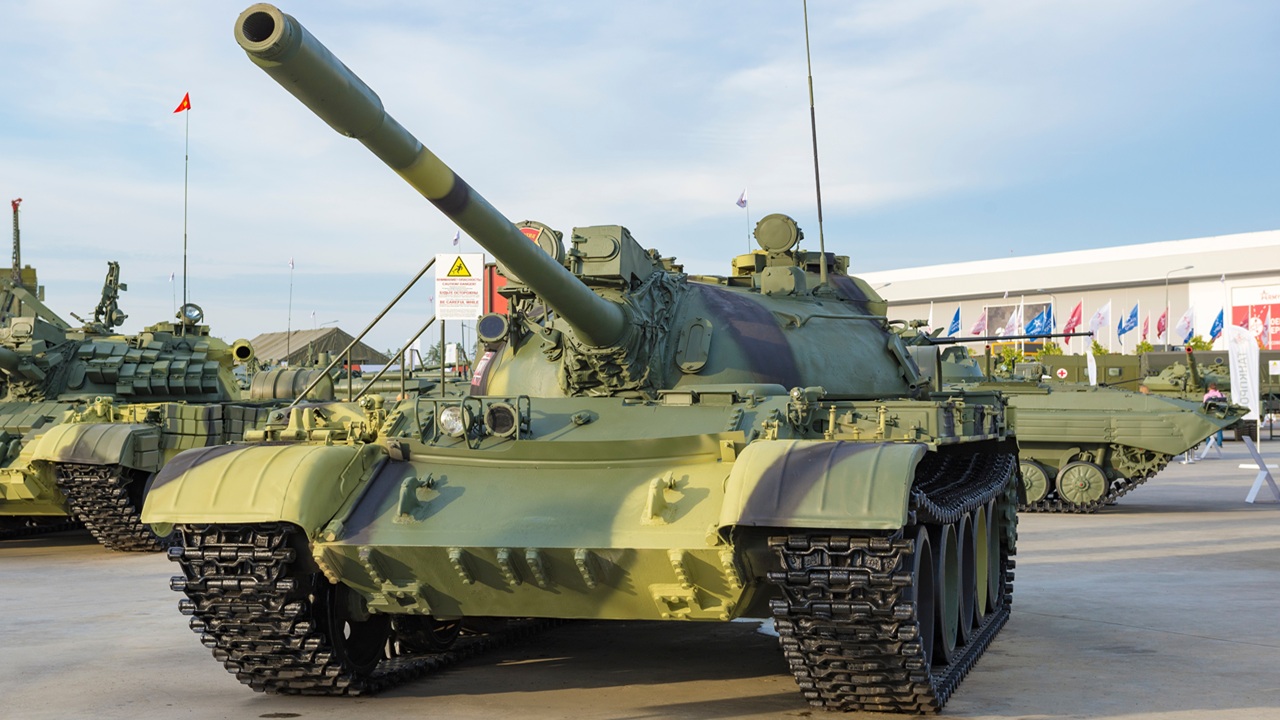
Ancient T-54/55 Tanks Have Been Spotted in Eastern Ukraine
But Pyongyang’s tactics aren’t the only holdover from the Korean War being employed in Ukraine. North Korea and Russia are also using equipment from the Cold War era, notably tanks.
Several social media accounts that track the war have shared images that purported to show Russian forces using 100mm tank rounds with North Korean markings dating back to the 1990s or earlier. The ammunition was fired by far older T-54/55 series tanks that were repurposed and deployed to the front lines.
“I think it’s no secret to anyone that some units of our army use T-54/T-55 tanks for shooting from covered positions at Ukrainian soldiers,” wrote one post in early December.
The presence of T-54/55 tanks isn’t surprising. Videos of the tanks being transported from storage facilities also circulated online in the summer of 2023. It highlighted the severe strain on Russia’s modern tank reserves, including the T-72 and T-90 models.
More than 83,500 T-54/55 tanks were produced in the Soviet Union, while Poland and Czechoslovakia also manufactured an additional 21,000. The platform provided services around the world during conflicts in Africa, Asia, and the Middle East. It was designed for a war in Europe, where it is now being employed—albeit not likely in a way its designers expected.
The largely obsolete T-54/55 would be outgunned against modern armor. As a result, the Kremlin has deployed them as makeshift 100mm artillery rather than armored vehicles, serving as self-propelled guns firing indirectly. It is hardly a practical use, but it does allow Russia to keep sending (antique) shells down range—while allowing for more capable vehicles to be employed elsewhere.
More importantly, it serves as a reminder that Russia’s demands for territory to end the war may be a bluff. Western experts have acknowledged that Russia continues to carry on the war, but it could be inching closer to a breaking point. The continued reliance on North Korean ordnance and the deployment of antiquated tanks is a reminder of that fact.
About the Author: Peter Suciu
Peter Suciu has contributed over 3,200 published pieces to more than four dozen magazines and websites over a 30-year career in journalism. He regularly writes about military hardware, firearms history, cybersecurity, politics, and international affairs. Peter is also a contributing writer for Forbes and Clearance Jobs. He is based in Michigan. You can follow him on Twitter: @PeterSuciu. You can email the author: [email protected].
Image: Shutterstock / Karasev Viktor.