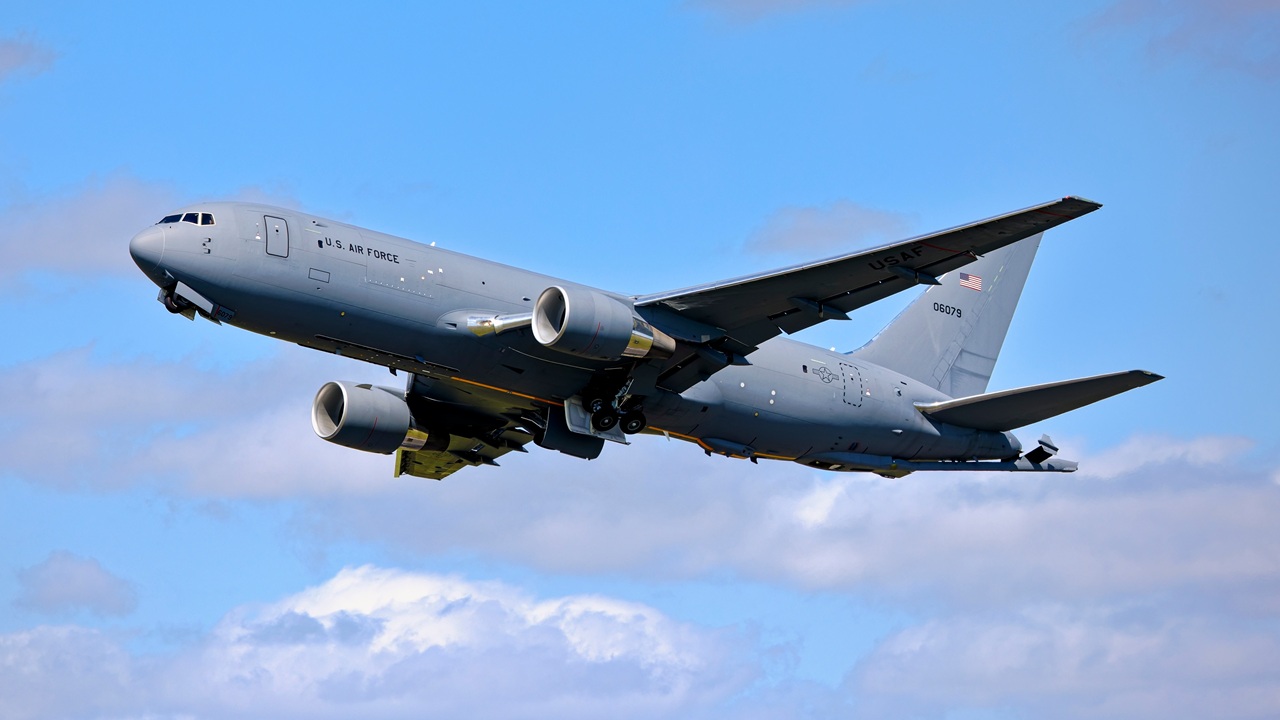
The US Air Force’s 99th and 100th KC-46A Pegasus aircraft were delivered to Travis AFB, California earlier this month—with a three-star and four-star general behind the controls!
It isn’t every day that general officers are charged with delivering aircraft to the United States Air Force, but that was the case on December 2, when the head of the Air Force Reserve and the Air Mobility Commander each opted to get some flight time.
There are currently 45 Rockwell B-1B Lancer, 19 Northrop B-2 Spirit, and 76 Boeing B-52 Stratofortress long-range bombers in operational service with the United States Air Force. Those aircraft can be deployed anywhere in the world, as noted by recent Bomber Task Force (BTF) missions, which saw the B-1s flying to Japan and the B-52s operating from Spain. Moreover, the B-2 Spirits that carried out the precise strikes on Iran in June did so by flying round-trip in CONUS-to-CONUS missions from Whiteman Air Force Base (AFB), Missouri.
Such deployments highlight the capabilities of the US Air Force’s bombers, but they require other aircraft to support the mission—namely, aerial tankers, which serve as flying fuel stations.
KC-46A Pegasus: The Flying Workhorse of the Air Force
- Year Introduced: 2019
- Number Built: ~100 (all operators); 180 planned for US Air Force, with additional orders from Japan and Israel
- Length: 165 ft 6 in (50.5 m)
- Wingspan: 157 ft 8 in (48.1 m)
- Weight (MTOW): ~415,000 lb (188,240 kg)
- Engines: Two Pratt & Whitney PW4062 high-bypass turbofan engines (~62,000 lbf thrust each)
- Top Speed: ~567 mph (913 km/h)
- Range: ~6,385 nmi (7,350 mi, 11,825 km)
- Service Ceiling: ~43,000 ft (13,100 m)
- Loadout: Up to 65,000 lb (29,500 kg) of cargo; can carry 18 standard 463L pallets; up to 114 passengers or 58 patients (aeromedical configuration)
- Aircrew: Typically 3 (pilot, copilot, and boom operator)
This month, the Air Mobility Command announced that it accepted delivery of the 99th and 100th Boeing KC-46A Pegasus tanks at a ceremony at Travis AFB, California. The arrival of the two aircraft was all the more notable because there weren’t just the stars of the US Air Force on the wings—but officers with stars on their shoulders in the cockpits!
Lt. Gen. John P. Healy, chief of the Air Force Reserve and commander of the Air Force Reserve Command, was at the controls of the 99th Pegasus, with Gen. John D. Lamontagne, AMC commander, flying the 100th aircraft.
“Today marks not just the arrival of the 100th KC-46 delivered, but the continued strengthening of our nation’s global reach and readiness. The Pegasus represents a key chapter in air mobility, one built on innovation and unwavering commitment to the mission,” said Lamontagne. “To the Airmen who will fly, fix, and support this aircraft, you carry forward a proud legacy of excellence.”
Pegasus is an apt moniker for the tankers, named for the winged horse of Greek mythology. As a flying workhorse, it allows the warbirds of the US Air Force fleet to carry out their respective missions.
The KC-46A Pegasus Tanker’s History
Development of the KC-46A Pegasus began in 2011, with the tanker based on the Boeing 767 jet airliner, and it was selected by the US Air Force as the winner of the KC-X tanker competition to replace the aging Boeing KC-135 Stratotankers.
The Pegasus can also accommodate a mixed load of passengers, as well as aeromedical evacuation and cargo capabilities. The KC-46A is climate-controlled and equipped with a kitchen, crew bunks, and a lavatory. The cargo area’s configurability allows the placement of airline-style seats, along with additional sleeping areas to accommodate larger crews. For long-endurance missions, a palletized kitchen and a second lavatory can be installed to support larger crews.
The tankers are equipped with a refueling boom driven by a fly-by-wire control system and will be capable of the “fuel offload rates” required by the Air Force’s larger aircraft. Fuel can be pumped via the boom, as well as drogue and wing aerial refueling pods, to support Air Force, US Navy, US Marine Corps, and partner nation receivers.
The first Pegasus was delivered to service in January 2019. According to the Air Force, “AMC certified the KC-46A worldwide deployable Sept. 14, 2022, following its first operationally tasked mission in a combat zone when it refueled two F-15E Strike Eagles assigned to the 335th Expeditionary Fighter Squadron.”
In November 2022, in a feat of air mobility endurance, a KC-46A Pegasus from the 157th Air Refueling Wing took part in a flight that would leave even the most hardened civilian frequent flier ready to bail out. The aircraft conducted a non-stop mission halfway around the globe and back in a point-to-point 36-hour, 16,000-mile, multi-crew flight. It was the longest such mission in the AMC’s history.
The KC-46A has already been deployed in multiple operations according to the Air Force, including June’s Operation Midnight Hammer, which saw the B-2 Spirits strike Iran’s nuclear program.
The Pegasus Is Getting a New “Stable,” Too
Last month, McGhee Tyson Air National Guard Base near Knoxville, Tenn., was selected as the preferred location to host the future KC-46A Pegasus Main Operating Base 7, as part of the Department of the Air Force’s ongoing aircraft recapitalization efforts. McGhee will become the third ANG to host the KC-46A, following basing at New Hampshire’s 157th ARW at Pease ANGB and Alabama’s 117th ARW at Sumpter Smith Joint National Guard Base.
The KC-46A also calls several bases home, including Altus AFB, Oklahoma; McConnell AFB, Kansas; Pease Air National Guard Base, New Hampshire; Seymour Johnson AFB, North Carolina; Joint Base McGuire-Dix-Lakehurst, New Jersey; and Travis AFB, California.
Additionally, Boeing was awarded a $2.47 billion contract to produce 15 more KC-46A Pegasus aerial refuelers in Lot 12 for the US Air Force.
The KC-46 tankers contract, issued by the Air Force Life Cycle Management Center at Wright-Patterson Air Force Base, Ohio, is scheduled to be completed by June 30, 2029. Work on the aircraft will be performed in Seattle, Washington. The new contract won’t exceed the 183-aircraft cap imposed by Congressional lawmakers earlier this year.
It is unclear who might be at the controls when those aircraft are delivered.
“Every KC-46A we deliver has a unique story on its path to joining the operational fleet,” said Col. David Hall, Air Force Life Cycle Management Center KC-46 program manager.
“From the specific artisans at Boeing and their suppliers creating the aircraft, to the Program Office, Federal Aviation Administration, and Defense Contracting Management Agency teams overseeing the build, test, and acceptance, to the Air Mobility Command crews who ferry the aircraft to her new home, many hands are ultimately responsible for this and every delivery,” added Hall. “This occasion is a testament to the dedication and hard work of all those who have contributed to the KC-46 enterprise as we modernize the Air Force’s aerial refueling capabilities.”
About the Author: Peter Suciu
Peter Suciu has contributed over 3,200 published pieces to more than four dozen magazines and websites over a 30-year career in journalism. He regularly writes about military hardware, firearms history, cybersecurity, politics, and international affairs. Peter is also a contributing writer for Forbes and Clearance Jobs. He is based in Michigan. You can follow him on Twitter: @PeterSuciu. You can email the author: [email protected].
Image: Shutterstock / Andrew Harker.