Recent stories of note:
“Ancient Etruscan monster gets new state-of-the-art home in Florence museum”
Kimberly Hatfield, The Art Newspaper
Adjacent to the Piazza della Santissima Annunziata, arguably Florence’s most harmonious square, one of the great treasures of Italian civilization has recently gone back on display: the Chimera of Arezzo. Predating the Renaissance by almost two thousand years, the Etruscan sculpture was a sensation at the court of Grand Duke Cosimo I when it was discovered in 1553. The bronze sculpture represents a mythical monster, a hybrid of a lion, goat, and snake, slain by the Greek hero Bellerophon. The statue had gone off view as Florence’s National Archaeological Museum, often overlooked by visitors despite its first-rate collection, undergoes a comprehensive redesign. The chimera now has its own dedicated gallery, where it will continue to stupefy visitors for generations to come.
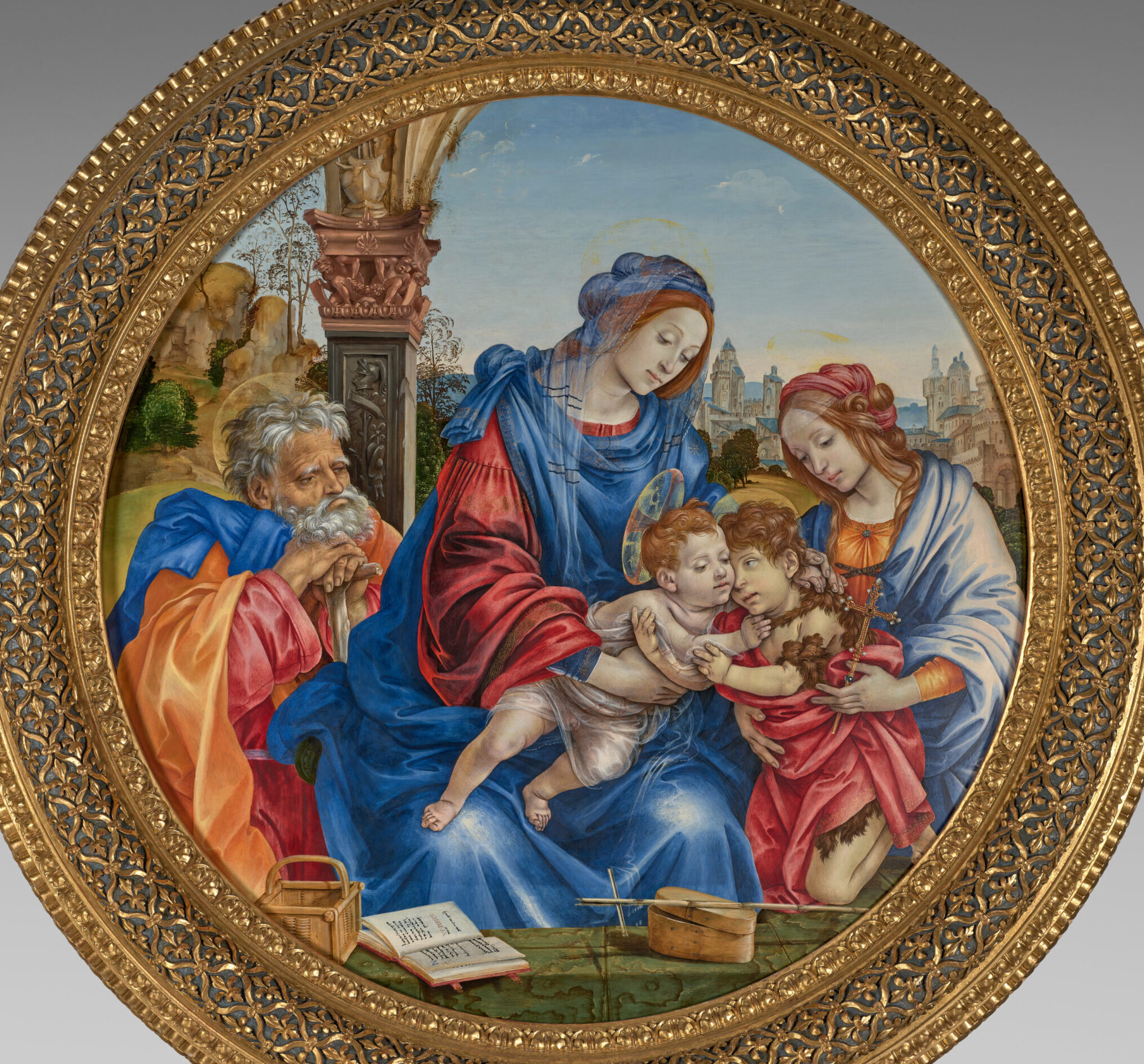
“How Filippino Lippi stayed ahead of the curve”
Alexander Noelle, Apollo
It’s tough being Filippino Lippi. His burden is that of a son seemingly destined always to be confused with, and overshadowed by, a more famous father: the rambunctious Florentine friar Filippo Lippi, who, despite not being able keep to his cell (or his vows of celibacy), produced some of the defining images of the early Renaissance. At the Cleveland Museum of Art, Lippi Jr. is getting his moment in the spotlight, with an exhibition centered on the painter’s most important work in the Western Hemisphere, the large tondo known as The Holy Family with Saint John the Baptist and Saint Margaret (ca. 1488–93). The work is dominated by the Virgin, whose tender gaze directed at her son is matched by that of the smaller figure of Saint Margaret, who holds John the Baptist. Joseph, with a weary and melancholy expression, is separated from the two women and babies by a lone classical pillar. The painting is notable not only for its harmonious composition but also for a delightful color scheme: all the main figures are dressed in the same three hues of red, blue, and orange. Alexander Noelle’s analysis of the work is enough to prove that this may be one of those rare cases when the son’s talent really does match the father’s.
“With all due respect . . .”
John Mullan, Literary Review
No figure of ridicule has traversed the centuries and millennia as unchanged as the type we now call the pedant. Already in Roman times, the satirist Juvenal had mocked the schoolteacher who loves to remind anyone who will listen “the name of Anchises’ nurse, of Anchemolus’s/ Stepmother, and her birthplace, how many years Acestes lived,/ And how many jars of Sicilian wine he handed to the Trojans.” Interestingly, as John Mullan points out in his review of Arnoud Visser’s recently published On Pedantry, schoolteaching and pedantry were originally synonymous in English until the sixteenth century, when “pedant” came to designate a certain kind of pretentious fool, but not necessarily the insufferable know-it-all that the word connotes today. Juvenal’s acerbic critique also points to one of the most distinguishing and universal features of pedantry: the hostility it incites from others, which in some cases can devolve into full-on anti-intellectualism. More often, however, as Mullan perceptively observes, the derision masks the paradox of pedantry whereby “those who scorn it are those who recognise it, often because they sometimes enjoy practising it themselves.”