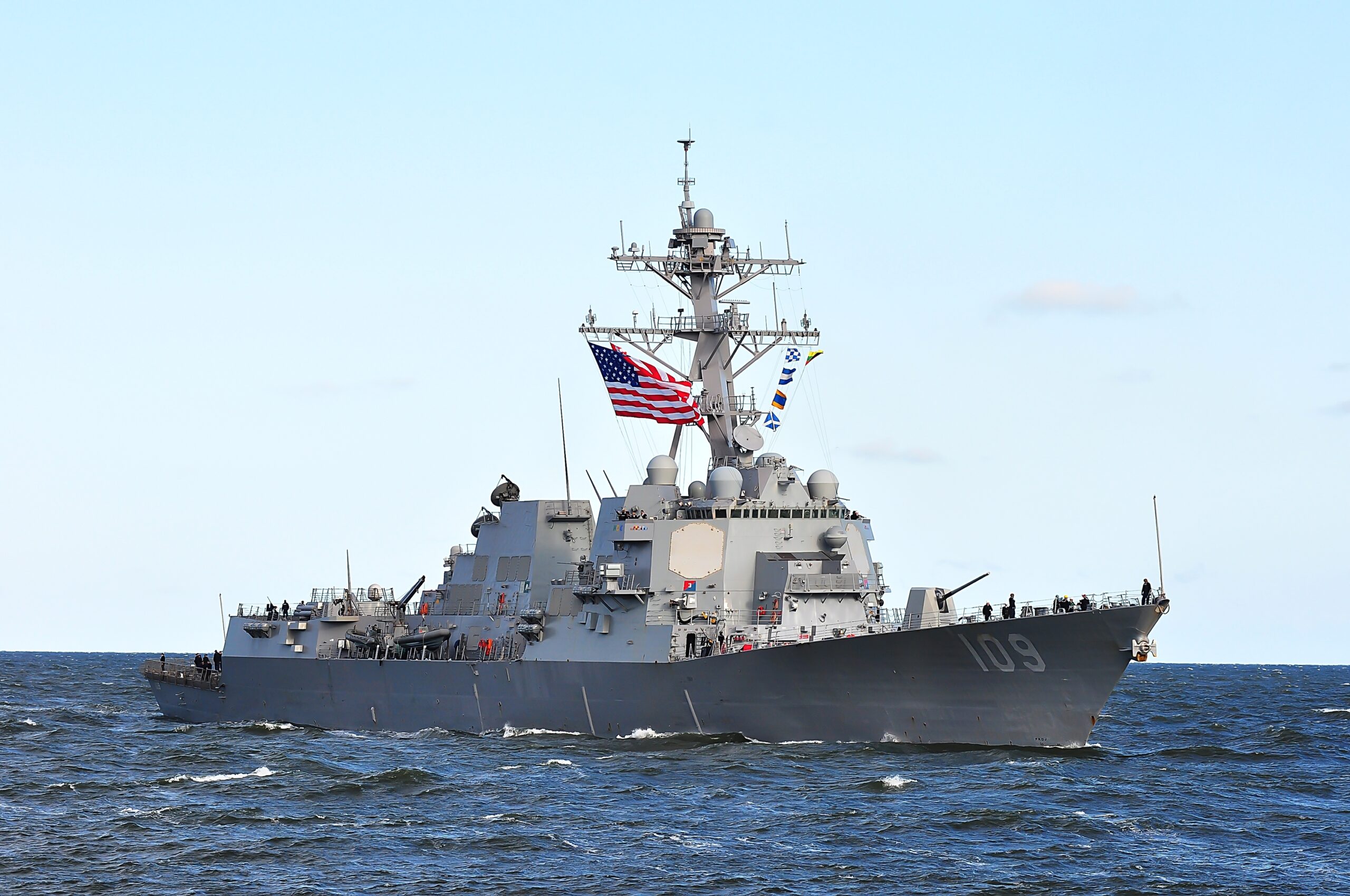
The future USS Harvey C. Barnum, Jr., named for a Vietnam War hero, is ready to set sail.
Last month, the United States Navy confirmed that General Dynamics Bath Iron Works handed over the future USS Harvey C. Barnum, Jr. (DDG-124), the newest Arleigh Burke-class guided missile destroyer. The warship had recently completed a series of at-sea and pier-side trials, which ensured that the key propulsion, combat, communication, and navigation systems were functioning correctly.
DDG-124 is one of the final Flight IIA variants of the Arleigh Burke-class, with development now beginning on the Flight III models. However, it was outfitted with the Flight IIA Technology Insertion, which enhanced the warship’s surface capacity in the form of significantly advanced sensors, power distribution, and combat systems. The Flight IIA TI was meant to serve as a transition between the original Flight IIA vessels and the Flight III.
“The future USS Harvey C. Barnum, Jr. will deliver powerful capability to the Fleet and enhance our maritime advantage,” explained Capt. Jay Young, Arleigh Burke-class program manager, Program Executive Office, Ships (PEO Ships). “DDG 124 and her crew will be a constant reminder of the service and commitment exhibited by her remarkable namesake.”
The Flight IIA destroyer will serve as a multi-mission surface combatant and, like other Arleigh Burke-class warships, can be employed in anti-air warfare (AAW), anti-submarine warfare (ASW), and anti-surface warfare (ASuW) roles.
Seven additional Arleigh Burke-class guided-missile destroyers are now in various stages of construction at the General Dynamics Bath Iron Works. These include the future Louis H. Wilson Jr. (DDG-126), Patrick Gallagher (DDG-127), William Charette (DDG-130), Quentin Walsh (DDG-132), John E. Kilmer (DDG-134), Richard G. Lugar (DDG-136), and J. William Middendorf (DDG-138).
The Ship is Named for a Medal of Honor Winner
The keel for DDG-124 was down at the General Dynamics Bath Iron Works in Bath, Maine, in 2021. The warship was christened in July 2023. DDG-124 is undergoing final outfitting and crew training and is scheduled to be commissioned in 2026.
According to the United States Navy, the guided-missile destroyer was named for Col. Harvey C. Barnum, Jr., United States Marine Corps (Retired), “a Medal of Honor recipient recognized for his extraordinary heroism and valor during the Vietnam War.”
The Congressional Medal of Honor Society (CMOHS) website documented Barnum’s Medal of Honor Action Date, which occurred 60 years ago this month, on December 18, 1965, outside the village of Ky Phu, Quang Tin Province, in the Republic of Vietnam (South Vietnam).
After his rifle company commander was mortally wounded, then-First Lieutenant Barnum took charge of the unit and rallied the troops.
“His sound and swift decisions and his obvious calm served to stabilize the badly decimated units, and his gallant example as he stood exposed repeatedly to point out targets served as an inspiration to all,” CMOHS explained, adding that, “His gallant initiative and heroic conduct reflected great credit upon himself and were in keeping with the highest traditions of the Marine Corps and the US Naval Service.”
Barnum later served as Assistant Secretary of the Navy for Reserve Affairs. He is unique in being among the few living namesakes of a US warship, and so this fact also gave him the opportunity to closely follow the construction of DDG-124.
“[Barnum] joined the crew, Navy programmatic team, and industry partners for the initial set of sea trials where he fired the first shot from the ship’s five-inch gun,” a spokesperson for the Navy added.
Arleigh Burke Flight IIA specs:
- Year Introduced: Fiscal year 1994
- Number Built: 37
- Length: 509.5 ft (155.3 m)
- Beam (Width): 66 ft (20 m)
- Displacement: 9,500 long tons (9,700 metric tons)
- Engines: Four (4) General Electric LM2500-30 gas turbine engines
- Top Speed: 30 knots (55.6 km/h)
- Range: 4,400 Nautical Miles
- Armaments: Mk 41 Vertical Launch System (VLS): A 96-cell system that can launch a variety of missiles, including:
- BGM-109 Tomahawk cruise missile
- RIM-66M, RIM-156, and RIM-174A Standard Missiles (surface-to-air and anti-ballistic missile versions)
- RIM-162 Evolved Sea Sparrow Missile (ESSM)
- RUM-139 Vertical Launch ASROC (VLA)
- Guns: Mk 45 5-inch Gun: A single gun mount on the bow for surface and shore bombardment; Mk 15 Phalanx CIWS: A close-in weapon system for last-ditch defense against incoming missiles and aircraft; Mk 38 Machine Gun Systems: Two 25mm cannons are also carried for use against fast attack craft.
- Crew: ~329, including officers and sailors
About the Author: Peter Suciu
Peter Suciu has contributed over 3,200 published pieces to more than four dozen magazines and websites over a 30-year career in journalism. He regularly writes about military hardware, firearms history, cybersecurity, politics, and international affairs. Peter is also a contributing writer for Forbes and Clearance Jobs. He is based in Michigan. You can follow him on Twitter: @PeterSuciu. You can email the author: [email protected].
Region: Asia
Tags:
Topic: Naval Warfare
Image: Shutterstock/Vytautas Kielaitis