The US Army is conducting a series of tank exercises near Poland’s border with Russia. Why?
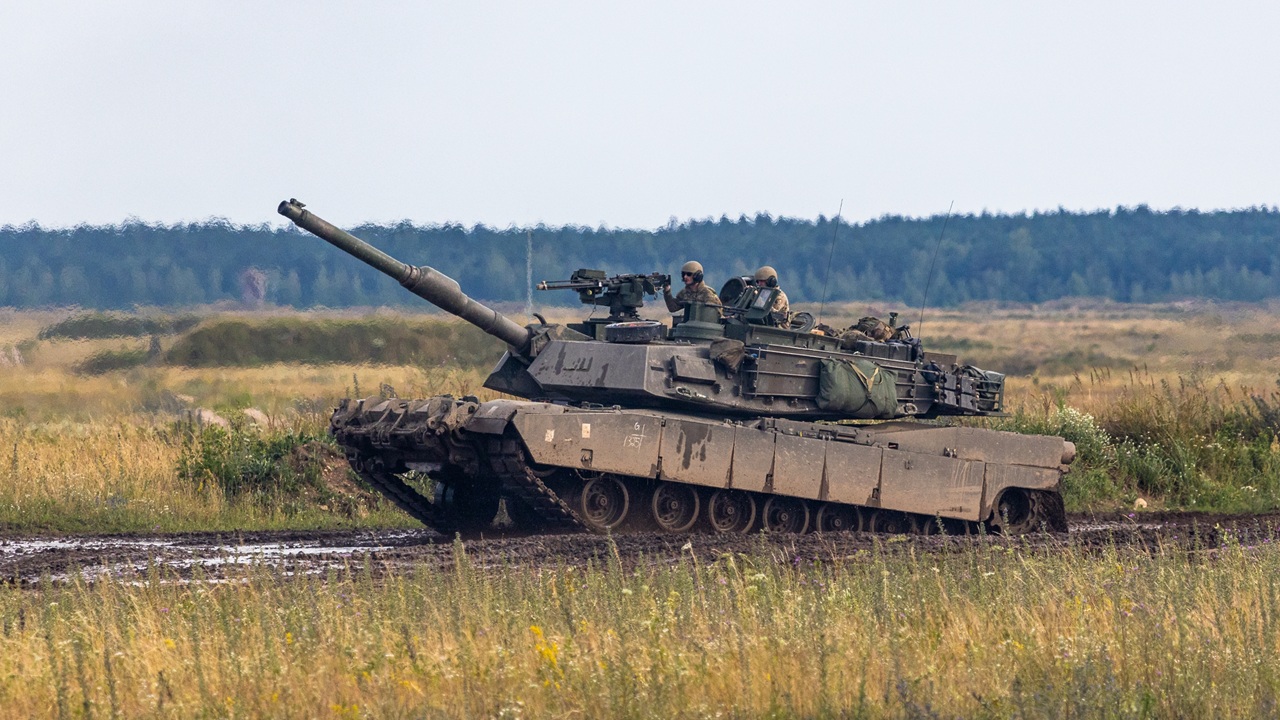
The US Army’s M1A2 Abrams Main Battle Tank (MBT) is the crown jewel of Western armor. With the Ukraine War grinding on, and fears that the conflict could spill beyond Ukraine’s borders, American forces are now pushing their iconic tanks through some of the most unforgiving terrain in Europe: Poland’s late-autumn mud.
Why Is the US Army Practicing Tank Maneuvers in Poland?
This isn’t a stunt. It’s a deliberate test—and a tactically valuable one—of how America’s premier heavy armor operates under the exact conditions US troops would face if war spread across NATO’s eastern flank.
At Poland’s Bemowo Piski Training Area and several other sites, Abrams crews are maneuvering through deep mud, waterlogged trenches, and soaked soil that sucks at a 70-ton tank like quicksand. US armor and support units were transported by rail across Poland, then dispersed to simulate wartime movement—a full-spectrum test not only of the machines themselves, but of the logistics network required to keep them alive.
Eastern Europe is a landscape of rivers, forests, wetlands, and sudden weather shifts. In the fall and early spring, the region becomes an ocean of mud. If heavy armor gets bogged down or fails under those conditions, NATO’s defensive plans collapse. Readiness exercises like these verify that the Abrams can fight and move in the environment that matters.
These drills test far more than mobility. They evaluate how quickly the US Army can reposition armor, sustain forward-deployed units, repair combat systems, and integrate them into a NATO-wide command-and-control structure. Training in Poland, with its rail corridors, logistics hubs, and proximity to Russia’s borders, gives the exercise a realism that no American training range could replicate.
Poland, after all, sits on the critical axis of any potential NATO-Russia confrontation. The Suwalki Gap, a narrow stretch of territory between Poland and Lithuania, is routinely identified by NATO planners as the most likely flashpoint for a major war between NATO and Russia. From the alliance’s point of view, practicing there is prudent.
Yet tactical logic is not the same as strategic logic. Preparing for war is, of course, responsible. But preparing for the wrong war—or preparing in ways that increase the risk of war—is something else entirely.
War Is Europe’s Problem—Let Europe Worry About It
This brings us to the essential question that almost no one in Washington or Brussels dares to ask: why does the United States need to be involved in this mission at all?
Poland today fields some of the most advanced Western weaponry, from HIMARS to K2 tanks to Patriot batteries. Warsaw boasts one of the fastest-growing defense budgets in Europe. The notion that the defense of Poland rests on US armored brigades is increasingly outdated.
Then there is the matter of the threat itself. Europe’s political leaders loudly insist that Russia is poised to storm across the continent, break NATO, and dismantle the European Union (EU). But after years of exhausting, attritional warfare in Ukraine, the Russian military remains largely confined to eastern Ukraine and Crimea. What’s more, there is no credible intelligence—neither presented publicly nor leaked from classified briefings—showing Moscow preparing for an invasion of Poland or any other NATO state.
What we do see are several European leaders talking about striking Russia first. France’s Emmanuel Macron has floated sending Western troops in Ukraine. Nordic and Baltic officials have warned that Europe may need to take “preemptive action” against the Kremlin. Even NATO’s military leadership recently suggested European forces might have to conduct preemptive strikes against Russia.
Moscow, of course, has issued no equivalent threats against Europe. And it has made no threats at all toward the United States, even though Washington has given copious amounts of lethal assistance to Ukraine. The Kremlin could reasonably argue that Russian blood is on American hands. Yet it has so far avoided escalatory rhetoric against the United States.
If deterrence is supposed to prevent war, one must ask: deterrence against what?
Driving Hundreds of Tanks Around Russia’s Border Could Be Dangerous
It is one thing to train in realistic environments. It is another to position US armor mere miles from an ongoing, high-intensity war with a nuclear-armed state. Whether Washington intends it or not, American military movements this close to Russia’s active battlefield risk being interpreted as signals—and not the kind we want to be misread.
At some point, one must confront the possibility that these exercises do not calm tensions at all. They inflame them. They create the appearance—if not necessarily the reality—of NATO preparing to intervene directly in Ukraine or expand the war geographically. They give European hawks precisely the political cover they desire, making a broader confrontation seem less like an accident and more like a plan.
Training is building readiness. But readiness for what? If the United States has no national interest in fighting Russia over Poland or Ukraine—and none has ever been articulated beyond vague commitments to “credibility”—then positioning American tanks in Polish mud is not defensive, but provocative. And provocations near a warzone rarely produce the outcome their architects expect.
The United States does not need to be rehearsing armored warfare on Russia’s doorstep. It needs to be focusing on preventing the Ukraine War from expanding and ensuring that Europe takes responsibility for its own defense.
Until this conflict ends, and cooler heads prevail on the continent, Washington must draw down in Europe, not ramp up. Let Poland defend Poland. Let Europe shoulder Europe’s ambitions.
America has real threats it faces today, and it has serious national interests—none of which begin in the Polish mud.
About the Author: Brandon J. Weichert
Brandon J. Weichert is a senior national security editor at The National Interest. Recently, Weichert became the host of The National Security Hour on America Outloud News and iHeartRadio, where he discusses national security policy every Wednesday at 8pm Eastern. Weichert hosts a companion book talk series on Rumble entitled “National Security Talk.” He is also a contributor at Popular Mechanics and has consulted regularly with various government institutions and private organizations on geopolitical issues. Weichert’s writings have appeared in multiple publications, including The Washington Times, National Review, The American Spectator, MSN, and the Asia Times. His books include Winning Space: How America Remains a Superpower, Biohacked: China’s Race to Control Life, and The Shadow War: Iran’s Quest for Supremacy. His newest book, A Disaster of Our Own Making: How the West Lost Ukraine is available for purchase wherever books are sold. He can be followed via Twitter @WeTheBrandon.
Image: Shutterstock / M2M_PL.