Only Hamas benefits from the deadlocked negotiations over the future of Gaza.
President Donald Trump’s Gaza plan faces a critical test that could determine whether it leads to a post-Hamas Gaza or merely institutionalizes the terror group’s rule over the Gaza Strip.
Hamas’ manipulation of the disarmament question is nothing but a vehicle for political legitimacy. The evidence is unmistakable. While Hamas formally agreed to Phase 1 of President Donald Trump’s 20-point proposal, it immediately conditioned all subsequent phases on discussions “within a unified Palestinian framework, in which Hamas will participate and contribute responsibly.”
Hamas’ strategic maneuver will position itself as an indispensable political actor rather than a terrorist organization required to disarm. As one Palestinian bluntly explained it to Al Jazeera: “[Hamas] will only give up [light] weapons when there is no need for these weapons. This means they will only hand them over to a Palestinian leadership that assumes control of a state after Israel ends its occupation.”
This rhetorical question reveals Hamas’s true strategy: using the disarmament issue as both a shield and a sword. By framing surrender as impossible without a legitimate Palestinian authority (a condition Israel and the United States have deliberately excluded from the current framework), Hamas creates an unresolvable paradox that serves its interests regardless of outcome.
Either negotiations stall (allowing Hamas to maintain its armed presence while blaming Israel), or the international community concedes to Hamas’s demand to be treated as Gaza’s governing authority, thereby granting it precisely the political legitimacy it seeks.
The Gaza-Syria parallel may look instructive, though not in the way many assume. Unlike Bashar al-Assad’s regime, which held on to power through military victory, Hamas is following a different path, where a militant leadership transitions into an internationally recognized political authority through negotiated engagement.
Participation in internationally sanctioned talks confers immediate legitimacy, regardless of compliance with substantive demands. Hamas, of course, has no incentive to surrender its arms, and its recent political messaging makes clear that it intends to remain a central actor in post-war Gaza.
While the Trump plan explicitly envisions “a temporary International Stabilisation Force (ISF)” and “the temporary transitional governance of a technocratic, apolitical Palestinian committee” overseen by an international “Board of Peace” (which would ultimately hand power to a reformed Palestinian Authority), current negotiations treat Hamas as Gaza’s de facto sovereign.
This contradiction undermines the very PA reform process the plan requires. What compounds this vulnerability are Israel’s actions in the West Bank, which directly undermine regional partners’ ability to support the Gaza plan fully.
The Saudi crown prince made this abundantly clear: “We want to be part of the Abraham Accords, but we want also to be sure that we secure a clear path to a two-state solution.” Current Israeli actions contradict that framework, and regional partners find themselves politically constrained from applying meaningful pressure on Hamas.
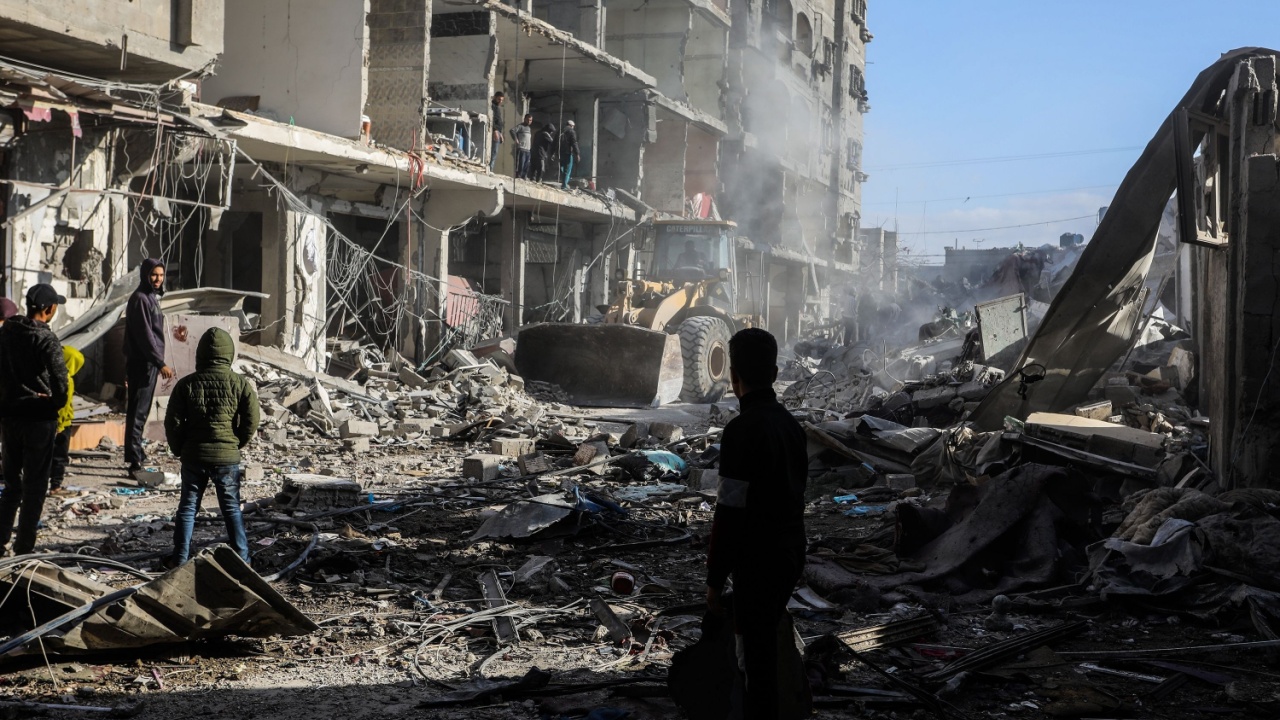
The result is a perfect stalemate best described by Dartmouth lecturer Ezzedine Fishere: “Israel will neither withdraw nor allow reconstruction if Hamas remains armed; Hamas will not sit idly by if Israel doesn’t withdraw.” This deadlock may soon become self-perpetuating, the very ambiguity that makes disarmament negotiations possible also ensures they will fail to achieve their stated purpose.
Breaking this cycle requires immediate course correction. First, the international community must cease treating Hamas as Gaza’s only legitimate negotiating partner. The PA must be included with clear mechanisms to ensure Hamas complies with disarmament without gaining political recognition.
Second, Israel must demonstrate concrete steps toward Palestinian statehood by halting settlement expansions and settlers’ hostilities against Palestinians. This could serve as a prerequisite for meaningful regional engagement. Most critically, the disarmament requirement must be absolute and immediate, not a prolonged negotiation that Hamas can exploit.
The truth is even more urgent: there can be no future Palestinian state if Hamas successfully transforms itself from a terrorist organization to an internationally recognized political authority through this process.
The window for genuine peace is narrowing, and without immediate correction, the Trump plan won’t end with Hamas’ disarmament; it will end with Hamas’s legitimization, the PA’s permanent exclusion from Gaza, and the consolidation of exactly the power structure the plan was designed to dismantle.
In the Middle East, peace processes that inadvertently strengthen the forces they seek to neutralize don’t just fail to achieve a genuine resolution of a conflict; they make the next conflict inevitable.
About the Author: Abdulla Al Junaid
Abdulla Al Junaid is a geopolitical columnist and commentator in Middle Eastern and international media. He is the former department head for Analysis and Policies at the National Unity Party in Bahrain, the former deputy director of MENA2050, an advisory board member of the German-Arab Friendship Association (DAFG), and a permanent committee member of the Germany-GCC Annual Conference on Security and Cooperation. He was a guest speaker at the German-GCC Annual Conference on Security & Cooperation, the Herzliya Conference, and the Abu Dhabi Strategic Forum. He is also an executive partner at INTERMID Consultancy (Bahrain).
Image: Anas-Mohammed / Shutterstock.com.