“Bingo fuel” is the hard limit of fuel that pilots need in order to safely return to base—a limit that can significantly restrict their mission envelope.
If one tracks military aviation closely enough, one will likely run across the term “bingo fuel,” which is pilot-speak for the pre-calculated minimum fuel level at which an aircraft must immediately stop its mission and divert to a pre-selected recovery location.
To be clear, bingo fuel is not an estimate or a guess or a suggestion. It is a non-negotiable hard limit. Once a pilot reaches bingo, the mission is over—period. This is not always the bare minimum of fuel needed to go back, but it is to go back safely; it ensures that there is enough fuel for the transit back, the approach and landing, a go-around if necessary, and required reserves. The concept of “bingo” is nearly universal within the US military, spanning fighters, bombers, tankers, helicopters, and naval platforms.
Fighter Jets Need Enough Fuel to Land!
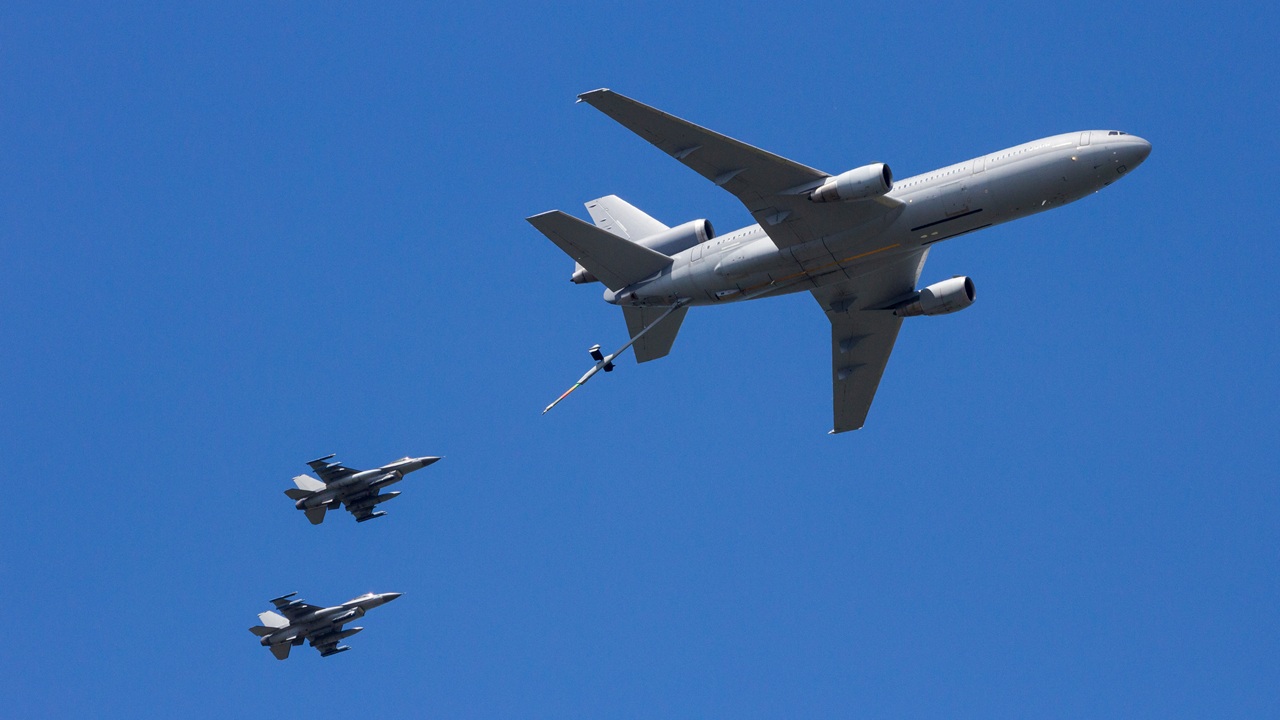
Bingo fuel exists because military aircraft operate far from their bases, often at the edge of their performance envelopes, in dynamic circumstances. Weather changes. Tankers move. Airfields close. Combat is inherently unpredictable. Bingo is a safeguard against that unpredictability—designed to prevent fuel starvation, ditching/ejection events, loss of an aircraft or pilot, or unscheduled landings in contested or hostile areas. For naval aviation, bingo ensures the aircraft has enough fuel to find the ship, enter the recovery pattern, and wave off if needed.
Bingo is calculated in flight planning, before the aircraft ever takes off. To determine it, pilots use the distance to primary and alternate landing sites; required reserves (which differ between the USAF and USN), fuel burn rates at various altitudes and speeds, anticipated holding patterns, mission profile (whether combat, training, or carrier ops, etc), and tanker availability. If mission parameters change in-flight, as they often do, bingo is recalculated.
Different aircraft have different bingo numbers. And while those numbers are mission-specific and vary by altitude, stores, and conditions, there are some general parameters. The F-16’s bingo is typically around 2,000 pounds. The F/A-18E/F can be higher, closer to 4,000 for carrier ops. The F-22 hits bingo in the 3,000-pound range. For larger aircraft like the B-52, bingo may be tens of thousands of pounds, depending on the distance of the mission.
When “Bingo” Matters in Combat
Tactically, bingo often forces fighters to disengage from combat—even when they are positioned advantageously. Adversaries aware of American fighter pilots’ bingo constraints could theoretically attempt to draw US fighters further away from tankers or carriers, increasing the aircraft’s vulnerability and reducing the time allowed for actual engagement. Bingo cutoffs therefore have significant impact on war planning, shaping air policing response windows and combat air patrol rotation rates.
In the Indo-Pacific, likely the most important theater of the 21st century, long distances make fuel margins tighter. Bingo directly impacts the US ability to maintain a presence near China—a fact that Chinese war planners are well aware of. Tanker availability becomes a vital interplay affecting bingo, which is why the People’s Liberation Army and its associated service branches have made shooting down US tanker aircraft their top priority.
Bingo has only become more relevant as modern fighters are more fuel-hungry. Stealth shaping, internal weapons carriages, and high-energy engines consume fuel at gluttonous rates, forcing war planners to implement more conservative bingo numbers for cutting edge aircraft. So, as the US pivots towards the Indo-Pacific, deploying modern fuel-intensive aircraft, expect bingo to be as relevant as ever.
About the Author: Harrison Kass
Harrison Kass is a senior defense and national security writer at The National Interest. Kass is an attorney and former political candidate who joined the US Air Force as a pilot trainee before being medically discharged. He focuses on military strategy, aerospace, and global security affairs. He holds a JD from the University of Oregon and a master’s in Global Journalism and International Relations from NYU.
Image: Shutterstock / VanderWolf Images.