Ukraine has successfully developed an AI-driven anti-drone gun—the next step in the race between drone and anti-drone warfare, and one that other nations are certain to copy.
Russia’s war against Ukraine has become the world’s most important laboratory for modern warfare. From long-range drones to cheap loitering munitions to satellite-guided artillery, nearly every destructive innovation of the twenty-first century has found its way into the conflict—and has been made all the more lethal as a result.
But now, Ukraine is quietly introducing something even more transformative: autonomous, AI-guided air-defense (AD) turrets capable of automatically detecting, tracking, and killing incoming aerial threats.
The Rise of Autonomous Air Defense
Ukraine’s “Sky Sentinel” system is the first autonomous air defense system to enter active combat use in the European theater. It is unlikely to be the last.
Developed by Ukrainian engineers and funded in part by UNITED24 and volunteers, Sky Sentinel represents a profound shift in how modern armies can defend themselves. During early combat testing, the turret reportedly destroyed six Shahed-136 drones, proving that machine-gun-based, AI-guided systems can do real work against the cheap, mass-produced threats that have been tormenting Ukrainian cities for nearly two years.
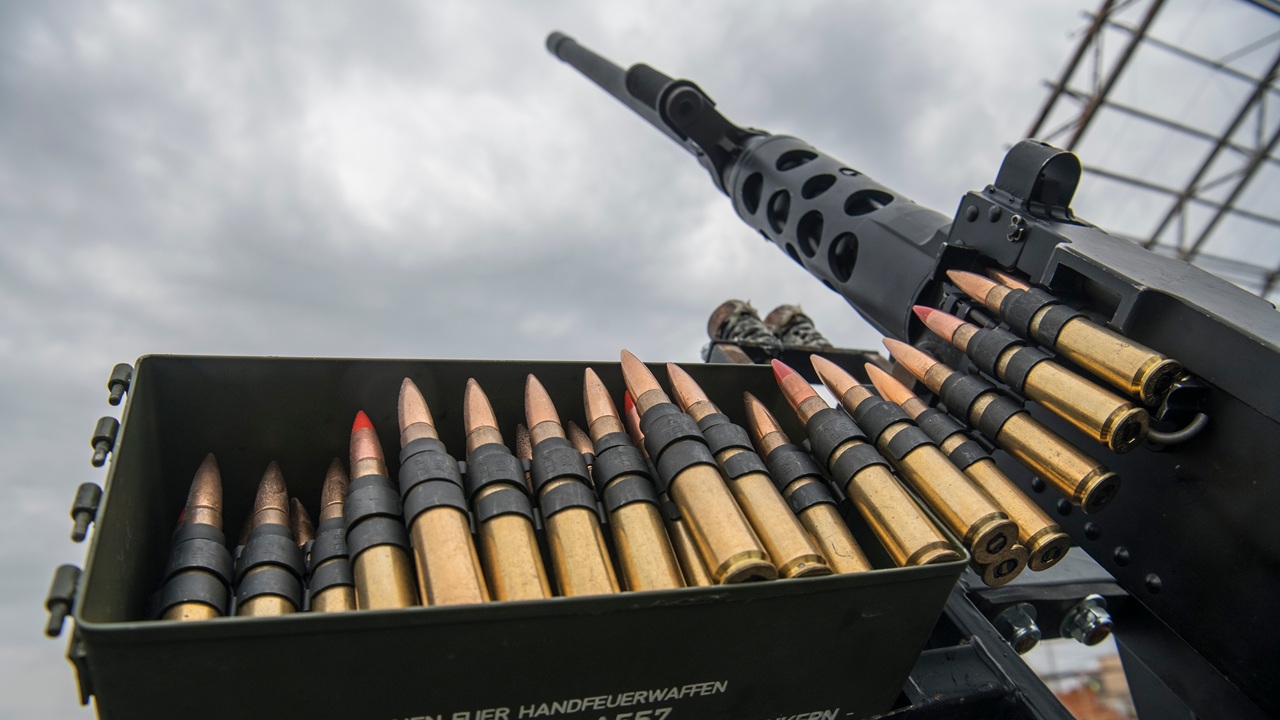
Unlike traditional missile-based air defense systems, the Sky Sentinel uses a standard heavy machine gun, bolted onto a robotic mount fed by radar, electro-optical sensors, and an AI-powered targeting brain. It rotates a full 360 degrees—constantly scanning the skies, automatically identifying targets, and calculating firing solutions in real time.
Why Ukraine Is Betting on AI Turrets
According to technical descriptions, the Sky Sentinel can engage the kind of fast, small, and maneuverable drones that historically challenge even high-end missile systems. Some estimates claim it can handle targets flying up to 500 miles per hour.
This is not science fiction. It is happening now—and it is occurring because Ukraine has no choice. The frontlines are fading. Russian forces are moving in. Ukraine is running out of money and people to feed into the meatgrinder along the front lines. Kyiv’s frontline forces are, therefore, having to act out of desperation. And desperation breeds remarkable innovation… especially in military affairs.
The sheer volume of Russian drone and missile attacks has pushed Ukraine’s air defenses to the brink. Missile-based interceptors are too scarce and too expensive to waste on $30,000 kamikaze drones. Every Shahed shot down with a NASAMS missile represents a losing economic exchange. Sky Sentinel flips that equation. A burst of machine-gun ammunition costs a tiny fraction of a guided interceptor.
The cost differential is the entire point of the system. Gun-based AI turrets offer a scalable, sustainable way to counter drone swarms—something every modern military is worrying about. Because they do not require complex missiles or foreign supply chains, Ukraine can build and deploy these weapons at a pace Western countries cannot yet match. Domestic manufacturing gives Kyiv strategic autonomy and the ability to defend not just frontline trenches, but power plants, railway junctions, ammunition depots, and civilian population centers.
Still, even the most sophisticated AI system is no magic shield. Sky Sentinel, like all emerging autonomous weapons, has limitations. Weather, electronic warfare (EW), complex urban terrain, and extremely fall and/or fast drones can still reduce the effectiveness of Sky Sentinel.
The Limits—and Risks—of Automated Warfare
Writing in CEPA this last October, David Kirichenko cautioned that such systems are “not there yet” when it comes to scaling up against the full variety of Russian aerial threats.
And a machine gun, no matter how smart the mount behind it, is still a short-range weapon. Turrets like Sky Sentinel will be superb for defending local zones, but they cannot replace medium-or-long-range missile systems. Nor can they reliably destroy larger, better protected aerial platforms. They are an answer—but only to one part of the problem.
Yet the significance of Sky Sentinel is not found in what it cannot do. It lies in what its existence actually means. For the first time, we are seeing a major military power fight off massed drone attacks not primarily with missiles, but with distributed, AI-enabled defensive nodes. Instead of relying on expensive, centralized batteries, Ukraine is building what amounts to a “drone wall”: hundreds, and eventually thousands, of autonomous gun platforms that can multiply the density of its AD at a fraction of the cost.
If the concept works, the implications will ripple far beyond Ukraine. Russia will, of course, adapt. They will deploy more decoys, faster drones, and EW tactics meant to blind or confuse the AI. Other nations will study the model, not merely for the tactical benefits but also for the industrial lessons.
Distributed, Algorithmic Air Defense Is the Future of Warfare
Ukraine, cut off at times from reliable Western resupply, is proving that a country under existential attack can leapfrog traditional defense concepts. Sky Sentinel may soon be more than a battlefield necessity. It may become an export, a template, or even a new doctrine.
The age of AI-driven air defense has already begun. And it did not start in Washington, Beijing, or Moscow. It started in Ukraine—with a machine gun, a robotic turret, and an algorithm trained to shoot down the future.
As Claude Rains’ duplicitous Mr. Dryden says in Lawrence of Arabia, “Big things have small beginnings.” In this case, though, the “big things” are an entirely new, profoundly visceral, and wholly frightening new way of fighting that will define how wars are won and lost for decades to come.
About the Author: Brandon J. Weichert
Brandon J. Weichert is a senior national security editor at The National Interest. Recently, Weichert became the host of The National Security Hour on America Outloud News and iHeartRadio, where he discusses national security policy every Wednesday at 8pm Eastern. Weichert hosts a companion book talk series on Rumble entitled “National Security Talk.” He is also a contributor at Popular Mechanics and has consulted regularly with various government institutions and private organizations on geopolitical issues. Weichert’s writings have appeared in multiple publications, including The Washington Times, National Review, The American Spectator, MSN, and the Asia Times. His books include Winning Space: How America Remains a Superpower, Biohacked: China’s Race to Control Life, and The Shadow War: Iran’s Quest for Supremacy. His newest book, A Disaster of Our Own Making: How the West Lost Ukraine is available for purchase wherever books are sold. He can be followed via Twitter @WeTheBrandon.
Image: Shutterstock / paparazzza.