The 2024 presidential election confirmed a political phenomenon that has been building for years: Hispanics are no longer a reliable Democratic constituency. Donald Trump won 48 percent of the Hispanic vote, just three points shy of Kamala Harris’s share. Perhaps even more striking, he carried 51 percent of foreign-born, naturalized Hispanic immigrants—a direct rebuke to the assumption that immigrants instinctively side with the Left.
This shift is not simply about politics. It reflects a deeper sociological reality: Hispanics are assimilating into America’s mainstream and, over generations, becoming white, in both culture and identification. That is not something to fear. It is the story of American integration, repeated again in our time.
Finally, a reason to check your email.
Sign up for our free newsletter today.
Progressives worked for decades to establish “Hispanic” as a distinct ethic category, hoping Latin American immigrants and their descendants would embrace it as a shared political identity. They assumed that these voters would sympathize with radical pro–illegal immigration policies, such as sanctuary cities that protect criminals, out of a sense of solidarity.
But the opposite is increasingly true. Hispanic immigrants follow news about the border and illegal immigration more closely than native-born Hispanics and shifted more toward Trump probably because of Biden’s open-border disaster—not only because they are more likely to be the victims of illegal-immigrant crime but also because they see themselves as distinct from illegal border crossers, even those from the same home country.
Further, when analysts talk about the “Hispanic vote,” they overlook a key fact: not all people of Latin American ancestry identify as Hispanic. One analysis showed that by the third generation, about one in four descendants of Hispanic immigrants no longer identify as Hispanic. By the fourth generation, half of all descendants no longer do.
What explains this pattern? Hispanics intermarry at high rates with non-Hispanic whites. As of 2016, over 40 percent of all interracial marriages in the U.S. involved one Hispanic and one non-Hispanic white spouse. The number of these couples climbed from 1.4 million in 2000 to 2.4 million by the 2010s and is almost certainly higher today. Children of these marriages often stop identifying as Hispanic, especially if Spanish is not spoken at home, which is often the case by the second and later generations. Moreover, nearly one in five Latin American immigrant married women are married to a native-born American, suggesting quick assimilation.
The ethnic attrition of Hispanics has real political consequences. Hispanics who intermarry and assimilate most quickly are often those who speak English fluently and are better educated. Their children are more inclined to identify as white and to join the cultural mainstream. Hispanics who graduate college are between eight and ten times more likely to marry a non-Hispanic white person than a Hispanic who didn’t complete high school. As Hispanics have gotten better educated, they also have mixed with whites at a higher rate.
Assimilation reduces the appeal of left-wing, ethnic grievance politics. If you don’t think of yourself as a minority, you’re less likely to vote like one. If you don’t speak Spanish, you care less about calculated political appeals in foreign languages.
As more Hispanics stop thinking of themselves as an identity group, their political preferences will shift accordingly to the average. That helps explain why Republicans have made inroads with Hispanic voters at every level, from residents in South Texas border towns several generations removed from their Mexican immigrant heritage to the more recent immigrants in Florida’s Cuban and South American communities.
Skeptics may balk at the claim that Hispanics are “becoming white.” But history offers precedents. In the early twentieth century, for example, Italians were considered racially suspect. They were stereotyped as criminals, unassimilable Catholics, and not quite white. Yet within three generations, they had intermarried, moved to the suburbs, and disappeared into the white majority.
Of course, some Italians today think of themselves as Italian-American, just as some Irishmen consider themselves Irish-American. The same will occur with people who today identify with various Latin American nationalities. But these cultural identities, often used to define things like food or sports preferences, do not constitute political loyalties, let alone national ones. They are the kind of diversity that is enriching, not threatening.
More Hispanics are identifying as white in part because a substantial share of them already report European ancestry. This share is larger among more recent Latin American immigrants. Today, third- and fourth-generation Hispanics are following the same path. Many also have substantial European ancestry. In Argentina, for example, a majority of the population descends from Italian and Spanish immigrants, and tens of thousands still hold EU citizenship through family lineage. For their American-born children and grandchildren, blending into the white mainstream is not a major leap.
Many immigrants identify as white on their arrival. One in four immigrants from Latin America identify as white. Among some groups, such as Cubans and Venezuelans, that rate exceeds one in three.
English proficiency is another measure of Hispanic assimilation. New immigrants from Latin America are much more proficient in English than they were decades ago. While barely 15 percent of young Latin American immigrants spoke English well or at a native level in the 1970s, over 25 percent of them do today.
These shifts are not limited to white-identifying descendants of Latin American immigrants. Indeed, the 2024 election reveals that even those who identify as Hispanic are moving beyond identity politics and toward mainstream values: family, faith, work, patriotism. That is good for the United States.
Far from being a permanent minority locked into the Democratic coalition, Hispanics are showing that the American melting pot still works. They are increasingly marrying into the white majority, shedding ethnic labels, and embracing mainstream politics. Indeed, Hispanics’ cultural assimilation means that in the future, ethnic identity will matter less—and America will be more united.
This article is part of a series on political realignment among ethnic groups in the United States.
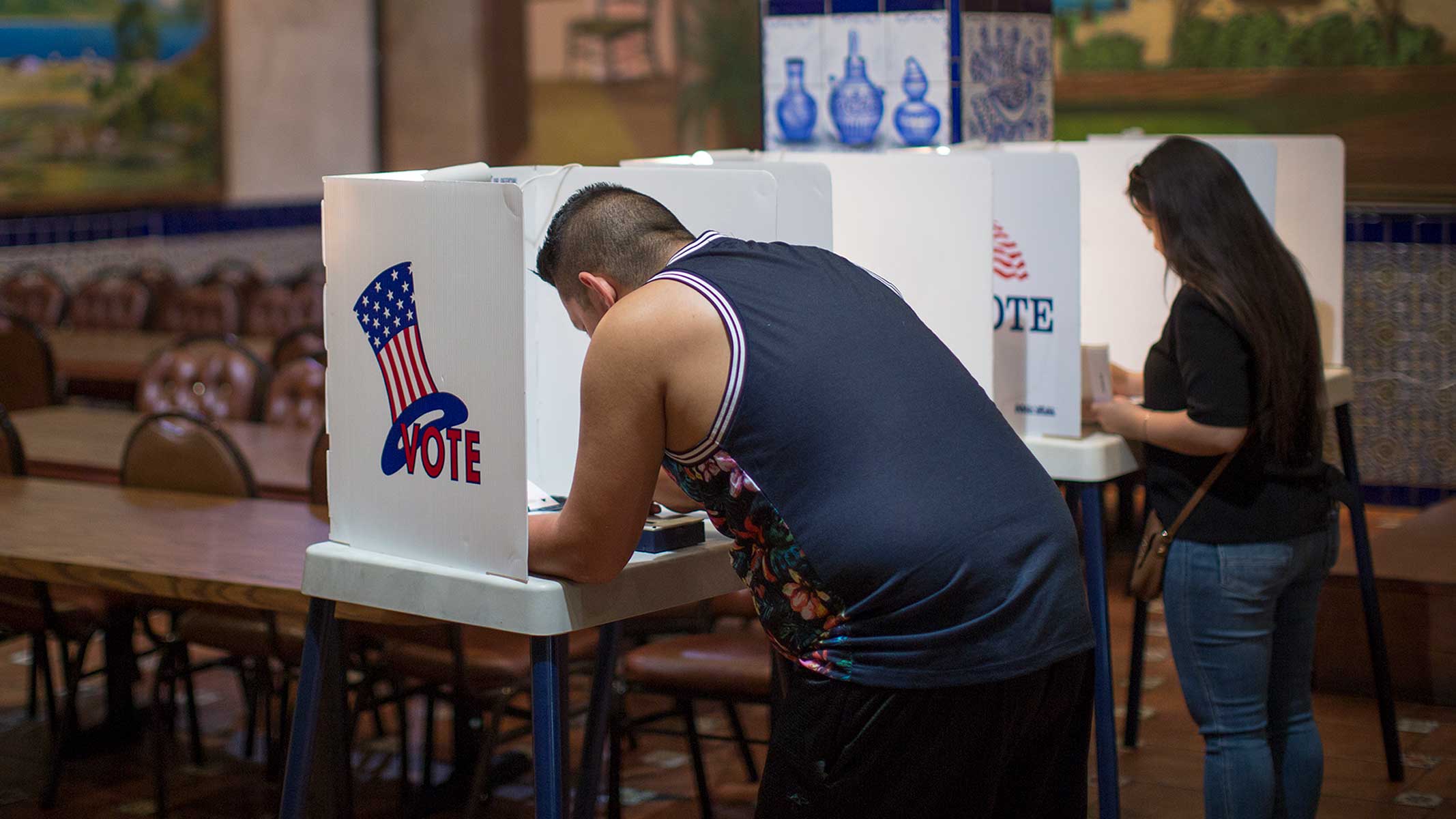
Photo by David McNew/Getty Images
Source link