
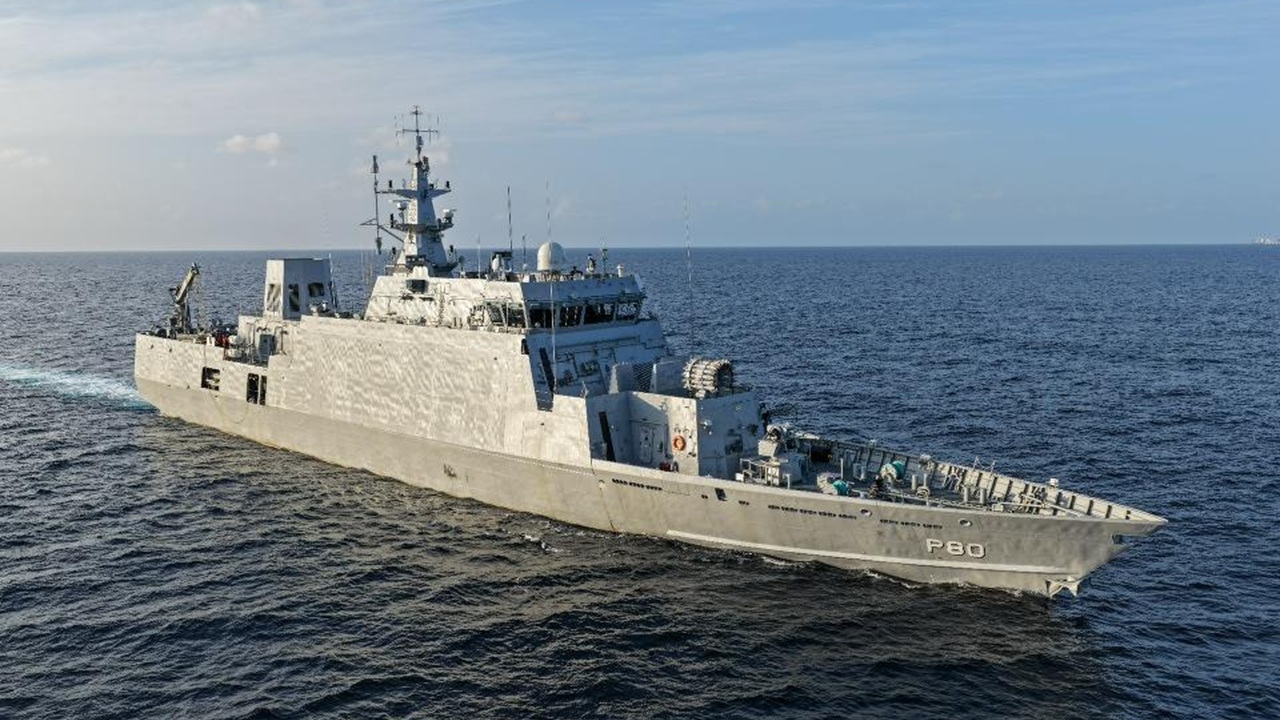
On November 24, the Indian Navy formally commissioned the INS Mahe—the lead vessel of a new class of eight anti-submarine warfare shallow-water crafts (ASW-SWC). That’s because the Indian Navy is focused on better countering the Pakistani Navy’s threat, as Islamabad is fixated on beefing up their naval capabilities, especially in undersea warfare.
The ASW-SWC Vessel’s Specifications
- Year Introduced: 2025
- Number Built: 3 (1 in active service; 16 planned)
- Length: 78 m (255 ft 11 in)
- Beam (Width): 11.26 m (36 ft 11 in)
- Displacement: 896–1,100 t, depending on loadout
- Engines: Three Larsen & Toubro marine diesel engines (6 MW); waterjet propulsion
- Top Speed: 25 knots (46 km/h; 29 mph)
- Range: 1,800 nmi (3,300 km; 2,100 mi); 14 days’ endurance
- Armaments:
- One RBU-6000 anti-submarine rocket launcher
- Two triple lightweight torpedo launchers
- One 30mm surface gun
- Two 12.7mm M2 Stabilized Remote Controlled Gun
- Anti-submarine mines
- Crew: 57 (7 officers, 50 sailors)
The Mahe’s primary mission is the detection and neutralization of submarines, coastal patrols, and safeguarding maritime approaches. She possesses hull-mounted sonar as well as other underwater sensors optimized for submarine tracking in shallow waters. There is a tactical emphasis on stealth, mobility, and coastal defense dominance, with Marine Insight describing the new Indian warship as a “silent hunter.”
India’s Navy is tasked with operating in heavily congested and shallow waters, such as the Arabian Sea, Bay of Bengal, and the littorals of the Indian Ocean. A shallow-water ASW craft, such as the INS Mahe, is better suited than larger deep-water destroyers and frigates to detect and counter submarine threats near to the coastlines of those regions.
This is a major milestone for India’s indigenization push and a boost for its domestic manufacturing. These ASW crafts are intended to replace older, less capable corvettes in the Indian fleet while improving the resilience and flexibility of India’s naval force projection along its vast coastline and strategic chokepoints.
Why Did India Build the INS Mahe?
Pakistan’s purchases of Chinese-made submarines have rightly gotten much attention in the international press—especially as the Chinese keep trying to make hay out of the excellent performance of their warplanes and missiles used by the Pakistanis in the last round of Indo-Pakistani warfare. Yet, Russian military expert Andrei Martyanov explained to me that the Chinese submarine force leaves much to be desired.
So the introduction of new Chinese submarines into Pakistan’s ailing fleet is certainly cause for concern in New Delhi. It is likely that these new Chinese made submarines are not yet prepared to square off against more sophisticated Western systems. Still, one can never underestimate the Chinese when it comes to building competitive new technology.
The Mahe was built by Cochin Shipyard Limited (CSL), Kochi—under the umbrella of the government’s self-reliance push Atmanirbhar Bharat, implemented after the COVID-19 pandemic. As a result, over 80 percent of the content in the INS Mahe is indigenous to India.
The INS Mahe Should Scare Pakistan’s (and China’s) Submarine Force
Because of the heavy emphasis on littoral combat capabilities, the INS Mahe and its forthcoming sister ships have limited utility in countering blue-water submersible threats. Still, these ASW enhancements are a necessary step for an Indian Navy whose own submarine capabilities remain modest.
Indeed, that modest submersible capability, as the South China Morning Post rightly notes, limits long-term undersea deterrence when faced against navies that are more invested in such capabilities.
The introduction of the INS Mahe may seem limited, but it actually reflects a broader pattern: a rising regional power investing in asymmetric, distributed maritime capabilities, increasing self-reliance, and building a multi-layered naval posture that—while optimized for shallower waters—helps India in securing sea lanes, chokepoints, and littoral zones.
That’s key, because as maritime competition intensifies from the Indian Ocean to the Arctic to the bottom of the sea, states will increasingly rely on a mix of submarines, ASW escorts, surface ships, and surveillance assets to project power and defend interests. India’s move to bulk up its ASW fleet is a sign of that strategic evolution.
About the Author: Brandon J. Weichert
Brandon J. Weichert is a senior national security editor at The National Interest. Recently, Weichert became the host of The National Security Hour on America Outloud News and iHeartRadio, where he discusses national security policy every Wednesday at 8pm Eastern. Weichert hosts a companion book talk series on Rumble entitled “National Security Talk.” He is also a contributor at Popular Mechanics and has consulted regularly with various government institutions and private organizations on geopolitical issues. Weichert’s writings have appeared in multiple publications, including The Washington Times, National Review, The American Spectator, MSN, and the Asia Times. His books include Winning Space: How America Remains a Superpower, Biohacked: China’s Race to Control Life, and The Shadow War: Iran’s Quest for Supremacy. His newest book, A Disaster of Our Own Making: How the West Lost Ukraine is available for purchase wherever books are sold. He can be followed via Twitter @WeTheBrandon.
Image: Government of India / Wikimedia Commons.

















_is_sailing_at_sea_-_2.jpg)