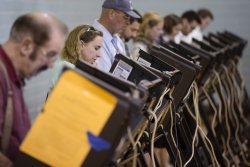
In Steadfast Democrats, their insightful analysis of black political behavior published in 2020, political scientists Ismail White and Chryl Laird argued that black voting patterns are largely a function of peer pressure. In the post-civil rights era, supporting Democrats—regardless of their track record on housing, unemployment, schools, public safety—became not only the right thing to do but also the “black” thing to do.
According to White and Laird, social pressure from other blacks is such that even those voters who don’t align with the Democratic Party’s position on major issues such as abortion, gay rights, or gun control are nonetheless more inclined to back Democrats out of racial solidarity. “Identifying with and voting for the Democratic Party and its candidates,” they wrote, “have come to be understood by most black Americans as in-group expected behaviors that individual blacks perform in anticipation of social rewards for compliance and sanctions for defection.”
Finally, a reason to check your email.
Sign up for our free newsletter today.
As one might guess, black support for Democrats peaked under President Barack Obama, who won 95 percent of the black vote when he was elected in 2008 and 93 percent when he was reelected in 2012. Obama’s job-approval rating among blacks during his two terms was similarly stratospheric. It hovered between the mid-90s and the low-80s, some 40 points higher than the average among all groups. Yet a Los Angeles Times story published shortly before Obama left office noted that polling had “shown black people to be more satisfied with Obama the man and less with their progress under Obama the president.”
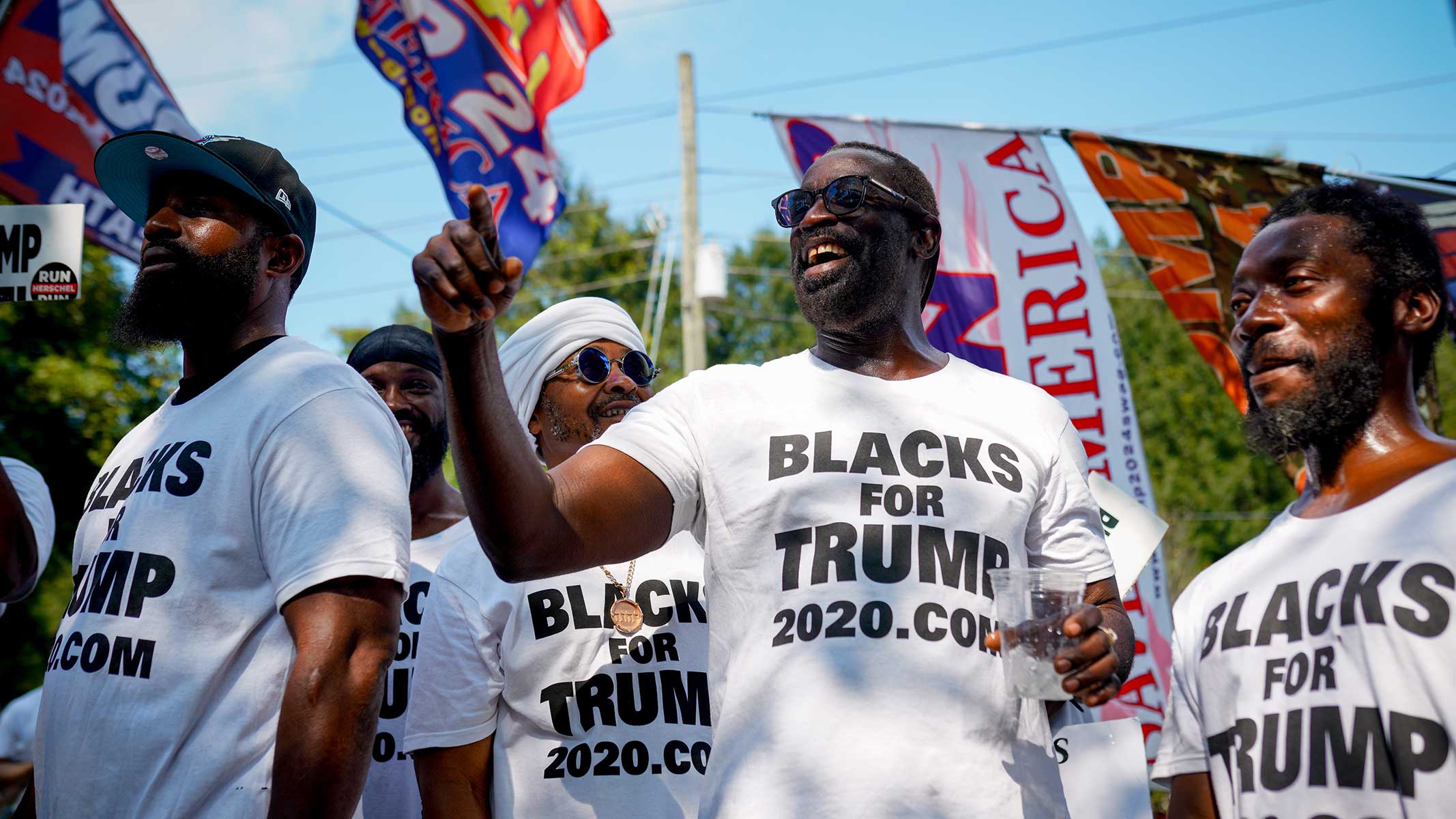
Today, black support for Democrats has weakened in ways that make the Right giddy and the Left sweat. The Democratic Party is in no danger of losing the black vote outright to Republicans anytime soon, but Donald Trump’s political success is evidence that Democrats can no longer count on black voters to back the Democratic candidate reflexively on Election Day. The Trump era has also demonstrated that other minority voters who have trended Democratic in recent decades, including Asians and Hispanics, are increasingly open to GOP appeals in numbers large enough to swing elections.
Between 2020 and 2024, Trump nearly doubled his support among black voters, from 8 percent to 15 percent, according to the Pew Research Center. Over the same period, his support among Asian voters rose from 30 percent to 40 percent, and his share of the Hispanic vote increased from 36 percent to 48 percent. That Trump was able to make these dramatic inroads among blacks and Asians while running against Kamala Harris, a woman of black and Asian descent, is even more remarkable.
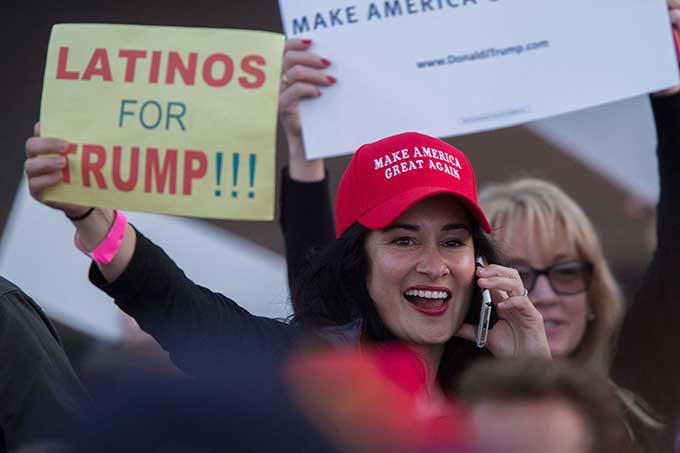
What’s especially worrisome for Democrats is that Trump didn’t simply improve his performance among these groups in swing states—he also made gains in states that Harris carried. A postelection New York Times analysis revealed that in predominantly black and Hispanic New York City neighborhoods, Trump’s support improved by 46 percent and 55 percent, respectively. Democrats easily won deep-blue states like California, New York, and New Jersey, but by significantly smaller margins than they won them four years earlier.
Declining minority support for Democrats is a function of the party’s waning support among blue-collar voters, who are disproportionately black and Hispanic. The white working-class began abandoning Democrats decades ago out of frustration that party leaders were prioritizing the concerns of college-educated professionals and cultural elites. Trump convinced more nonwhites to do the same.
During Trump’s first term, millions of working-class minorities experienced low inflation and low unemployment. Prior to the pandemic, black and Hispanic poverty rates also dipped to record-low levels, and black wages rose faster than white wages. Clearly, it was an experience that convinced more blacks and other ethnic minorities to reconsider their fealty to the Democratic Party. What’s less clear is whether the shift in voting patterns is a temporary phenomenon linked to Trump or a more enduring realignment that will continue after he leaves office.
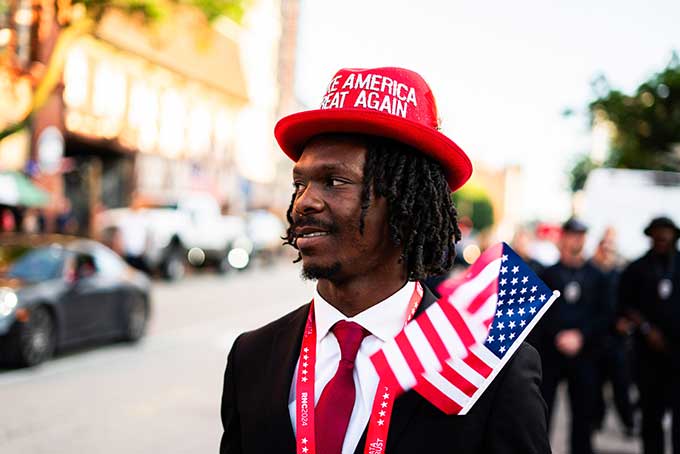
GOP losses in Virginia and New Jersey’s off-year gubernatorial races indicate that the party’s gains among nonwhite voters could be fleeting. In New Jersey, Mikie Sherrill not only beat Republican Jack Ciatarelli by more than 13 points but also clawed back black and Hispanic voters who supported Trump in 2024. Last year, for example, Trump carried the Garden State’s heavily Hispanic Passaic County by roughly 3 percentage points. This year, Sherrill won it by about 15 points.
It’s bad news for Democrats if ethnic identity is no longer political destiny, but it’s good news for the country. If more minorities become swing voters, the quality of their political representation will only improve. And if more voters in general are looking to turn the page on racial tribalism, that’s progress.
This article is part of a series on political realignment among ethnic groups in the United States.
Top Photo by Benjamin Hendren/Anadolu Agency via Getty Images
City Journal is a publication of the Manhattan Institute for Policy Research (MI), a leading free-market think tank. Are you interested in supporting the magazine? As a 501(c)(3) nonprofit, donations in support of MI and City Journal are fully tax-deductible as provided by law (EIN #13-2912529).
Source link