The RAAF has developed into Oceania’s strongest air force—driven in large part by alarm over Chinese expansion in the Indo-Pacific.
The Royal Australian Air Force (RAAF) is one of the most modern and technologically advanced air forces in the Indo-Pacific. Spurred by Chinese ambitions, the RAAF has undergone a transformation from a traditionally defensive, continental-security air posture to a more forward-leaning, regional force focused on deterrence. Ongoing modernization efforts relate to incorporating fifth-generation platforms, long-range strike capabilities, and deeper integration with the US and other allies.
Understanding the RAAF’s Force Composition
The RAAF is fully dependent on aircraft imported from the United States. The crown jewel of the RAAF’s current force composition is the F-35A Lightning II. Like so many US allies, Australia has imported the F-35A to replace legacy fourth-generation fighters with a stealthy, sensor-fusing option capable of operating against sophisticated adversaries—most obviously China in Canberra’s case. The F-35A will supplement, and eventually replace, older US imported F/A-18F Super Hornets. In the interim, the RAAF has relied upon the Super Hornet to perform strike, maritime interdiction, and air defense. Basically, the Super Hornet has served as a jack-of-all-trades—and a bridge until more F-35As can be procured.
Australia also happens to be the only country in the world outside of the US to field the EA-18G Growler, an electronic attack aircraft derived from the Super Hornet. The Growler provides Australia with jamming, SEAD capabilities, and electric denial—all critical against China’s A2/AD network.
Unsurprisingly, for a nation surrounded by as much water as Australia, the RAAF fields the P-8A Poseidon for maritime patrol and anti-submarine warfare (ASW). The P-8A is arguably the world leader in ASW while also providing a stand-off maritime strike option and an intelligence gathering option. As the Chinese naval fleet expands, both above and below the surface, the P-8A will be increasingly important.
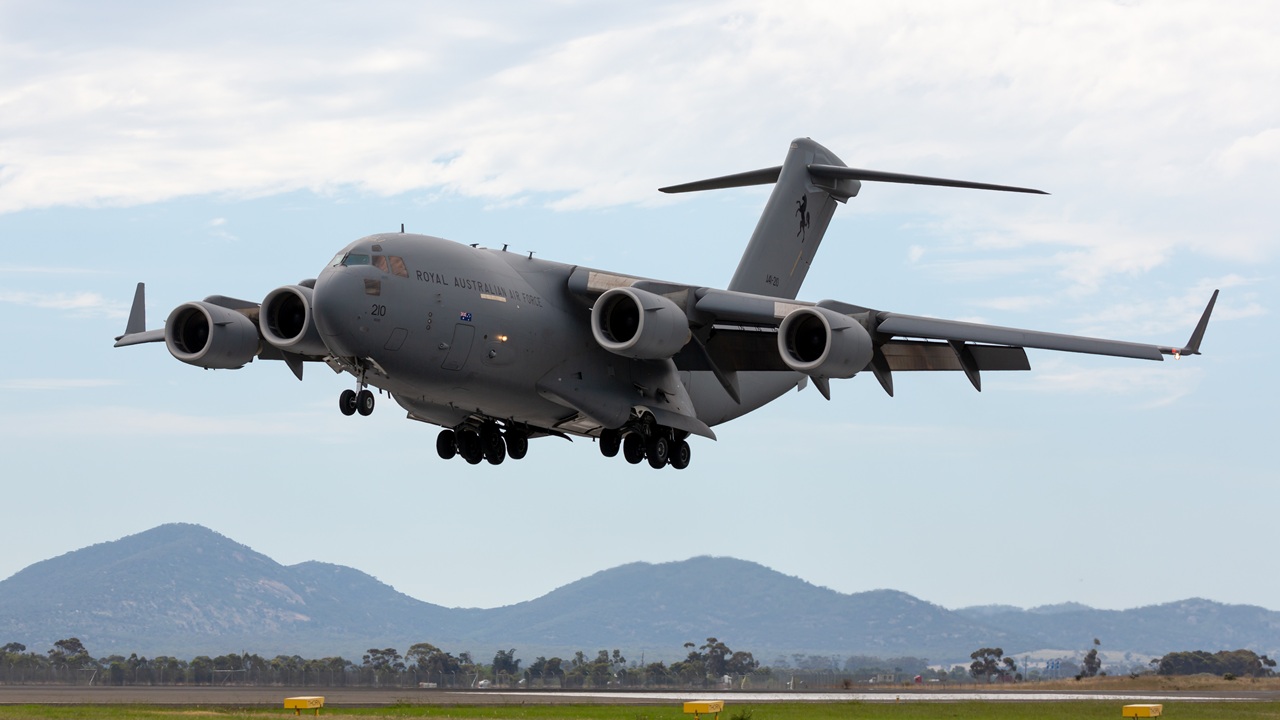
The RAAF also fields a variety of support aircraft—notably the E-7A Wedgetail, one of the world’s most advanced AEW&C platforms—providing superior radar, long endurance, and excellent C2 capabilities. The KC-30A, based on the A-330, is a tanker aircraft that allows the RAAF to extend fighter reach, which is absolutely vital when operating across a region as expansive as the Indo-Pacific. Similarly, the RAAF operates the C-17 Globemaster III (for strategic airlift) and the C-130J (for tactical airlift).
And like all modern air forces, the RAAF is beginning to integrate unmanned systems. The MQ-4C Triton, derived from the famed Global Hawk system, is a high-altitude maritime ISR system, ideal for gathering ISR in the Indo-Pacific.
Australia Is an Ideal Pacific Partner for the United States
The US has invested heavily in the RAAF as a key pillar of Western air power in the Indo-Pacific; Australia’s mix of stealth fighters, legacy fighters, electronic attack, and maritime surveillance forms a joint deterrent architecture against China. The RAAF’s combination of the F-35A, Growler, and Wedgetail form arguably the most advanced integrated air package in the region outside of the US.
Still, challenges remain. Australia is remarkably isolated. It is far from likely conflict zones like Taiwan or the South China Sea, which will require robust support networks (tankers and logistics). China’s impressive A2/AD network will make airspace access difficult without heavy investment in stealth, electronic warfare, and long-range munitions. Accordingly, to stay relevant, to help bolster the Western coalition in the Indo-Pacific, the RAAF will need to expand its industrial capacity (which is still relatively humble) and accelerate the pace of modernization.
About the Author: Harrison Kass
Harrison Kass is a senior defense and national security writer at The National Interest. Kass is an attorney and former political candidate who joined the US Air Force as a pilot trainee before being medically discharged. He focuses on military strategy, aerospace, and global security affairs. He holds a JD from the University of Oregon and a master’s in Global Journalism and International Relations from NYU.
Image: Shutterstock / Ryan Fletcher.