
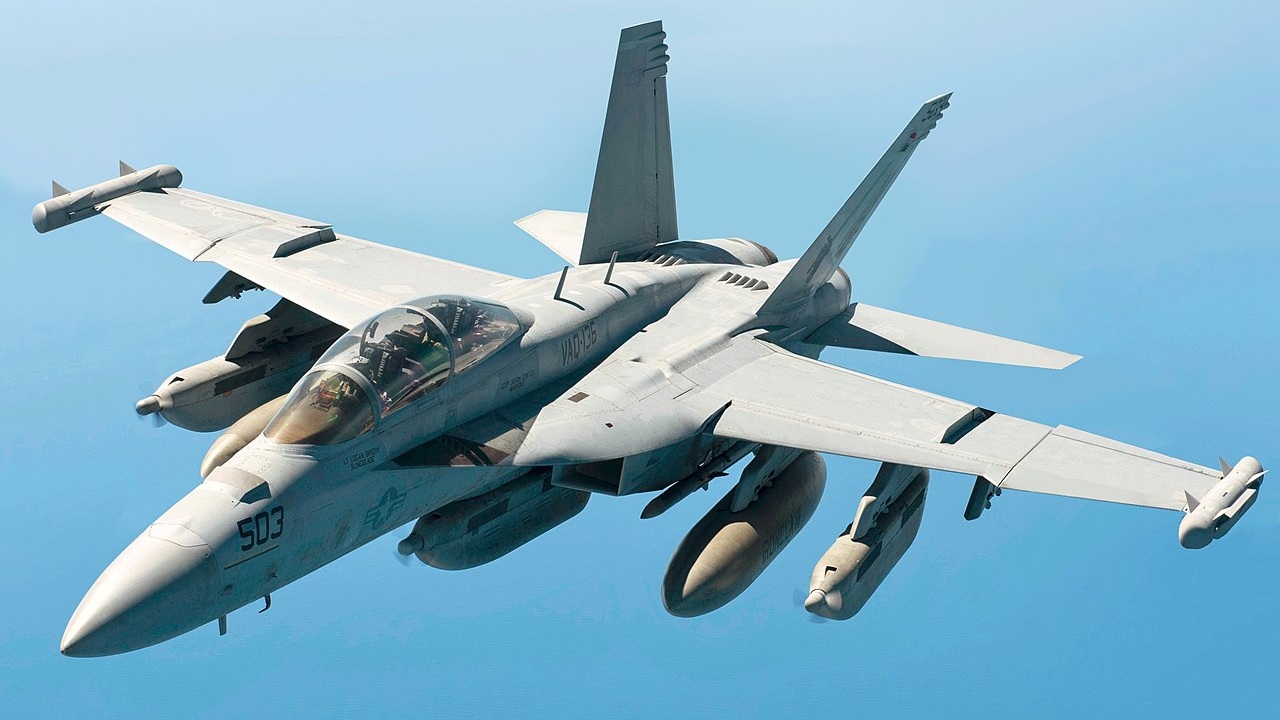
Jamming pods are designed to mimic and confuse enemy radar, helping a fighter jet to enter and escape contested airspace undetected.
Airborne jamming pods are one of the least visible, yet most important, components of modern air power. Functioning both as an electronic shield and a spear, the jamming pod allows aircraft to survive and operate inside defense airspace. Mounted externally on fighters, strike aircraft, and dedicated electronic warfare platforms, jamming pods hold receivers, processors, and high-power transmitters that can manipulate the electromagnetic spectrum, the domain within which radars, missiles, and communications operate. And although the science behind jamming pods is highly complex, the pod’s basic function is simple: it listens for enemy signals, analyzes them in real time, and emits tailored response signals to confuse, overload, or blind the enemy system.
What Jamming Pods Actually Do
In essence, jamming pods work by attacking the connection between an enemy sensor and its target. For example, radars depend on reflected energy to track an aircraft. A jamming pod can disrupt that process by flooding the radar with noise—injecting false signals, altering timing, or deceiving the radar into tracking a “ghost” location. The result is simple confusion; amid the noise and contradictory information, the radar cannot determine where the aircraft actually is. In practice, that means a jamming pod can prevent a surface-to-air missile from locking onto a target, saving lives and allowing for the penetration of fortified airspace.
The tactical advantages to such technology are obvious. Using jamming pods, strike packages are able to penetrate heavily defended airspace, stymying efforts by enemy sensors to pin them down. Jamming pods extend the survivability of fighters and bombers, buying time for them to deliver their weapons and exit the battle space.
Jamming pods can also serve as force multipliers. A single electronic attack aircraft equipped with powerful pods, such as the US Navy’s EA-18G Growler, can protect an entire formation of strike aircraft. And jamming pods can also provide critical support for suppression of enemy air defense (SEAD) missions—enabling aircraft armed with anti-radiation missiles to locate, target, and destroy hostile radars without being targeted in return.
All Major Air Forces Are Working on Better Jamming Pods
From a strategic perspective, jamming pods are vital, allowing air forces to operate against adversaries who field dense layers of radars and missile systems, such as Russia, China, and Iran. Jamming pods essentially open up a window of opportunity—a gap where air defense systems are degraded or blinded, making it possible for air campaigns to proceed without unacceptable losses.
In the future, jamming pods will continue to be central to wartime operations. In a prospective Indo-Pacific conflict, jamming pods on US aircraft would be vital to disrupting China’s sophisticated A2/AD network. Accordingly, jamming pods are being updated for future conflicts. Traditional analog systems like the ALQ-99 are being replaced with digital, software-first pods that use electronically steered beams, faster processors, and broader frequency coverage. These new systems can adapt to real-world situations in milliseconds, shifting from radar jamming to communications disruption to electronic deception instantly.
Of course, America’s adversaries are adapting, too. Countries like China and Russia are developing radars that hop frequencies rapidly, use multiple geographically dispersed transmitters, or rely on infrared or passive sensors that are harder to jam. Even so, the strategic role of airborne jamming is only expected to increase in the coming decades. Future air combat will be decided as much by software as by airframes—and jamming pods will house some of the most valuable combat software in the battlespace.
About the Author: Harrison Kass
Harrison Kass is a senior defense and national security writer at The National Interest. Kass is an attorney and former political candidate who joined the US Air Force as a pilot trainee before being medically discharged. He focuses on military strategy, aerospace, and global security affairs. He holds a JD from the University of Oregon and a master’s in Global Journalism and International Relations from NYU.
Image: Wikimedia Commons.















.jpg)