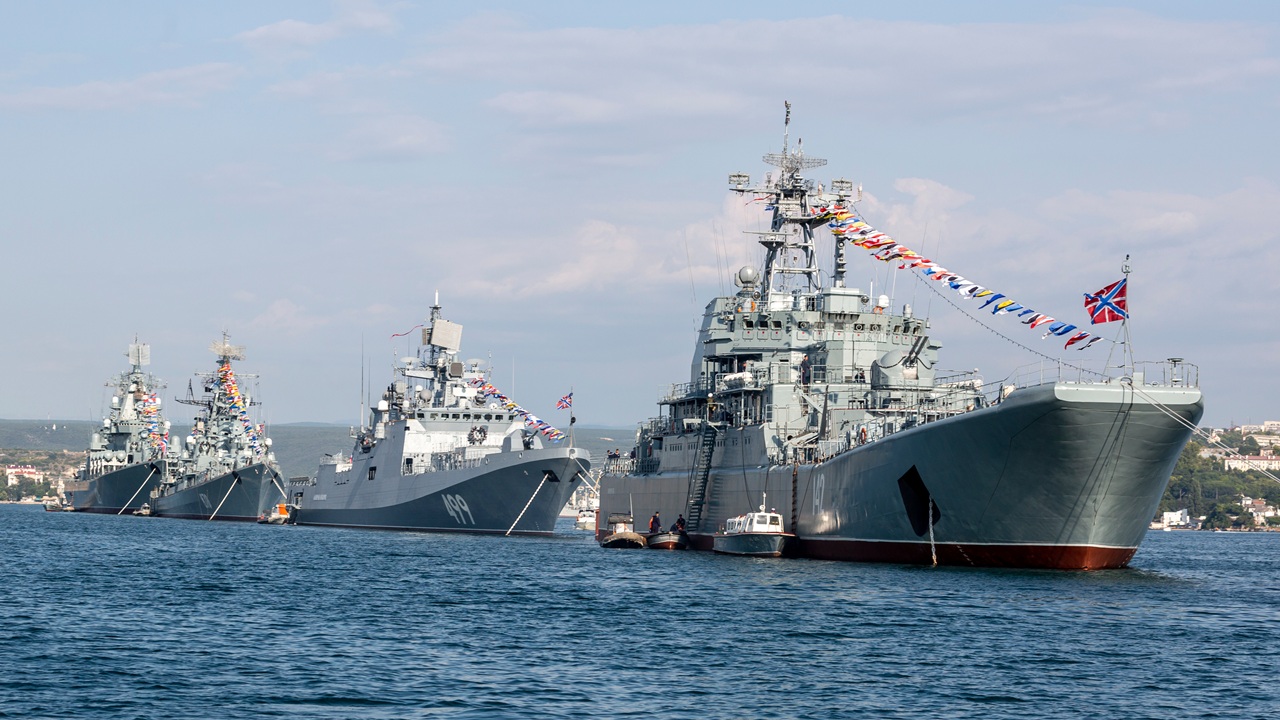
The Russian Navy has had difficulty naming its ships for famous Russian admirals—in large part because there have been so few of them deserving of the honor.
During the Soviet era, the Kremlin adopted a naming convention for its warships that honored Soviet heroes, cities, and even key moments in the revolution. That included battleships named for Soviet themes, cruisers named for revolutionaries, and destroyers named for cities. The naming convention was part of a deliberate, calculated ideological shift from the Tsarist era, when the Imperial Russian Navy’s warships were named for past Tsars, generals, and even saints.
In today’s Putin-led Russian Federation, which has an ambivalent and somewhat contradictory attitude towards the Soviet era, the Kremlin has sought a balance—naming its vessels after historic Russian figures, both from the days of Imperial Russia and the Soviet Union. The Russian Navy’s submarines have been named after historical figures, including Alexander Nevsky and Count Alexander Vasilyevich Suvorov-Rymniksky.
However, the Russian Navy is unique in that it has named more than a dozen warships after admirals—many of whom could only be described as having less-than-stellar careers—while others are individuals that even their crews likely had never heard of.
Russia Is Not Exactly a Nautical Nation
Throughout modern history, many nations have named their warships after flag officers, highlighting past naval glories. Russia’s problem is that it has had extremely few of these.
Whereas the UK’s Royal Navy has innumerable victories at sea, and the United States Navy could claim success in several battles before its stellar performance in World War II, Russia’s naval triumphs have been few and far between. Three of its most significant victories—the Battle of Chesma, the Battle of Tendra Cape, and most notably, the Battle of Sinop—were against the Ottoman Empire, a power in rapid decline.
Still, Russia has tried to rewrite the narrative, suggesting it has a rich naval heritage. In 2009, then-president Dmitry Medvedev made a bold acknowledgement: “Without a proper navy, Russia does not have a future as a state.” Yet Medvedev may have forgotten that, until the Soviet era, Russia was generally a second-rate naval power. Even during the Cold War, when the Soviet Union had massively expanded its navy, it still arguably wasn’t a naval power.
Despite all of those facts, Russia continues to name its warships for its past admirals.
Among the most infamous ships named for such a high-ranking officer was the former flagship aircraft carrier. Originally laid down as Riga, launched as the Leonid Brezhnev, and then renamed Tbilisi, the aircraft cruiser was finally renamed Admiral of the Fleet of the Soviet Union Nikolay Gerasimovich Kuznetsov, or Admiral Kuznetsov for short. The story of the notoriously trouble-prone carrier is legendary—and the same could arguably be said of Kuznetsov himself, who was twice removed from command but still received the Marshal’s star by the time his career ended.
A similar story of promotion and demotion occurred with Nikolai Mikhailovich Kulakov, an officer who likely wouldn’t have been promoted past captain had he served in the Royal Navy or United States Navy. Yet, he was honored by a Udaloy-class destroyer named in his honor.
Russia Has Only a Handful of Naval Heroes
Western history is replete with naval heroes, including the likes of the Royal Navy’s Horatio Nelson, Edward Hawke, and Roger Keyes, or the US Navy’s John Paul Jones, David Farragut, Matthew C. Perry, George Dewey, Chester Nimitz, Ernest King, and William “Bull” Halsey. The Russians have few such figures that are remembered fondly. In Russia, a few men have been shown as exceptions to the rule that Russia has, at best, average sailors.
Among those that could be described as truly worthy of having a warship named for them would be Fyodor Ushakov, who won every engagement he participated in as the admiral of the Russian fleet during the French Revolutionary and Napoleonic Wars, notably the Battle of Tendra Cape, and who is considered Russia’s greatest admiral; Pavel Nakhimov, the hero of the Battle of Sinop during the early stages of the Crimean War; and Sergey Georgyevich Gorshkov, who served with distinction in World War II and then oversaw the expansion of the Soviet Navy during the early Cold War.
Ivan Grigorovich, who led the Imperial Russian Navy’s massive rearmament program before and during World War I, and Stepan Makarov, an inspiring figure until he was killed in action during the Russo-Japanese War in 1904, are also examples of men who might merit having a ship named in their honor.
Still others, like Vladimir Tributs, Nikolai Vinogradov, Gordey Levchenko, Andrei Chabanenko, Vladimir Lvovich Kasatonov, and Yuri Panteleyev, were seemingly competent naval officers—though none is likely even to make the list of the world’s best admirals. Yet, given that Russia doesn’t have a fleet numbering in the hundreds of warships, it almost seems that Kremlin officials simply want to have warships with the word “Admiral” in their names, and thus these men fit the bill.
Russia’s Greatest Admirals Were Famous for Exploration, Not Warfare
What is also noteworthy about Russia’s modern naming practices is that a few men have never had a warship named after them. That includes Mikhail Lazarev, who led expeditions in the Pacific and Antarctic oceans and commanded the Black Sea Fleet, and Grigory Spiridov, who led the Imperial Navy to victory in the Russo-Turkish War of 1768-1774.
Then there is the controversial career of Alexander Kolchak, widely considered a highly effective and brave naval officer. Kolchak was also a renowned Arctic explorer and oceanographer, served with distinction at the Siege of Port Arthur during the Russo-Japanese War, and was a capable leader during World War I.
However, in the interwar era, Kolchak also served as the “Supreme Ruler” of the anti-Bolshevik White movement in Siberia, making him a somewhat divisive figure in modern Russian history. He was described as a villain during the Soviet era, and attempts to rehabilitate his reputation, including through legal challenges with the Supreme Court of the Russian Federation, have failed to gain traction.
At one point, the Russian Navy considered naming an Admiral Grigorovich-class frigate after Kolchak, but the proposal was eventually shelved. There were fears that Russia’s sailors might recall the mutinies of the pre-revolutionary period and refuse to serve on a ship named for the onetime Supreme Leader.
As such, there will likely be a US Navy vessel named for Admiral Husband Kimmel—who oversaw the catastrophe at Pearl Harbor—before a Russian warship is ever named for Kolchak.
About the Author: Peter Suciu
Peter Suciu has contributed over 3,200 published pieces to more than four dozen magazines and websites over a 30-year career in journalism. He regularly writes about military hardware, firearms history, cybersecurity, politics, and international affairs. Peter is also a contributing writer for Forbes and Clearance Jobs. He is based in Michigan. You can follow him on Twitter: @PeterSuciu. You can email the author: [email protected].
Image: Shutterstock / Vectorkel.