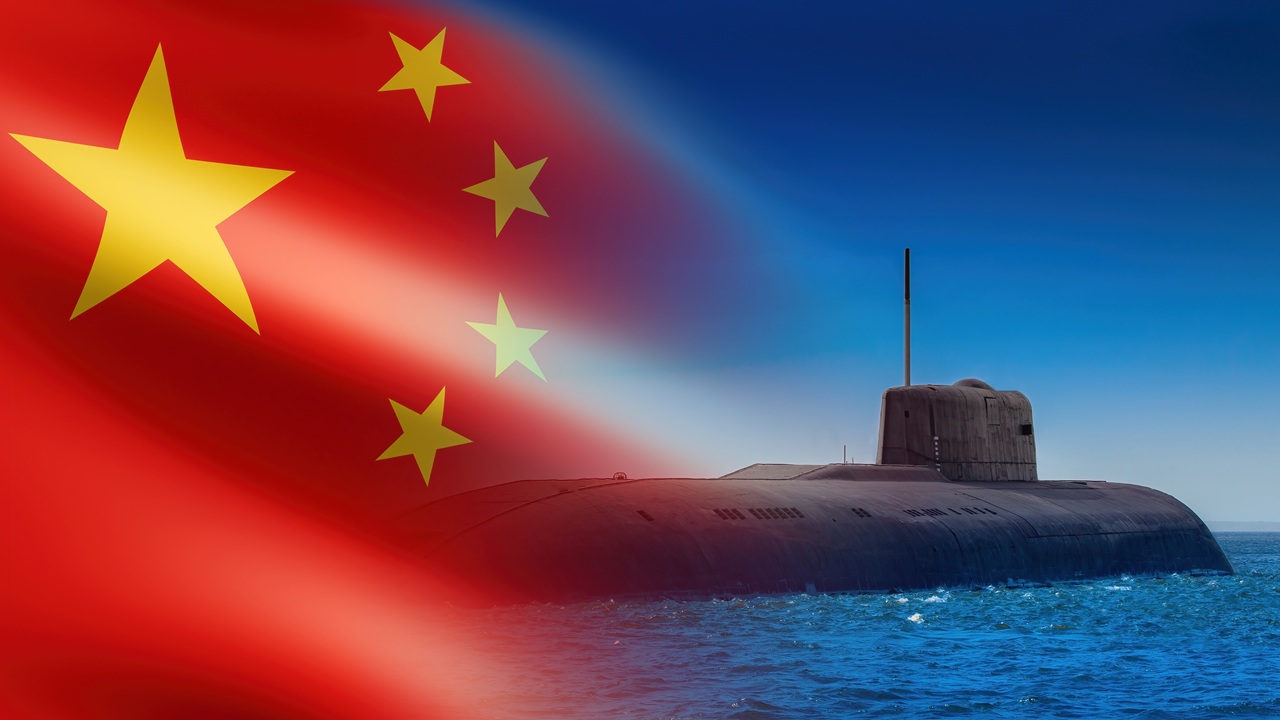
Since the end of the Cold War, China has built up a top-notch submarine force—posing a significant threat to the US Navy’s operations in the Indo-Pacific.
China is currently undertaking one of the most ambitious naval expansions in military history. The transformation has been rapid and deeply consequential—and envelopes not just surface vessels but undersea vessels.
Historically, the Chinese submarine fleet was coastal, noisy, and outdated. Today, however, that fleet has been updated into a large and increasingly sophisticated undersea force—potentially capable of threatening US carrier strike groups, regional surface fleets, and even projecting nuclear deterrence into the Pacific. The People’s Liberation Army Navy (PLAN) now fields a mix of diesel-electric attack submarines (SSKs), nuclear-powered attack submarines (SSNs), and ballistic missile submarines (SSBNs), creating an important facet of China’s Anti-Access/Area-Denial (A2/AD) strategy.
China’s Fearsome Submarine Inventory
The PLAN’s current submarine inventory starts with its nuclear-armed submarines—the SSBNs. The Type 094 Jin-class was China’s first credible-sea-based nuclear deterrent, rounding out the nuclear triad with a complement of two Jl-2 submarine-launched ballistic missiles (SLBMs) with a range exceeding 7,000 kilometers (4,350 mi). The Type 096 SSBN is under development and is expected to represent a major leap in quieting and survivability, while carrying the upgraded JL-3 SLBM, offering intercontinental range.
The Type 093 Shang-class represents the PLAN’s SSN capability—nuclear-powered submarines that are not equipped with nuclear weapons. Quieter and more capable than earlier Chinese SSNs, the Type 093 give China a reliable strike option. The Type 095 is under development and is expected to rival the American Virginia-class, with improved sensors and stealth relative to the Type 093.
The diesel-electric SSK submarine is the most readily available type in the PLAN inventory. The Type 039 Yuan class, of which the PLAN has roughly 20, features air-independent propulsion and is optimized for littoral ambush. The Type 035 Ming-class is outdated, but still available. And China’s Russian-made Kilo-class submarines carry the Kalibr anti-ship and land-attack missiles.
How China’s Submarine Force Got So Strong
For decades, noisy diesel boats constituted the majority of the Chinese undersea fleet, which allowed only for limited blue-water operations. But starting in the 1990s—particularly after the import of the Russian Kilo class and China’s attempts to reverse-engineer it—the Chinese began investing heavily in indigenous designs, quieter tech, advanced sonar, anti-ship missile integration, nuclear propulsion, and undersea basing infrastructure. The investment has been manifesting slowly.
By the 2010s, China began shifting from quantity to quality in its sub force, prioritizing quietness, sensors, and weapons over the mass production of obsolete designs. The results placed the PLAN on a clear trajectory from coastal defenders to regional sea denial to an emerging global undersea capability.
Now, China’s emerging submarine capabilities are reshaping the undersea balance in the Indo-Pacific. Newer boats equipped with advanced anti-ship cruise missiles like the YJ-18 give the PLAN a true standoff strike capability, enabling submarines to threaten US carrier strike groups without ever exposing themselves to surface sensors.
Strategically, the PLAN’s submarine improvements represent real challenges for the United States. Quiet Chinese diesel boats could threaten US amphibious forces in contested littoral waters, while advanced SSNs extend the risk envelope around carriers and surface vessels. And the forthcoming Type 096 SSBN, outfitted with the JL-3 SLBM, deepens China’s second-strike capability, enabling further deterrence. Combined, these new capabilities transform the PLAN’s submarine arm from a coastal force into a centerpiece of A2/AD strategy, complicating US operations in the region significantly.
About the Author: Harrison Kass
Harrison Kass is a senior defense and national security writer at The National Interest. Kass is an attorney and former political candidate who joined the US Air Force as a pilot trainee before being medically discharged. He focuses on military strategy, aerospace, and global security affairs. He holds a JD from the University of Oregon and a master’s in Global Journalism and International Relations from NYU.
Image: Shutterstock / FOTOGRIN.