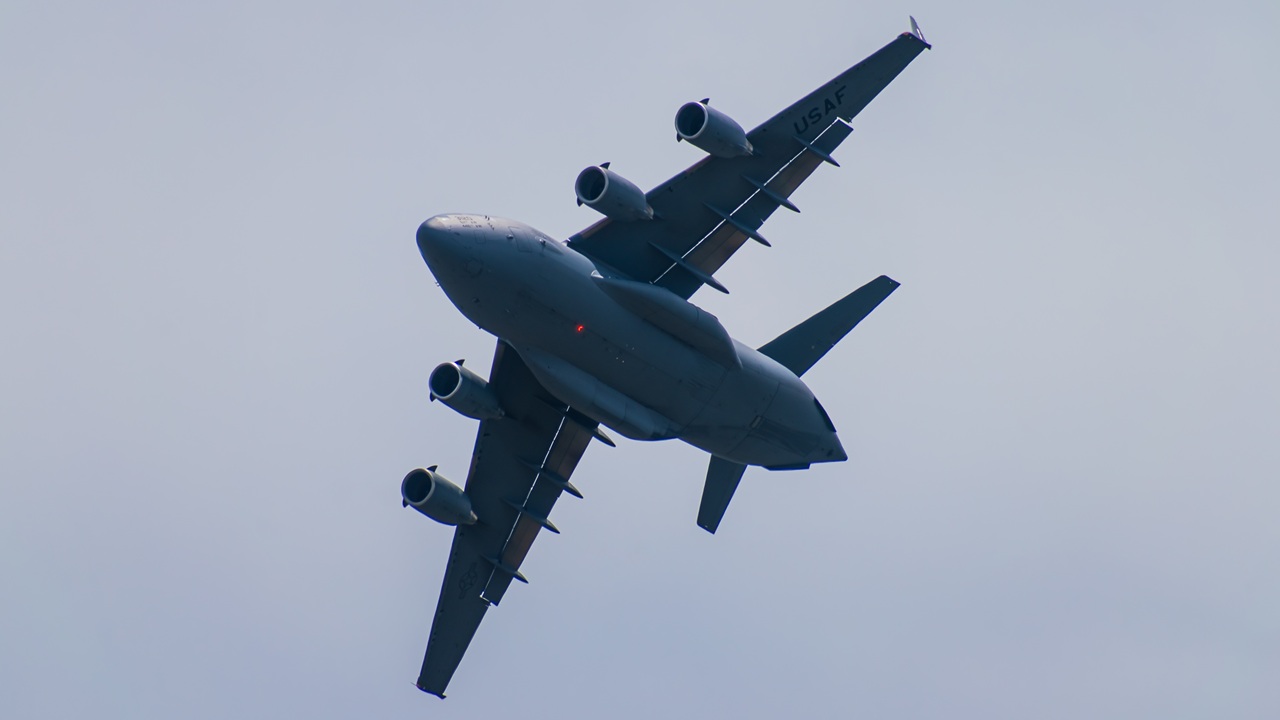
An Air Force general speculated that the C-17 Globemaster III would remain in service until 2075, even after its NGAL successor platform comes online.
The United States Air Force today operates a fleet of 222 Boeing C-17 Globemaster III heavy lift aircraft—with 157 in active service, 47 serving with the Air National Guard, and 18 more operated by the Air Force Reserve. In addition, the C-17 is operated by multiple US military partners as the “Virtual Fleet,” which supports operations worldwide.
In 2021, the C-17 Globemaster III reached a combined total of 4 million flight hours. That number is certain to double, and perhaps even triple, by the time the aircraft is retired.
The C-17 Globemaster III’s Specifications
- Year Introduced: 1995
- Number Built: 279 (total; US operates 222)
- Length: 174 ft (53 m)
- Wingspan: 170 ft (51.8 m)
- Weight: 585,000 lb (265,350 kg)
- Engines: Four Pratt & Whitney F117-PW-100 turbofans (~40,440 lbf thrust each)
- Top Speed: ~450 knots (520 mph, 837 km/h)
- Range: 2,420 nmi (2,780 mi, 4,482 km)
- Service Ceiling: ~45,000 ft (13,700 m)
- Loadout: 170,900 lb (77,500 kg) max payload; can carry M1 Abrams tank, armored vehicles, helicopters, or 102 paratroopers
- Aircrew: 3
The C-17 Globemaster III Has a Long History
Boeing delivered its final C-17 Globemaster III nearly a decade ago. In addition to the United States Air Force, which operates the Globemaster III from 12 different bases around the world, the C-17 is in service with the Royal Air Force (RAF), the Royal Australian Air Force, the Royal Canadian Air Force, the Indian Air Force, the Qatar Emiri Air Force, the United Arab Emirates Air Force, the Kuwait Air Force, and the NATO Strategic Airlift Capability. The latter aircraft are based in Pápa, Hungary, and 12 participating NATO members manage all three.
The aircraft, which made its maiden flight in September 1991, has a maximum payload of 100,000 pounds and a range of more than 4,500 nautical miles. It can also operate from unimproved runways as short as 3,500 feet and just 90 feet wide—and carry an M1 Abrams main battle tank (MBT) in the process. Competing aircraft, including the Airbus A400M, Embraer C-390 Millennium, and Kawasaki C-2, cannot perform that task.
The demand for the aircraft led to speculation that Boeing would resume production, but the aerospace firm has not indicated it would (or even could) move forward with such a plan. The biggest issue is that the company’s manufacturing facilities in Long Beach, California, have been put up for sale, effectively ending its production of military aircraft in the Golden State.
The Globemaster’s “NGAL” Successor Won’t Replace It
Although the US Air Force has unveiled plans to replace both the Lockheed C-5 Galaxy and C-17 cargo aircraft by 2038—with a new fleet of heavy lifters now under development as part of the Next-Generation Air Lifter (NGAL)—the Globemaster III will likely keep flying even after the NGAL is introduced, perhaps for as many as 50 years more.
Brigadier General David A. Fazenbaker, director of strategy, plans, requirements, and programs for the Air Mobility Command (AMC), told reporters this month that “current projections indicate that the C-5 and C-17 will be kept in service until 2045 and 2075, respectively.”
Current plans call for the NGAL to reach initial operational capability (IOC) around 2041. Still, just 7.4 aircraft will be delivered annually, a conservative pace that can enable a transition from the C-5 to the NGAL. That will allow the aging fleets to be replaced on a one-for-one basis, with the Air Mobility Command (AMC) eventually obtaining 274 new large cargo jets.
“With an accelerated NGAL Analysis of Alternatives (AoA) in FY27 [Fiscal Year 2027] and an uninterrupted acquisition process with consistent funding, the first NGAL aircraft could be produced as early as FY38,” an Airlift Recapitalization Strategy document, dated November 18, 2025, explained.
There are currently 52 C-5M Galaxy aircraft in service, all of which entered service in the 1980s as the older C-5B and C-5C models and have since been upgraded.
Can the Air Force Really Keep the C-17 Flying Until 2075?
Given the slow adoption of NGAL, the C-17 will likely need to undergo a service life extension program (SLEP), but it remains unclear what that will entail. The Globemaster fleet has already received updates to its Heads-Up Display (HUD) systems after the original supplier, GEC Avionics, was acquired by BAE Systems, which said it couldn’t repair broken units due to a lack of components from suppliers.
As Simple Flying reported earlier this year, the C-17s are now “equipped with modernized Heads-Up Display systems supplied by the Israeli contractor, Elbit Systems.” The new HUD offers high-resolution displays, lower power consumption, and enhanced video capabilities. The same system is used in the C-130 Hercules, as well as the Airbus C295 and Embraer C-390 Millennium cargo aircraft.
Other updates have included an Identification, Friend or Foe (IFF) upgrade and an improved JetWave Ka-band fuselage-mounted antenna, which can provide real-time weather reports and video conferencing from the aircraft.
RTX subsidiary Pratt & Whitney was also awarded a contract modification in July for F117 engine sustainment for the Globemaster III.
“The sustainment work will be provided between now and the second half of 2027 and will be conducted at Tinker Air Force Base in Oklahoma as well as facilities in San Francisco and Columbus, Georgia,” the aircraft engine maker announced.
The engine update will improve the F117’s fuel efficiency, reducing fuel consumption by up to 6.5 million gallons annually and CO2 emissions by up to 140 million pounds.
Other systems will need to be updated as part of an SLEP, but this has been seen before with aircraft like the Boeing B-52 Stratofortress, which will likely hit the 100-year mark by the time it is retired. It serves as a reminder that it is often easier to keep old aircraft flying than to build new ones!
About the Author: Peter Suciu
Peter Suciu has contributed over 3,200 published pieces to more than four dozen magazines and websites over a 30-year career in journalism. He regularly writes about military hardware, firearms history, cybersecurity, politics, and international affairs. Peter is also a contributing writer for Forbes and Clearance Jobs. He is based in Michigan. You can follow him on Twitter: @PeterSuciu. You can email the author: [email protected].
Image: Shutterstock / John Tetzlaff.