American Coach: The Triumph and Tragedy of Notre Dame Legend Frank Leahy, by Ivan Maisel (Grand Central Press, 288 pp., $21.99)
College football coverage today reflects the journalistic shifts of the last three decades. It’s fast and informal, with news of injuries, coaching changes, and recruiting commitments often breaking on social media rather than on the nightly news or in a morning edition. It has almost no barriers to entry. Newspaper beat reporters compete in local markets with team-focused podcasts produced by ordinary fans who may hope, in time, to monetize their content. And it often prizes sharp opinion over carefully sourced reporting and grammatical prose.
Finally, a reason to check your email.
Sign up for our free newsletter today.
Ivan Maisel, who began his career at the Atlanta Constitution in 1981, belongs to an older generation of sportswriters whose heroes include Red Smith and Jimmy Cannon, men of considerable cultural authority in their time. Maisel’s new book, American Coach, a biography of former Notre Dame football coach Frank Leahy (1908–1973), takes him deep into the archives of an analog America that is just now disappearing over the horizon. Maisel begins with the life of a driven man and gradually expands to a broader consideration of the forces that shaped him. Pullman dining cars, telegrams, universal military service—this is the world Leahy knew. It must have seemed terribly modern to those who lived in it.
Frank Leahy played football at Notre Dame in the 1920s as an undersized lineman, maintaining a grade-point average barely sufficient to keep him eligible. Somehow his legend was forming even then. As an undergraduate, he forged the pivotal relationship of his life with then-Notre Dame coach Knute Rockne. Their first meeting left an impression: “He was the kind of man,” Leahy later said, “who made you feel as if you’d known him for a long time.” Both men loved football and Notre Dame and perhaps did not draw sharp distinctions between the two. (Leahy was devoutly Catholic; Rockne was raised Lutheran but converted to Catholicism in 1925.) Rockne saw promise in Leahy and arranged his first opportunity in coaching. The pact between them was sealed with Rockne’s death a few years later in a plane crash. Leahy would be the one to restore Notre Dame to greatness on the field.
His intense drive for success and recognition began early, and its source is hard to pinpoint definitively. Leahy was born in Nebraska in 1908 and raised in the aptly named town of Winner, South Dakota. He was a big, athletic teenager, hardworking and serious-minded, but his father, a failed farmer and successful barnyard brawler of local legend, offered his son little encouragement. Rockne appeared fortuitously as a surrogate father. The spirit of the times, too, underwrote Leahy’s burgeoning ambition. The Depression and the Second World War hardened young men of his generation, and postwar expansion gave them their chance. Leahy was determined not to miss his.
Leahy was 32 when Notre Dame offered him his dream job as head coach. He would lead the team from 1941 to 1953, save for two years in which he served as a U.S. Navy officer in the Pacific. He recorded six undefeated seasons, won four national championships, and coached four Heisman Trophy winners. He appeared on the cover of Time in October 1946 above what was, for him, an unusually irreverent observation: “Prayers work better when the players are big.”
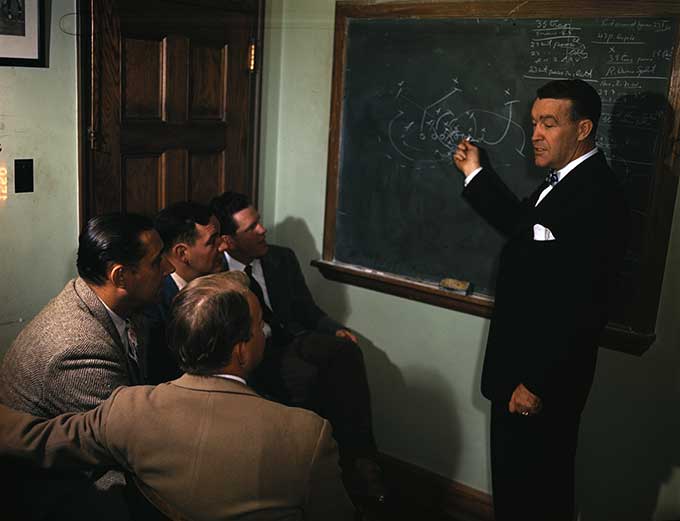
What made Leahy a great football coach? He was an offensive innovator, adapting the T-formation to feature the forward pass. He was an exceptional teacher of offensive- and defensive-line technique. Like his mentor, Rockne, he was a resourceful psychologist. If, in Maisel’s account, the motives of other human beings sometimes eluded Leahy, he could always communicate on the field, sometimes with praise, sometimes with bitter sarcasm. He consistently outworked his rivals, pushing his sturdy body to the point of exhaustion. He did not see why his teams should ever lose; his conviction was that if they did lose, it must be the result of his own failure or weakness.
The common understanding has been that Leahy, just 45, resigned from Notre Dame following the 1953 season for health reasons. He was indeed a sick man. He suffered from chronic pancreatitis and, in the euphemism of the time, “nervous exhaustion,” driven by overwork and his obsessive fear of losing. He collapsed at halftime of the 1953 Georgia Tech game and was given last rites. (This was almost certainly not a ploy to rally his struggling team.)
Maisel, however, makes a near-definitive case that Leahy was forced out by Notre Dame’s president, Father Theodore Hesburgh. Hesburgh wanted Notre Dame to be known first for academics rather than football and saw Leahy as an obstacle to this goal. Hesburgh was also affronted by Leahy’s national celebrity and might have wanted to cut him down to size. Hesburgh, who led Notre Dame until 1987, later expressed regret at his treatment of Leahy. When Leahy died in 1973, Hesburgh presided at the funeral Mass.
Even in Leahy’s era, college football was not a clean game. It is not clear whether Leahy paid players directly—Maisel suggests he might have—but no-show jobs and other such benefits were common. Whether the sport’s recent professionalization, which has made some players millionaires, is an improvement over the official hypocrisy of Leahy’s era is debatable. But the outcome Hesburgh feared—that the tail of college athletics would wag the dog of higher education—has now come to pass in ways he could scarcely have imagined. With capital projects and enrollment targets riding on football success, a university president with a losing team is unlikely to sleep well.
Despite his wholesome public image, a countercurrent of negative press ran through Leahy’s career. He left Boston College for Notre Dame immediately after signing a five-year contract extension, claiming a verbal agreement that he would be released from his contract if offered the Notre Dame job. Boston College’s president did not recall providing such assurances. Leahy’s teams were sometimes accused of unsportsmanlike play, and rival coaches complained about his recruiting tactics. (As Maisel notes, the NCAA did not create formal rules for recruiting until much later.) After he left Notre Dame, Leahy was publicly critical of the unsuccessful coaches who succeeded him, breaking one of the coaching fraternity’s unwritten rules.
These now seem like minor offenses, but they were enough to delay for a decade Leahy’s admission to the College Football Hall of Fame. Some of the resentment directed at him might have been inevitable, given the dominance of his teams. Some might have been rooted in anti-Catholic bias; Maisel notes that “Leahy succeeded . . . just as postwar anti-Catholicism surged.” In Maisel’s account, Leahy was essentially a decent and honorable man, something like the “Catholic gentleman” he aspired to be. But how desperate he was to succeed.
And while Leahy conceived of himself as a family man, his performance in that role was uneven. He rarely found occasion to go home. He worked constantly during the season, sleeping on a cot in the campus firehouse during the week, and spent much of the off-season on the road, attending banquets and coaching clinics. He had begun farm work at age six; childhood was almost a foreign country to him. Leahy’s son, Fred, recalls that his neighborhood friends stopped showing up at the Leahy house to play football because his father would come out to the yard to drill them.
Leahy’s wife, Floss, was an alcoholic for most of her adult years. With his absences and her incapacity, their children suffered. Several struggled with alcohol abuse as adults, and one served a year in prison after being caught sending hashish through the mail. Leahy was a strong man and, in his way, a loving one, but in domestic matters, he could not be the hero that he was on the sidelines. Two of his grandchildren later played football at Notre Dame, but Leahy did not live long enough to see them run out of the tunnel at Notre Dame Stadium, a moment he would have treasured.
Leahy lived for almost 20 years after he left Notre Dame. They were restless years, and how could they have been otherwise, given his tremendous energy and his confession that football was only thing aside from his family that he really cared about? He nearly returned to coaching in 1957, when Texas A&M sought a replacement for Bear Bryant, who had just left to coach Alabama. Leahy and A&M reached an agreement in principle, contingent on his passing a physical, but Leahy’s doctor told him that resuming his career would put his life at risk. At 49, he accepted that he would never coach again.
Despite compiling a coaching record of 107-13-9 at Boston College and Notre Dame, Leahy is little remembered today, even on the Notre Dame campus. Beyond South Bend, his name has almost no resonance. If Leahy matters to us now, it may be as a symbol of an era as much as for his record. Since Notre Dame in the 1940s and 1950s was a national brand in what was otherwise a regional sport, Leahy was effectively America’s coach in, as Maisel says, “a postwar nation craving a return to normalcy.” He was conscious of this role as both a privilege and a burden. His stiff and curiously formal public manner reflects his eagerness to set a high moral tone at a time when American Catholics were still struggling for mainstream acceptance. He stood for all the right things: patriotism, hard work, loyalty. Over time, perhaps, the boy from Winner, South Dakota slipped away behind this facade of received ideas. In the grainy old newsreels of Knute Rockne, dead now for nearly a century, a distinctive personality emerges. Leahy looked like a movie star—he bore a striking resemblance to the actor William Holden—but he doesn’t come through the screen with the same force.
Today’s sideline megalomaniacs make it easy to forget that coaching is essentially a generous pursuit, founded in the desire to help young people. Most college coaching stars have an origin story of grueling hours, bad pay, and unglamorous assignments as graduate assistants. Twenty years later, these same coaches may be more famous than the governors of their own states, but their love of the game and its folkways is what they return to for renewal. Leahy’s career, like those of Bear Bryant and Bo Schembechler, probably contributed something to our idea that a winning coach is also a repository of transcendent values. What Leahy longed to do, though, in a busy retirement of speaking engagements, gladhanding, and radio commentary, was to put his hand in the dirt once more and teach line technique to his “lads.” The fullback dive play was his Rosebud.
Leahy’s story ultimately is a sad one, not because his fame proved impermanent but because he struggled to enjoy what he had achieved. His American striving, his conviction that, as George S. Patton said, “the very idea of losing is hateful,” drove his success and ensured that it would never be enough. He remained an innocent, bound to simple faiths that even celebrity couldn’t sully. In this, at least, he retains our sympathy.
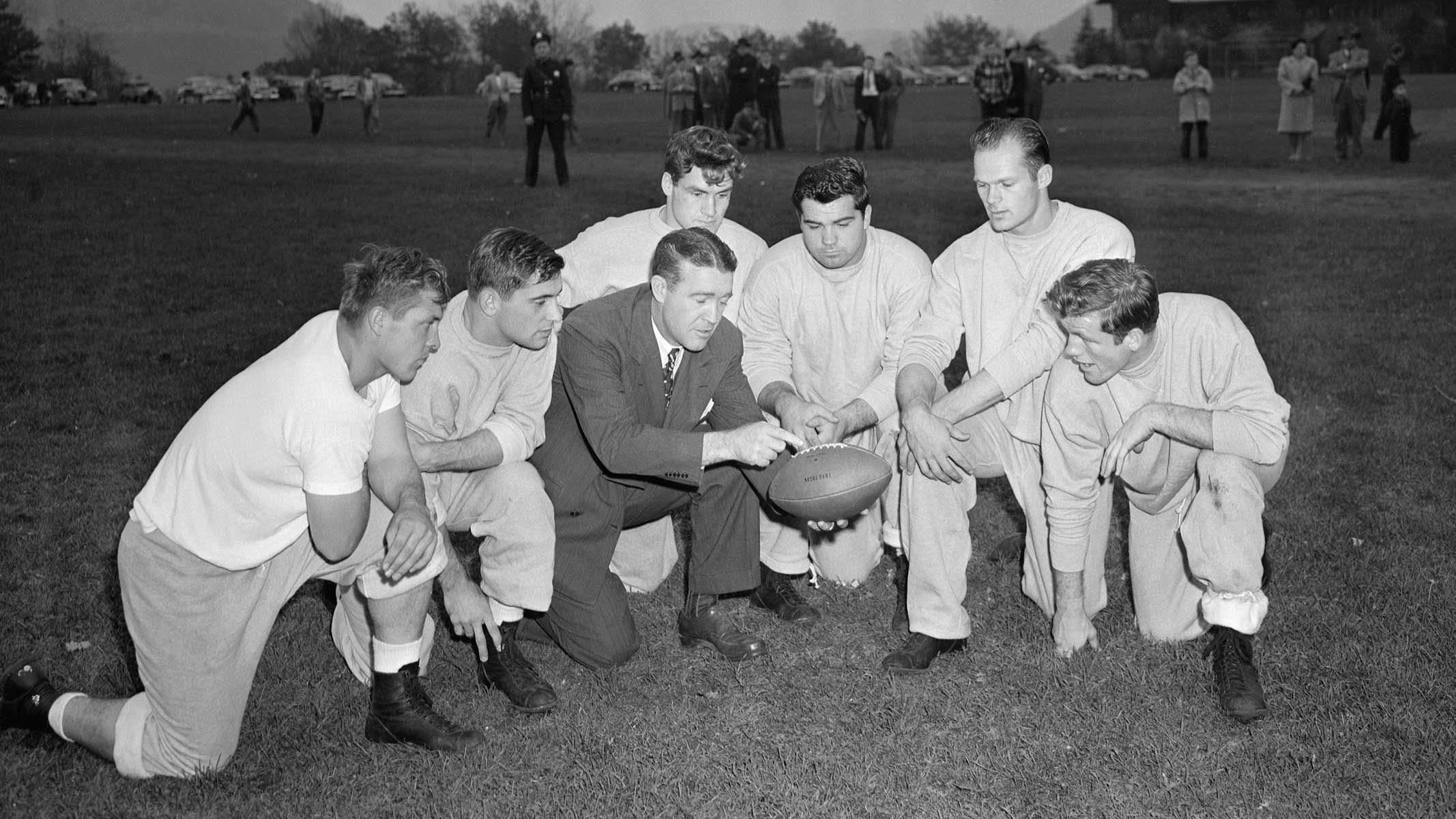
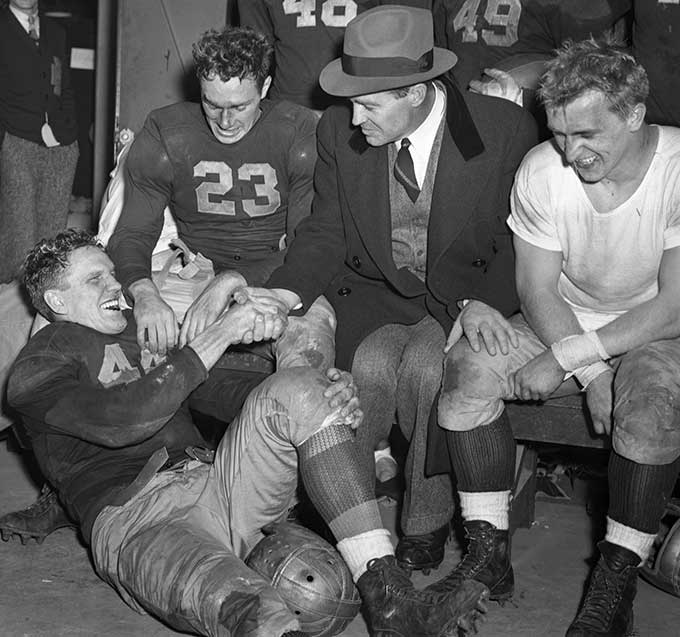
Top Photo: Frank Leahy in 1946 (Bettmann / Contributor / Bettmann via Getty Images)
Source link