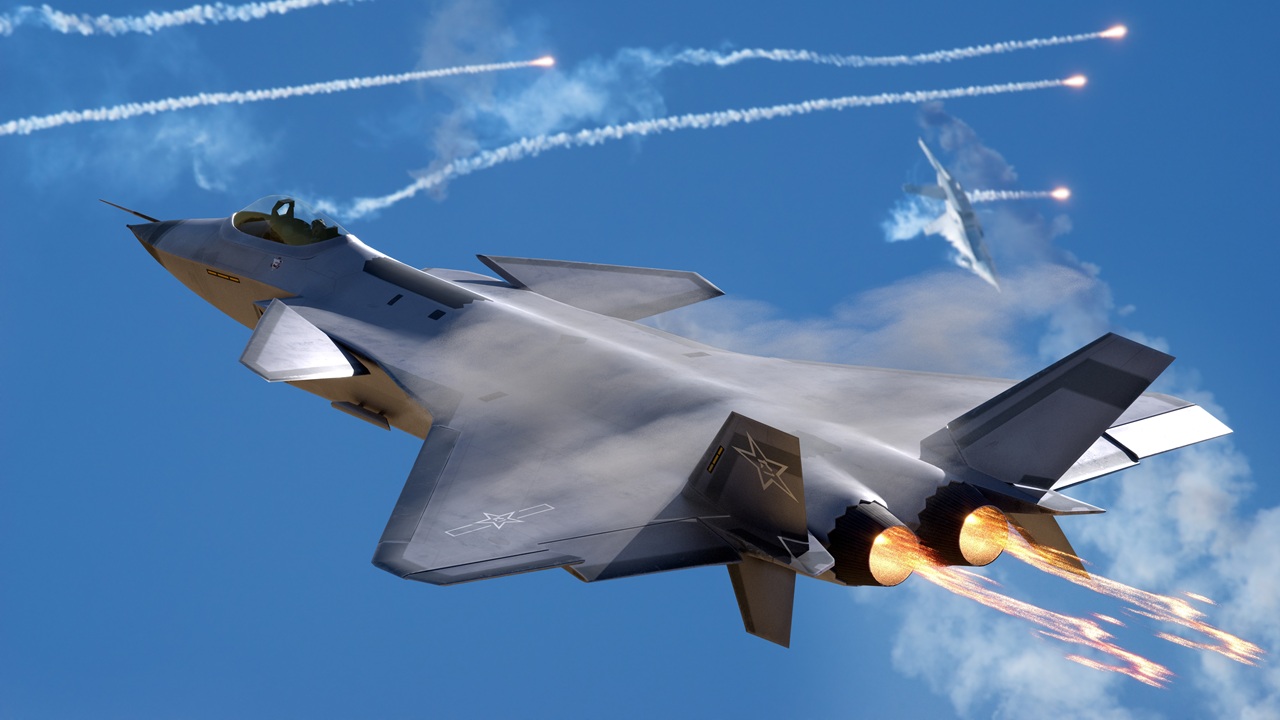
The J-20 fighter jet’s enormous range and endurance give it the ability to strike at targets far away from China’s coastline—perfect for keeping America on edge across the Indo-Pacific.
The Chengdu J-20 Mighty Dragon, while an effective warplane all on its own, does not operate in isolation. Instead, the fifth-generation fighter jet is a key node in China’s vast, layered, sensor-rich A2/AD (Anti-Access/Area Denial) defensive web—which also includes missiles, ships, satellites, radars, and cyber-electronic warfare systems, all working together to make US operation near Chinese territory and interests prohibitively dangerous.
Understanding the J-20 Mighty Dragon
- Year Introduced: 2017
- Number Built: ~200–250+ (rapid production ongoing)
- Length: ~69 ft (20.9 m)
- Wingspan: ~42–45 ft (≈13–14 m)
- Weight (MTOW): ~80,000 lb (36,000+ kg)
- Engines: Two WS-10C afterburning turbofans; likely upgrade to WS-15 in future
- Top Speed: ~1,320 mph (2,130 km/h) / Mach 2.0
- Range: ~1,200 mi (2,000 km)
- Service Ceiling: ~65,000 ft (20,000 m)
- Loadout: Internal weapons bays, external hardpoints; 24,000 lb (11,000 kg) payload capacity
- Aircrew: 1
Within the A2/AD network, the J-20 serves an important role: to threaten the enablers of US air power, i.e., AWACS, aerial refueling tankers, ISR platforms, maritime patrol aircraft, and EA-18G electronic warfare platforms. While these enabler platforms do not project power themselves, they are a vital component to the actual projection of power. And China recognizes that by denying these relatively vulnerable, non-stealth platforms, America’s power projection into the Indo-Pacific will falter.
The J-20 is outfitted with a large AESA radar, long-range PL-15 missiles (and in the future potentially PL-21 hypersonic missiles), which allow for long-range engagements with US aircraft, further shrinking the envelope within which these aircraft can operate safely.
The J-20 Has One Mission: Keep America Away from the Chinese Coast
Relatedly, the J-20 also serves to extend China’s A2/AD reach further into the Pacific; its large internal fuel stores and long combat radius allow for operations over the Taiwan Strait, across the South China Sea, deep into the Philippine Sea, and even out toward Guam. This impressive range results from a conscientious design choice—the intent not only to defend China’s coastline, but to apply pressure on US forces operating near the First Island Chain and to deter US aircraft from approaching within striking range of Chinese territories. In doing so, US aircraft are forced to operate from further away—which increases their reliance on tankers, slows sortie rates, reduces time on station, and exposes enabler aircraft such as tankers to interception.
The J-20 also acts as a stealth sensor node within the wider A2/AD network, thereby expanding the scope and sensitivity of the system. With onboard AESA radar and IRST, the J-20 can detect aircraft that might slip past other sensors in the network, thereby tightening the web and enhancing the denial effect.
And although the J-20 is kinetically humble relative to the US F-22 Raptor, and sensor/data humble relative to the US F-35 Lightning II, its integration within China’s A2/AD network gives it a degree of advantage. Basically, the J-20 does not operate alone; it enjoys the protection of layered missile systems, maritime strike assets, networked fighter coverage, and electronic warfare platforms.
The strategic implications of the J-20 platform are significant. It gives China the ability to contest air superiority of key flashpoints like Taiwan or the South China Sea; pushes US aircraft further out from Chinese territory and interests; threatens US enablement aircraft; and operates as the forward element of a larger kill chain. The simple takeaway is that the J-20’s presence shifts the Indo-Pacific region from one where the US formerly enjoyed routine dominance to one where the US must fight for access. That is the entire point of the A2/AD network, within which the J-20 operates as a vital component.
About the Author: Harrison Kass
Harrison Kass is a senior defense and national security writer at The National Interest. Kass is an attorney and former political candidate who joined the US Air Force as a pilot trainee before being medically discharged. He focuses on military strategy, aerospace, and global security affairs. He holds a JD from the University of Oregon and a master’s in Global Journalism and International Relations from NYU.
Image: Shutterstock / Mike Mareen.