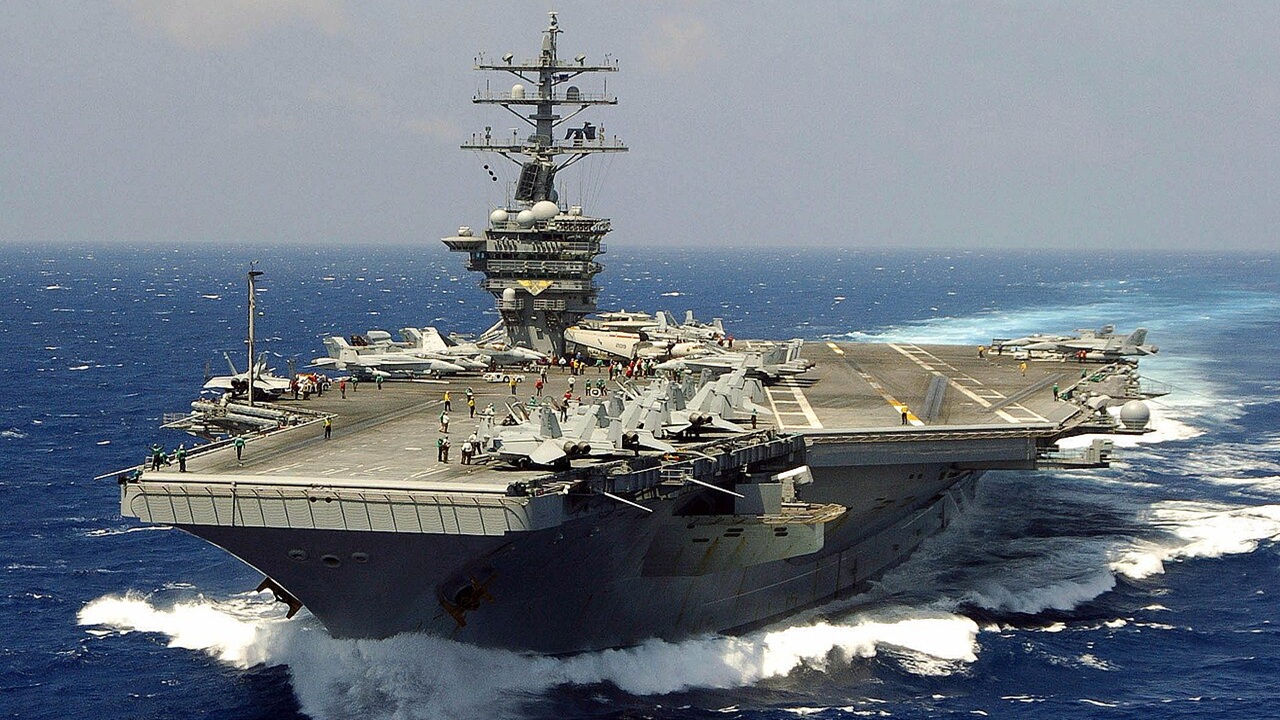
Most recent aircraft carriers have been named for US presidents—but this is not a hard and fast rule, and many other servicemembers and officials have also been honored.
Of the 10 United States Navy Nimitz-class nuclear-powered aircraft carriers, seven were named for former presidents of the United States. Three others were not. What explains the disparate naming?
The answer is, like the naming of most warships, a little complicated.
Since the arrival of the United States Navy’s aircraft carriers just over a century ago, most of the flattops weren’t named for people—or at least they weren’t after the first one.
The very first aircraft carrier, USS Langley (CV-1), began her service as the collier USS Jupiter (Navy Fleet Collier No. 3) before being converted to the Navy’s first platform for naval aviation at sea and the first turbo-electric-powered ship. That vessel was recommissioned in honor of Samuel Pierpont Langley, an early pioneer of aviation and a professor at the US Naval Academy.
There isn’t a reason the carrier was named after Langley, but he may have seemed like a good choice. The warship was still in service when the United States went to war, but USS Langley was scuttled after being damaged by Japanese bombers in February 1942.
US Navy Ships Are Often Named for Battles—or Earlier Warships
The first actual class of US Navy aircraft carriers, the Lexington-class—two converted battlecruisers—was named after early battles in American history: the Battle of Lexington and the Battle of Saratoga, respectively. Similar names were used, often from key battles in American history or from warships that served in early American conflicts, leading to names like Ranger, Enterprise, Wasp, and Hornet.
It wasn’t until the commissioning of the Essex-class aircraft carrier USS Franklin (CV-13) in January 1944 that the US Navy had another carrier named for a person, Founding Father Benjamin Franklin. There has been some confusion about the name, with some reports suggesting CV-13 was named for the Battle of Franklin, Tennessee, but that is not the case. (For the record, the Tennessee city near the battle site was also named for Ben Franklin.)
Franklin started a brief trend, as two other carriers were named for Founding Fathers, including USS Randolph (CV-15) for Peyton Randolph, president of the First Continental Congress; and USS Hancock (CV-19) for John Hancock, president of the Second Continental Congress.
It could be argued that Benjamin Franklin was honored twice, as the 14th Essex-class carrier was named the USS Bon Homme Richard (CV-31) in honor of Franklin’s Poor Richard’s Almanack, which was published in France while the Founding Father served as American Commissioner in Paris, under the title Les Maximes du Bonhomme Richard. That name had previously been used on the frigate commanded by Admiral John Paul Jones.
An Independence-class light carrier laid down during World War II was also named for Samuel Pierpont Langley, as was CV-1, a common practice during the conflict to name new warships for those lost earlier in the fighting. Still another Independence-class flattop, the USS Cabot (CVL-28), was named for explorer John Cabot and later sold to Spain, where she served as the first Spanish Navy aircraft carrier, the Dédalo, named for the mythological Greek craftsman Daedalus.
USS Wright (CVL-49), a Saipan-class light carrier and later command ship (CC-2), was named for both Wright brothers. It arrived too late to see service in WWII, but operated during the early stages of the Cold War.
Most Aircraft Carriers Are Named for Former Presidents
It wasn’t under the second of three Midway-class aircraft carriers, the USS Franklin D. Roosevelt (CV-42), that entered service in the late 1940s, that a flattop was named for a former president. It followed the Secretary of the Navy’s recommendation to President Harry S. Truman to name the carrier after the late president, just weeks after FDR’s death.
The christening of the Roosevelt didn’t exactly start a trend, however. More than 20 years passed until a second carrier named for a president, the USS John F. Kennedy (CV-67), was commissioned. The last conventionally powered aircraft carrier built for the United States Navy, she remained in service from September 1968 until March 2007. Efforts to preserve the warship as a museum ship failed, and she was sold for one penny and is now undergoing scrapping.
The switch to naming carriers for presidents is also a bit confusing and suggests it wasn’t really thought out.
The Nimitz-class and lead vessel, CVN-68, were named for Pacific fleet commander Chester W. Nimitz, and the US Navy’s third fleet admiral. The decision to name the next nuclear-powered carrier, the USS Dwight D. Eisenhower (CVN-69), was as much to honor the fact that Ike had been General of the Army, and thus of equal rank to Nimitz.
Clearly, there was no precedent for naming flattops after presidents, as CVN-70 was named for Congressman Carl Vinson—a worthy namesake in his own right, given his track record as a major supporter of the US Navy and his reputation as the father of the two-ocean naval force.
There had been some questions about why a former congressman received such an honor, and it was finally decided that the fourth Nimitz-class carrier would honor presidents, resulting in USS Theodore Roosevelt (CVN-71), followed by USS Abraham Lincoln (CVN-72) and USS George Washington (CVN-73).
For reasons that remain controversial, President Ronald Reagan authorized that CVN-74 would be named for Senator John C. Stennis of Mississippi. It was the result of a political favor, as Reagan was a popular Republican president who needed support from the Mississippi Democrat. Like Vinson, Stennis was a lifelong advocate for a strong military, and he served as the chairman of the Senate Armed Services Committee. He was also instrumental in the creation and funding of new naval assets, including aircraft carriers, and is sometimes known as the “Father of the Modern Navy”—even as some of his critics would label that claim a stretch.
The issue over the name was questioned at the time as Stennis was still living, and it received renewed criticism in recent years due to his past opposition to civil rights and his record of legislative support for racial segregation.
Given the current political climate, however, it is unlikely CVN-74 will see her name changed, despite ongoing calls to do so. There are other controversies with upcoming carrier names, a point to be discussed.
It should be added that three final Nimitz-class carriers were named for Presidents Harry S. Truman, CVN-75; Ronald Reagan, CVN-76; and George HW Bush, CVN-77. What is also noteworthy is that the final two were laid down while both men were still alive, and CVN-77 was even in service before President Bush passed away, breaking with longstanding traditions.
The late President Gerald R. Ford didn’t live to see the lead ship of the Gerald R. Ford-class of nuclear-powered supercarriers enter service, but the former president was told just months before his passing in 2006 that CVN-78 and the class of supercarriers would be named in his honor.
There won’t be a carrier named for Presidents Lyndon Johnson or Jimmy Carter, because other warships have been named in their honor—a Zumwalt-class stealth destroyer and a Seawolf-class nuclear-powered fast attack submarine, respectively.
The Next Carriers Have a Mix of Names
The second Ford-class carrier, named for President John F. Kennedy, is running behind schedule but is likely to enter service in 2027. She will be followed by the third carrier, the USS Enterprise, carrying on a longstanding naval tradition.
The next three flattops are already controversial, and that controversy isn’t likely to be resolved even once they enter service.
CVN-81 will be the USS Doris Miller, the first aircraft carrier named for both an enlisted sailor and an African-American. It will be the second ship named for Messman Second Class Doris Miller, who received the Navy Cross for his actions during the attack on Pearl Harbor on December 7, 1941. However, questions have been raised about why the carrier will be named for Miller, as he wasn’t an aviator and didn’t even serve on a carrier.
That brings us to the future USS William J. Clinton (CVN-82) and USS George W. Bush (CVN-83), which are on order but won’t be laid down until the end of the decade. Both ships’ names were announced in January by former President Joe Biden, just days before he left office.
Although President Donald Trump hasn’t indicated he would seek to have the names changed, speculation persists that he could do so, even though it is considered bad form to change a name after a ship’s keel is laid. Of course, this minor point isn’t likely to stop Trump, and his supporters would likely argue it has been done, usually to honor another ship or person.
Finally, to date, no US Navy aircraft carrier has been named for a woman—unlike the UK’sflagship carrier, which was named for Elizabeth II, its longest-serving monarch.
About the Author: Peter Suciu
Peter Suciu has contributed over 3,200 published pieces to more than four dozen magazines and websites over a 30-year career in journalism. He regularly writes about military hardware, firearms history, cybersecurity, politics, and international affairs. Peter is also a contributing writer for Forbes and Clearance Jobs. He is based in Michigan. You can follow him on Twitter: @PeterSuciu. You can email the author: [email protected].
Image: Wikimedia Commons.