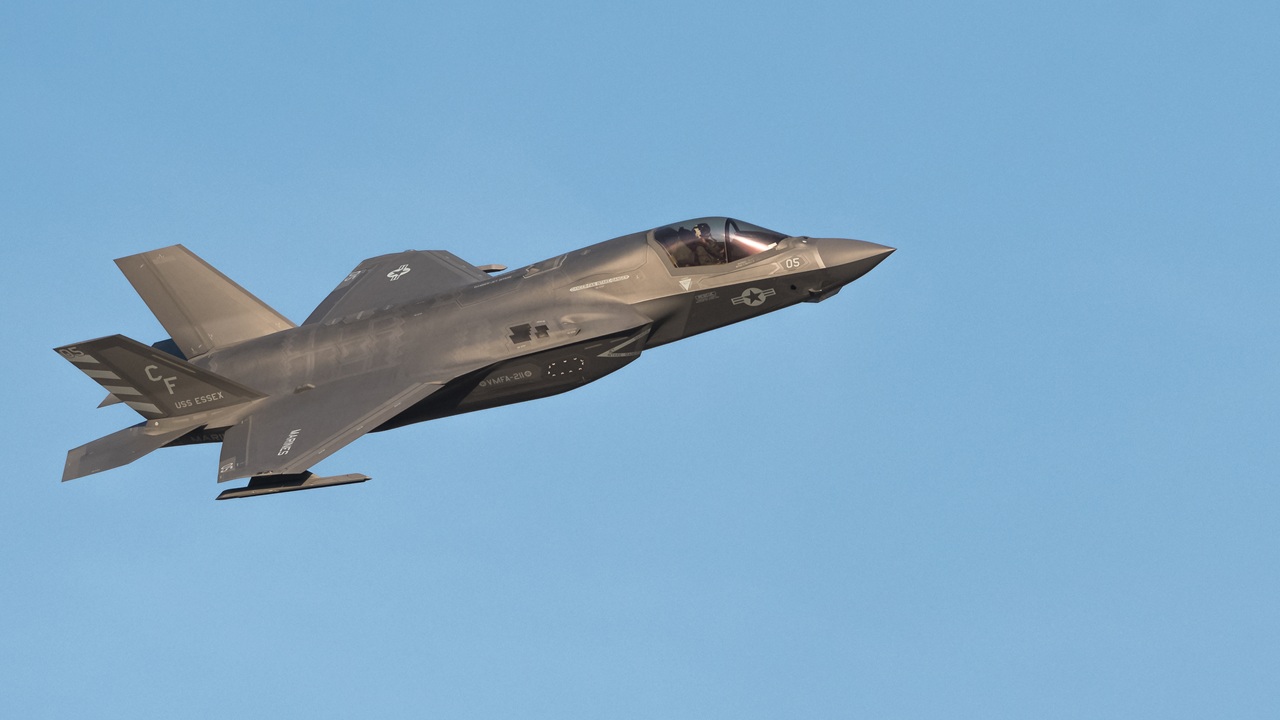
The F-35 has aerodynamic advantages over the J-20, and also outperforms it in stealth. But in any future battle between the two, the J-20 will almost certainly have home-field advantage.
The Chengdu J-20 Mighty Dragon and the Lockheed Martin F-35 Lightning II are often compared to one another. Each represents the most recently produced fifth-generation fighter of their respective countries; indeed, the two jets even bear a certain aesthetic resemblance. But the J-20 and F-35 are very distinct from one another, representing different philosophies in air power. The J-20, the larger, longer-range interceptor of the two, was designed to facilitate regional air denial—that is, to keep the United States out of the Indo-Pacific. The F-35, meanwhile, is smaller and networked, a multirole fighter built to serve as the backbone of allied air power. The head-to-head comparison reveals not just technical differences, but contrasting visions of war planning.
Comparing the J-20 to the F-35
| Aircraft | J-20 Mighty Dragon (China) | F-35A Lightning II (USA) |
| Year Introduced | 2017 | 2016 |
| Number Built | ~200–250+ (rapid production ongoing) | 1,250+ (all variants) |
| Length | ~69 ft (20.9 m) | 51.4 ft (15.7 m) |
| Wingspan | ~42–45 ft (~13–14 m) | 35 ft (10.7 m) |
| Weight (MTOW) | ~80,000 lb (36,000 kg) | ≈70,000 lb (31,750 kg) |
| Engines | Two WS-10C afterburning turbofans; likely upgrade to WS-15 in future | One Pratt & Whitney F135-PW-100 afterburning turbofan (~43,000 lbf thrust) |
| Top Speed | ~1,320 mph (2,130 km/h) / Mach 2.0 | ~1,228 mph (1,976 km/h) / Mach 1.6 |
| Combat Radius | 1,200 mi (2,000 km) | 770 mi, (1,239 km) |
| Service Ceiling | ~65,000 ft (20,000 m) | 50,000 ft (15,000 m) |
| Loadout | Internal weapons bays, external hardpoints; 24,000 lb (11,000 kg) payload capacity | One 25mm GAU-22/A 4-barrel rotary cannon; 10 hardpoints; 8,200 kg (18,000 lb) payload capacity |
| Aircrew | 1 | 1 |
How Are the J-20 and the F-35 Different?
The J-20 is big and heavy. With twin-engines, large internal weapons bays, long-range missiles like the PL-15, and a sensor suite calibrated to detect far-off threats, the J-20 is optimized for long-range engagements. The airframe features canards, a blended fuselage, and thoughtful shaping to reduce radar signature (although not as effectively as US designs).
The J-20 debuted with the Russian made AL-31 engine, but has since transitioned to the indigenous WS-10C engine—giving the platform more reliable supercruise and a higher thrust-to-weight ratio than the F-35. The avionics suite includes an advanced AESA radar, electronic warfare systems, high-powered IRST (infrared search and track), and distributed sensors. And thanks to the J-20’s hulking size, the platform has space for more fuel and apertures, allowing it to operate over sprawling geographies like the Taiwan Strait, the South China Sea, and Western Pacific without constant tanker support.
The F-35 was designed differently—with a single-engine, world-class stealth, and unrivaled sensor fusion. America’s fifth-gen fighter is the gold standard for both electronic warfare and data fusion. Whereas the J-20 was built for range and long-range missile engagements, the F-35 was built for stealth penetration, ISR, battlefield management, and precision strike. To complement the F-35’s mission profile, the platform was outfitted with the AN/APG-81 AESA radar, electro-optical DAS (Distributed Aperture System), and a high-end EW suite. The result is an unmatched level of situational awareness.
Kinetically, the F-35 is relatively humble; it is slower and less agile than the F-22 Raptor—and likely the J-20. But the F-35 wasn’t built for kinetic dominance, but for information dominance and integration with other US and allied platforms.
So Which Plane Would Win in a Fight?
Any head-to-head engagement between the J-20 and F-35 would almost certainly occur at long range. The J-20 would attempt to leverage its PL-15 missiles and large radar aperture. The F-35 would avoid a symmetric fight, using its stealth and passive sensors and data fusion to get off a high-percentage missile shot.
In a neutral environment, given its superior stealth technology, the F-35 likely has the advantage. But in an engagement near China’s coast, where the J-20 benefits from integration with a larger air defense system, the advantage tilts towards the J-20’s favor.
The comparison between the two platforms is telling, highlighting a broader contest between the US desire to project power globally, and the Chinese desire to deny power regionally. Both platforms are formidable in isolation, but their maximum potential unlocks from integration within the systems they were designed to serve, which in turn facilitates very different grand strategies.
About the Author: Harrison Kass
Harrison Kass is a senior defense and national security writer at The National Interest. Kass is an attorney and former political candidate who joined the US Air Force as a pilot trainee before being medically discharged. He focuses on military strategy, aerospace, and global security affairs. He holds a JD from the University of Oregon and a master’s in Global Journalism and International Relations from NYU.
Image: Shutterstock / PVRM.