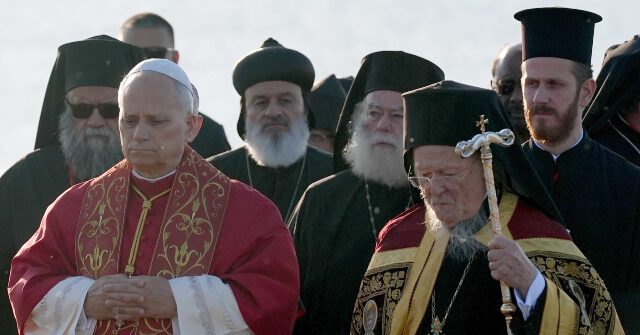
Pope Leo XIV led a prayer meeting for Catholics in Turkey on Friday, highlighting Turkey’s status as a “holy land” critical to early Christianity and urging the extremely small population of Catholics in the country to keep the flame of faith alive.
The pope appeared close to tears during several segments of the service, particularly the sung and chanted parts.
Turkey is a 99.8-percent Muslim country, the result of the widespread extermination of Christian populations in various genocides in the 20th century. Estimates indicate that the country of nearly 90 million people is home to 33,000 Catholics. The government of Islamist President Recep Tayyip Erdogan, who openly cheerleads for jihadist terrorist organizations such as Hamas, has led government initiatives to persecute local Christians and has enabled the attempted erasure of Turkey’s rich Christian heritage, most notably by turning the Hagia Sophia basilica into a mosque.
Pope Leo used his address to Catholic clergy and laypeople in Turkey on Friday to recall the “deep roots” Christianity has in Anatolia, from the travel of the Apostles to the work of Roman Emperor Constantine to spread the faith, through centuries of Christian worship.
“We recall with admiration the great Byzantine history, the missionary impulse of the Church of Constantinople and the spread of Christianity throughout the Levant,” Pope Leo stated. “Even today in Türkiye there are many communities of Eastern-rite Christians — Armenians, Syrians and Chaldeans — as well as those of the Latin rite. The Ecumenical Patriarchate remains a point of reference both for its Greek faithful and for those of other Orthodox Churches.”
“Dear friends, your communities emerged from the richness of this long history, and it is you who are called today to nurture the seed of faith handed down to us by Abraham, the Apostles and the Fathers,” he said.
The pope continued:
The history that precedes you is not something merely to be remembered and then venerated as a glorious past while we look with resignation at how small the Catholic Church has become numerically. On the contrary, we are invited to adopt an evangelical vision, enlightened by the Holy Spirit.
Pope Leo noted the small size of the Church in Turkey, declaring that the “logic of littleness is the Church’s true strength.”
“It does not lie in her resources or structures, nor do the fruits of her mission depend on numbers, economic power or social influence,” he affirmed. “The Church instead lives by the light of the Lamb; gathered around him, she is sent out into the world by the power of the Holy Spirit.”
“The Church in Türkiye is a small community, yet fruitful like a seed and leaven of the kingdom,” he continued. “I therefore encourage you to cultivate a spiritual attitude of confident hope, rooted in faith and in union with God. There is a need to witness to the Gospel with joy and look to the future with hope.”
Pope Leo also highlighted two aspects of the Turkish population that offer opportunities for the Church: growing numbers of young people interested in Christianity and Turkey’s massive refugee and migrant population. Turkey has taken millions of refugees from the Syrian civil war, in addition to others fleeing conflict from Afghanistan, Iraq, and other locations.
Pope Leo is currently on his first international tour as pontiff, traveling first to Turkey to mark the 1,700th anniversary of the Council of Nicaea and then to Lebanon to meet with Christians and call for peace in the Middle East. Pope Leo is expected to meet Islamist Turkish President Recep Tayyip Erdogan while in Turkey. Erdogan, while expanding persecution and intolerance of Christians, nonetheless called the pope’s visit a “very important step that strengthens our common ground.”
“I believe the messages to be delivered from Türkiye (with Pope Leo XIV) will reach the Turkish-Islamic world and the Christian world, and will strengthen hope for peace around the globe,” Erdogan announced, according to the state outlet Anadolu Agency.
Anadolu also noted that Erdogan claimed that his country had a “tradition of religious coexistence.”
“Since taking office in 2002, we have completed the restoration of nearly 100 churches, monasteries, and other places of worship,” Erdogan claimed. “Every one of our citizens, regardless of language, religion, sect, or ethnic background, is a first-class citizen of the Republic of Türkiye. We will not allow even a single person to face discrimination.”
In reality, the Republic of Turkey was founded by the perpetrators of the first modern genocide, an extermination of the majority-Christian Armenian, Assyrian, and Pontic Greek populations of Anatolia. The Turkish government has a formal policy of denying that the genocides occurred, claiming that they were actually wars in which Turks also died. Erdogan himself made it a personal project to erase Christian history in Istanbul, turning the Hagia Sophia, a Christian basilica that the Republic of Turkey had turned into a secular museum, into a mosque. For the conversion, the Turkish government covered up priceless Christian art in the building.
“Reverting Hagia Sophia to its original form as a mosque was a dream of my youth,” Erdogan declared in 2020.
The Christian humanitarian organization Open Doors ranks Turkey as number 45 on its list of most dangerous countries in the world to practice Christianity.
“Christians in Türkiye face everyday discrimination for their faith. Foreign Christians with Turkish spouses and children have been banned from entering or re-entering the country. Religion is recorded on the Turkish ID card, making it easy to discriminate against Christian job applicants,” Open Doors explains in its World Watch List rankings. “Even Greek and Armenian Christians who attend traditional churches aren’t considered full members of Turkish society. Their churches struggle with legal obstacles and red tape intended to obstruct the practice of their faith.”