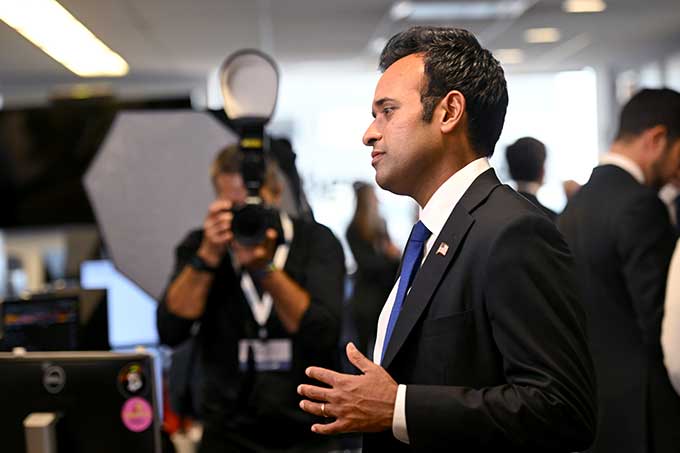
In early October, Vivek Ramaswamy, a Republican candidate in Ohio’s 2026 governor’s race and former co-chair of President Donald Trump’s Department of Government Efficiency, headlined an event for Turning Point USA in Bozeman, Montana. Standing in for the late Charlie Kirk, Ramaswamy paid homage to the organization’s assassinated founder by speaking about many of the things that he held dear, such as family, freedom, and the American Dream.
Many of the conservative students who attended Ramaswamy’s talk, however, seemed more interested in the gubernatorial candidate himself—namely, his ethnic and religious identities—than anything he had to say. They wondered, during the Q & A portion of the event, whether an Indian American who identifies as Hindu could lead a state that’s 64 percent Christian.
Finally, a reason to check your email.
Sign up for our free newsletter today.
“If you are an Indian, a Hindu, coming from a different culture, different religion than those that founded this country, those who grew this country, made this country the beautiful thing that it is today. What are you conserving? You are bringing change,” said one student. “I’ll be 100 percent honest with you—Christianity is the one truth.”
Ohio’s Republican gubernatorial primary is several months away, and it remains to be seen how many voters will be as troubled by Ramaswamy’s cultural background as this conservative student apparently was. But many believe that Ramaswamy will become the Buckeye State’s next governor. Consider how, in May, the 40-year-old biotech billionaire secured the backing of the state Republican Party, bringing with it substantial monetary and institutional support. On November 8, President Trump formally endorsed Ramaswamy, calling him “young, strong, smart, and deeply in love with the United States.” A Bowling Green University poll from last month found that Ramaswamy leads Democrats Amy Acton and Tim Ryan, both vying for their party’s gubernatorial nomination, by three (50 percent to 47 percent) and two (49 percent to 47 percent) percentage points, respectively.
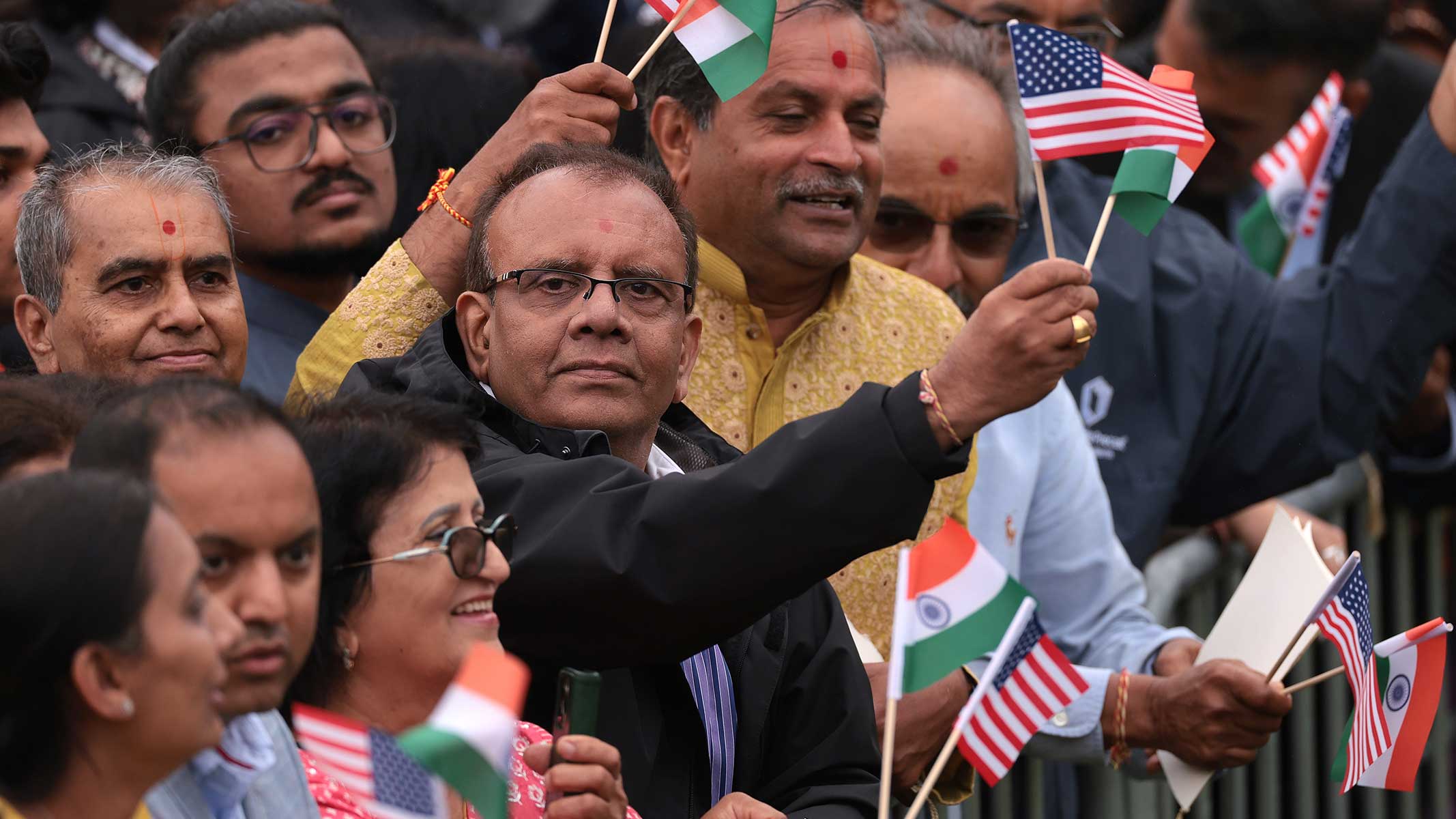
All this is to say that an Indian American Hindu might soon be elected governor of one of the nation’s reddest states. Time will tell whether this is something that the Republican Party at large will embrace, and whether the party will welcome the Indian-American voters who have, in recent years, started joining its electoral coalition.
Indeed, a few months before the 2024 presidential election, the Carnegie Endowment for International Peace released the results of its 2024 Indian American Attitudes Survey (IAAS). This nationwide survey of 714 Indian Americans found that 60 percent of the group planned to vote for Kamala Harris, compared with 31 percent who planned to vote for Trump. The 2020 IAAS similarly found that 68 percent of Indian-American voters planned to vote for Joe Biden, while 22 percent planned to vote for Trump. The news here is not that more Indians preferred the Democratic Party’s nominee to that of the Republican Party by wide margins in both 2020 and 2024. That’s to be expected, given Indian Americans’ historically liberal disposition. What was striking was that more Indian voters intended to vote for Trump in 2024 than in 2020.
Indian Americans’ shift toward Trump in the IAAS was especially prevalent among men between the ages of 18 and 39. In 2024, more members of this group said that they intended to vote for Trump than intended to vote for Harris (48 percent versus 44 percent). This represented a dramatic turnaround from 2020, when young Indian men preferred Biden to Trump by a margin of 47 percentage points (70 percent versus 23 percent). Even Indian women in this age range were more likely to vote for Trump in 2024 (29 percent) than in 2020 (19 percent). Political realignment, however modest, appears to have occurred over the course of these two elections.
In an interview with Scroll, an Indian digital news publication, Milan Vaishnav, one of the political scientists behind the IAAS and director of Carnegie’s South Asia Program, attributed this shift to Indian voters’ “concerns about inflation, the state of the economy, illegal immigration, and a sense that the Democratic Party has been too focused on identity politics.” Vaishnav observed that Trump has “a unique appeal in some quarters. He projects himself as a strong leader, he rates better on the economy in most surveys, and he is tough on illegal immigration.”
Most significantly, the IAAS noted that, compared with 2020, the share of Indian Americans identifying as Democrats in 2024 dropped from 66 percent to 57 percent, while the share of those calling themselves Republicans grew from 18 percent to 27 percent. These swings appeared to translate into electoral victories. Across the country, Indian Americans helped flip deep-blue enclaves red during the 2024 election cycle.
Yet, these Republican gains proved unsteady. New Jersey offers a good case study: Edison, the Garden State’s sixth-largest municipality, is home to one of the largest concentrations of Indian Americans in the country. While President Trump won nearly half (45 percent) of the vote there in 2024, in the 2025 New Jersey governor’s race, Jack Ciattarelli, the Republican candidate, secured only 33 percent of the vote.
What accounts for Indian Americans’ swing back toward the Democratic Party? It’s likely a convergence of three factors: tariffs on Indian imports, the Trump administration’s recent crackdown on H-1B visas (71 percent of which were awarded to Indian nationals in 2024), and a surge of anti-Indian sentiment within the Republican base, particularly on the social media platform X.
For Indian voters in New Jersey, tariffs seemed to be the sticking point. A September report from the Wall Street Journal noted that Trump’s levies on Indian imports had devastated businesses in heavily South Asian communities such as Woodbridge and Edison. “The economy here is plateauing or even going down,” said Mahesh Shah, vice chairman of the area’s Indian Business Association. “Smaller businesses may not survive.”
Just one day after these tariffs doubled to 50 percent, Edison mayor Sam Joshi hosted a luncheon for Democrat Mickie Sherill, who went on to defeat Ciattarelli in the New Jersey governor’s race, at a local Indian restaurant. There, she met with business owners negatively affected by the tariffs and shared footage from the event on her X account. Sherill also criticized Republicans’ newfound hostility toward the H-1B visa program during her campaign.
While Indian Americans have historically viewed the Democratic Party more favorably, their belief in meritocracy, free markets, and the American Dream aligns them, nowadays, with the GOP. They should not be taken for granted—and neither should their votes.
Top Photo by Win McNamee/Getty Images
Source link