The Government Accountability Office has castigated the Coast Guard for failing to set priorities in vessel acquisition, urging it to slow down and finalize its design choices.
The United States Coast Guard has too few icebreakers, and it will take years to build up its fleet. To resolve the issue, the Coast Guard—the lone branch of the United States military under the Department of Homeland Security (DHS) rather than the Department of Defense (DoD)—purchased a former oilfield supply ship and recommissioned the vessel as the USCGC Stories (WAGB-21) last summer.
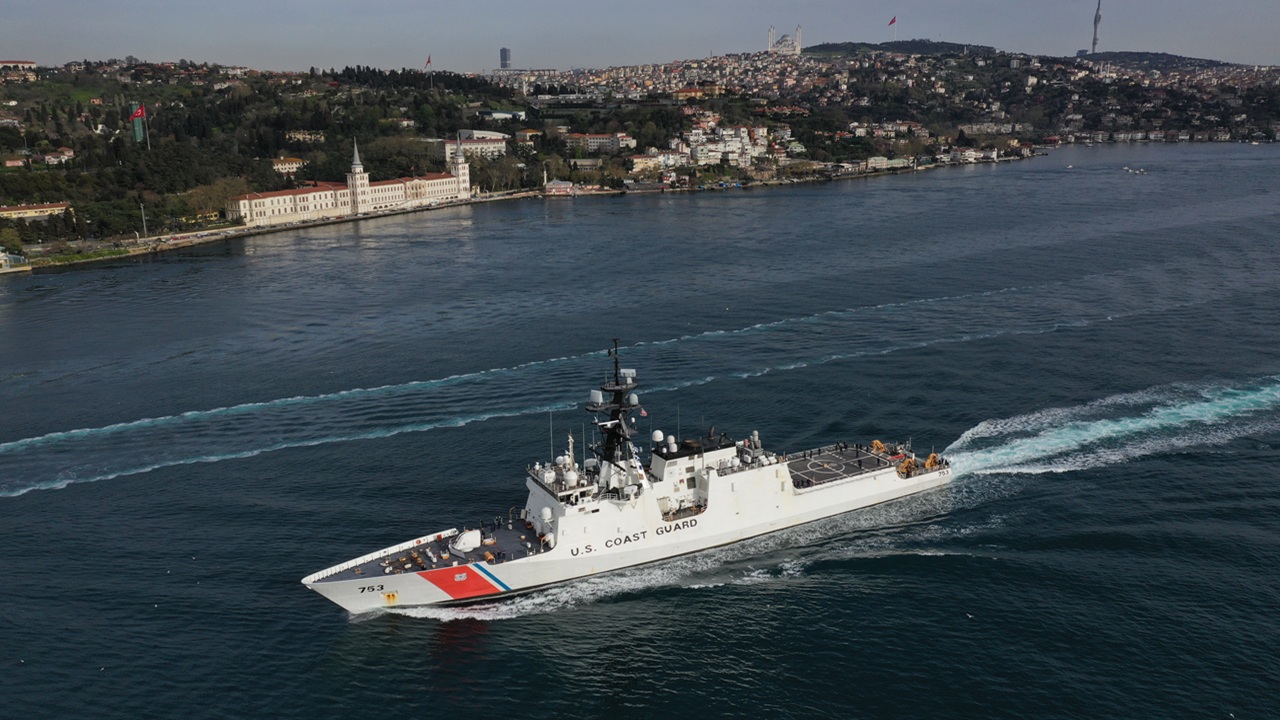
There has been criticism that WAGB-21 may not be the right ship for the job; yet it may be the least of the problems facing the Coast Guard, the Government Accountability Office (GAO) warned in its recent report to lawmakers. The watchdog group noted that the US Coast Guard is investing more than $17 billion to acquire 25 “Offshore Patrol Cutters” (OPCs), which will be able to carry out law enforcement and search-and-rescue missions.
“Two shipbuilders have started building the ships before completing the design. Building ships with incomplete designs is risky. The first shipbuilder repeatedly faced costly rework and delayed deliveries, leading the Coast Guard to cancel half the ships on the contract,” the GAO explained.
Two Shipbuilders, One Big Problem
The “Stage 1 OPC Shipbuilder,” Eastern Shipbuilding Group, recently halted work on the Heritage-class OPCS, citing “significant financial strain” from the program.
“Eastern Shipbuilding Group has made the difficult decision to suspend work on the Offshore Patrol Cutter program due to significant financial strain caused by the program’s structure and conditions. Despite our best efforts, continuing under the current circumstances is not sustainable,” Joey D’Isernia, CEO of Eastern Shipbuilding Group, said in a statement to USNI News last week.
Four Heritage-class vessels were in various states of construction at the company’s Panama City, Florida, facility. Earlier this year, Eastern Shipbuilding Group announced it would not be able to complete work on the OPCs without taking on an “unabsorbable loss.” That resulted in the Coast Guard issuing stop-work orders on hulls three and four in July, and DHS then issued a request for information (RFI) to identify vendors capable of towing and subsequently completing the construction of the vessels.
Work on the other two hulls has since been halted entirely.
“Our shipyards will continue to build quality American vessels and support the regional economy. We’ve overcome a major hurricane and a global pandemic, and we will overcome this challenge as well,” D’Isernia added.
Eastern had been awarded a $714.5 million contract to build hybrid-electric ferries over the summer, with gCaptain reporting the issue isn’t the shipbuilding capability, but rather “the complexity of the Coast Guard vessels.”
The problem is also affecting the program’s “Stage 2 OPC shipbuilder,” Austral USA, which has begun construction of one of the vessels despite a stable design that has not yet been finalized. The shipbuilder was contracted to build up to 11 OPCs under a $3.3 billion deal.
“This may drive cost increases and schedule delays, which may be hard to monitor given weaknesses with the company’s schedule and cost tracking system,” the GAO warned.
The watchdog added that the USCG is “unlikely to have results from performance testing of any OPCs before it starts stage 3 procurement activity.” Yet the Coast Guard and DHS still don’t know whether the OPCs even meet the requirements and operational needs to accomplish their future missions.
What is surprising is that the program is also running five years late.
GAO’s Recommendations to DHS: Set Clear Goals
The GAO made four recommendations to the USCG and DHS, including that designs are stabilized before construction moves forward on any additional stage 2 vessels, and that the Coast Guard should collaborate with the US Navy to clarify and document how to evaluate any deficiencies within the OPC program. The GAO further called up DHS to set cost goals that are reported at each OPC stage, and that a plan is formulated for the acquisition of stage 3 ships, which “identifies how it will use test results to inform procurement activities and further incorporate shipbuilding leading practices.
“DHS concurred with two of the four recommendations, and did not concur with the other two. GAO maintains that all four recommendations are warranted,” the GAO added.
About the Author: Peter Suciu
Peter Suciu has contributed over 3,200 published pieces to more than four dozen magazines and websites over a 30-year career in journalism. He regularly writes about military hardware, firearms history, cybersecurity, politics, and international affairs. Peter is also a contributing writer for Forbes and Clearance Jobs. He is based in Michigan. You can follow him on Twitter: @PeterSuciu. You can email the author: [email protected].
Image: Shutterstock / Archaeonavall.