The new “Speed to Power Initiative” must overcome dangerous assumptions that put America’s future at risk.
Last week, hundreds of private sector companies and organizations provided input to the Department of Energy in response to its “Speed to Power Initiative” — an exciting program prompted by the Trump Administration to help the nation with “accelerating large-scale grid infrastructure projects to win the AI race.”
While many respondents involved for-profit corporations proposing projects, one exclusively represented the public interest. The nationwide Secure the Grid Coalition submitted comments to the DOE, warning that a critical vulnerability of the current electric grid must be mitigated for “Speed to Power” to succeed. The Coalition backed up its recommendations with an authoritative report on the matter.
Photo: Secure the Grid Coalition Report. Credit: Center for Security Policy
The Coalition’s warnings echoed those of the influential and bipartisan National Conference of State Legislators (NCSL), who, over the summer, passed a resolution urging swift action to mitigate the same vulnerability that occurs from both solar weather (known as a geomagnetic disturbance — (GMD) and high-altitude electromagnetic pulse (HEMP).
GMDs and HEMP both produce ground-induced currents (GICs) that invade the power grid from the earth through the neutral-to-ground connection of high-voltage transformers. GICs turn these large power transformers across the power grid into “harmonic generators” that destroy components all the way to the load, eventually destroying themselves and taking down the grid.
These transformers are extremely hard to replace. Some take three to six years to produce, and most are made overseas.
Unfortunately, the electric utility industry has assumed that their transformers are invulnerable to GICs because they have been complying with a federally approved solar storm protection standard (“TPL-007”) that is dangerously low.
That low standard was developed by the North American Electric Reliability Corporation (NERC) and is pictured below alongside real-world historical GIC-producing events and the HEMP protection standard from the International Electrotechnical Commission (IEC), which was recently updated in May 2025.
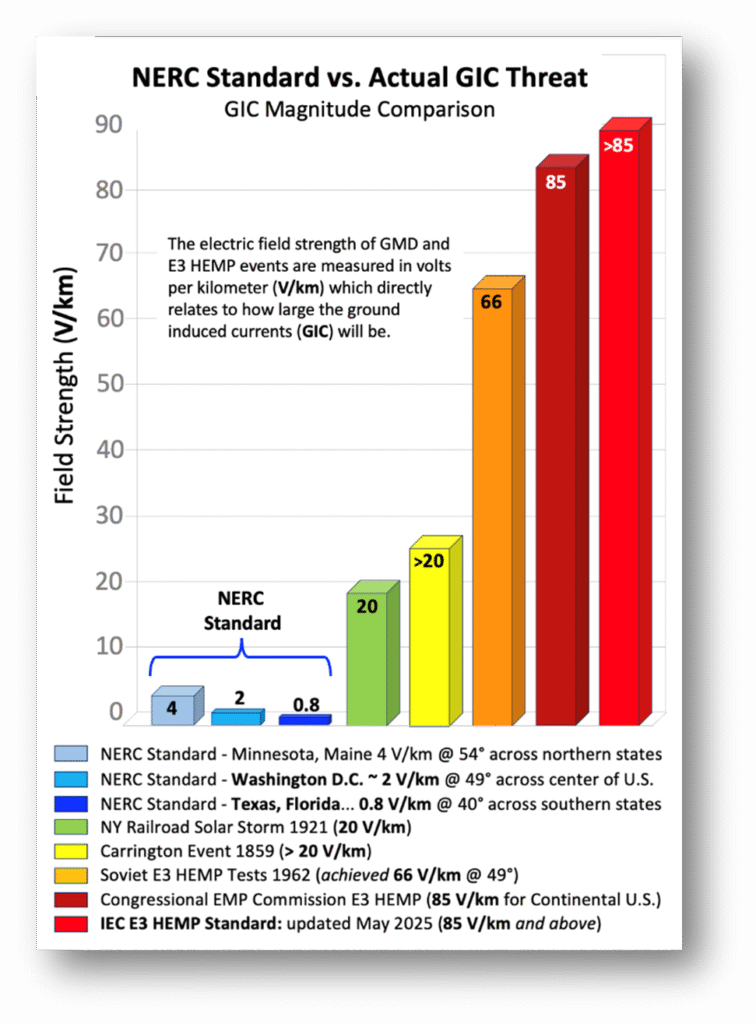
Photo: Comparison of NERC GIC Protection alongside past GIC-inducing events and recommended IEC Standard Credit: Secure the Grid Coalition
The Risks of GIC Events
The Secure the Grid Coalition’s report warned that these assumptions led the Nuclear Regulatory Commission (NRC) to recently issue a ruling that could be detrimental to nuclear safety in the United States.
Dangerous assumptions of low GIC, based on the arbitrarily set NERC TPL-007 standard, have caused utilities and regulators to overestimate transformer resilience and underestimate a GIC’s impact on the overall grid. It takes very little GIC (2 to 5 amps/phase) to turn large power transformers into harmonic generators. It was the GIC-induced harmonics that knocked out Quebec’s grid in 93 seconds (during a small 2 V/km GMD event) in 1989.
During a severe GMD event or HEMP attack, the GIC-induced harmonics would be catastrophic, leading to widespread grid collapse and damage to large power equipment across the grid, including transformers, high-voltage circuit breakers, and large power generators — all equipment with very long production lead times.
Even routine minor solar storms harm the American economy. Low-level GICs from regularly occurring solar weather pass through transformers, causing them to generate harmonics that ruin downstream equipment — causing economic losses in the United States of approximately $10 billion each year.
It is therefore vital to keep GICs from entering America’s transformers, which not only protects those transformers but also protects the rest of the power grid and critical components from those transformers.
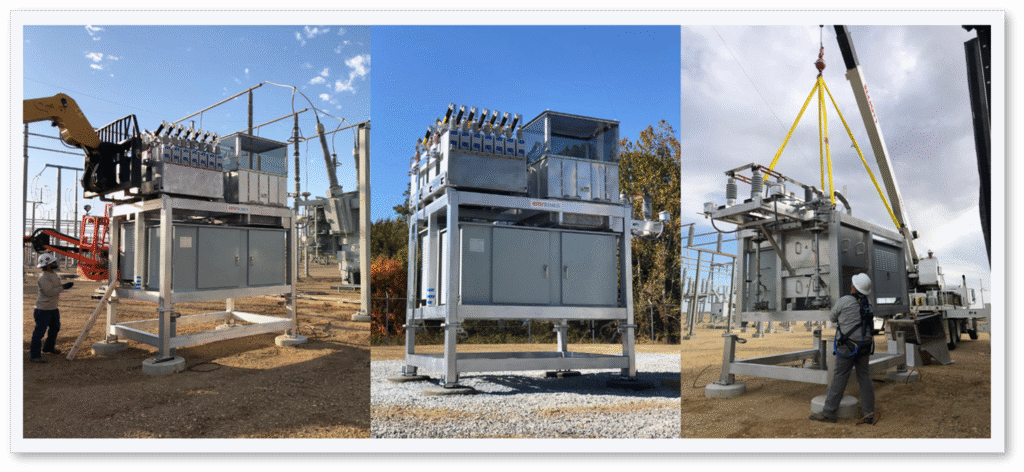
Photo: SolidGround® units being installed. Credit: EMPRIMUS
The protection solution — known as the SolidGround® capacitive neutral-blocking device — developed by EMPRIMUS and validated by the Department of Defense’s Defense Threat Reduction Agency (DTRA), Idaho National Laboratory (INL), Oak Ridge National Laboratory (ORNL), and the Department of Energy (DOE) automatically blocks GICs from entering transformers without affecting AC grounding or fault-current handling.
SolidGround® has been operating for over a decade on our bulk power grid at the 345 kV and 500 kV level in the American Transmission Company (ATC), Western Area Power Administration (WAPA), and Tennessee Valley Authority (TVA), performing as designed without failure. These three utilities have all contributed to the design of SolidGround® and have co-written papers, published articles, written reports, and submitted testimony to the US Senate on its performance.
Each SolidGround® unit is standardized, making them able to be produced on an assembly line — but so far, they are only being ordered by foreign nations. The Secure the Grid Coalition’s report also warned that a Chinese entity has “infringed upon the patents of the EMPRIMUS SolidGround® system” and “is in production of these duplicate counterfeits, which are being deployed within China.”
Nationwide deployment on the estimated 6,000 critical large power transformers identified as “high-risk design” to GIC (the first to generate harmonics) would cost around $3-4 billion — less than one-third of one percent of the $1.2 trillion Bipartisan Infrastructure Bill. Yet we remain vulnerable.
What Must Be Done to Protect America
Ultimately, to protect America’s electric power grid from the GIC threat, the nation must identify those transformers that are most vulnerable and then create financial incentives for the electric utility industry to protect them.
Leaders at both the federal and state levels must act if we are to expect swift results.
The Secure the Grid Coalition recommends that the Secretary of Energy issue an emergency order to identify GIC-vulnerable transformers by requiring all Independent System Operators (ISOs) and Regional Transmission Operators (RTOs) to conduct a thorough survey of all large power transformers vulnerable to GIC using credible GIC scenarios for a 100-year solar storm and waveforms associated with the recently updated international IEC standard on HEMP.
The DOE should then begin to use federal funds to immediately deploy SolidGround® on federally owned portions of the US electric grid, such as the Tennessee Valley Authority (TVA), Bonneville Power Administration (BPA), Western Area Power Administration (WAPA), etc.
State leaders can also play a vital role by requiring their utilities to conduct the same type of survey. The Secure the Grid Coalition’s report included model language for this state action known as the “SAVE – Survey All Vulnerable Electric Transformers Act.” It compels the electric industry to not only identify vulnerable transformers but also to provide recommendations for how to fund the protection, including through “rate recovery.”
Lawmakers in New Hampshire, who were instrumental in the NCSL resolution this summer, have become the first legislators in the nation to have filed a version of the SAVE Transformers Act.
For the sake of America’s future, it would be wise for other state leaders to follow.
Authors’ Note: The Secure the Grid Coalition is a group of policy, energy, and national security experts dedicated to strengthening the resilience of America’s electrical grid. It is sponsored by the Center for Security Policy, a 501(c)(3) nonprofit that receives no funding from governments, foreign sources, the electric industry, or any for-profit corporations involved in protecting the grid, including EMPRIMUS, which has developed the capacitive neutral blocking device known as SolidGround.®
About the Authors: Tommy Waller and Douglas Ellsworth
Lt. Col. Tommy Waller is the president & CEO of the nonprofit Center for Security Policy. Waller retired from the US Marines after two decades of service in both active duty and the reserves as an Infantry and Expeditionary Ground Reconnaissance Officer with deployments to Afghanistan, Iraq, Africa, and South America and with cross-assigned service to the US Air Force’s Electromagnetic Defense Task Force (EDTF). His formal education includes numerous military schools and colleges, a B.A. in International Relations from Tulane University, and executive education from the Wharton School. In addition to running the Center for Security Policy, he also manages the nationwide bipartisan Secure the Grid Coalition.
[NOTE: The Center for Security Policy exists for the public interest and receives no funding from government, foreign sources, or any industry that can profit from its policy work.]
Douglas Ellsworth is a senior fellow at the Center for Security Policy and serves as the Co-Director of the Center-sponsored Secure the Grid (STG) Coalition — an ad hoc group of policy, energy, and national security experts, legislators, and industry insiders who are dedicated to strengthening the resilience of America’s electrical grid. Through the support of the Center for Security Policy, the STG Coalition aims to raise awareness about the national security threat of grid vulnerability and encourage the steps needed to neutralize it. The STG Coalition brings a wide variety of expertise in cybersecurity, physical security and public policy, and expressly serves the public interest. Mr. Ellsworth’s full bio can be found here.
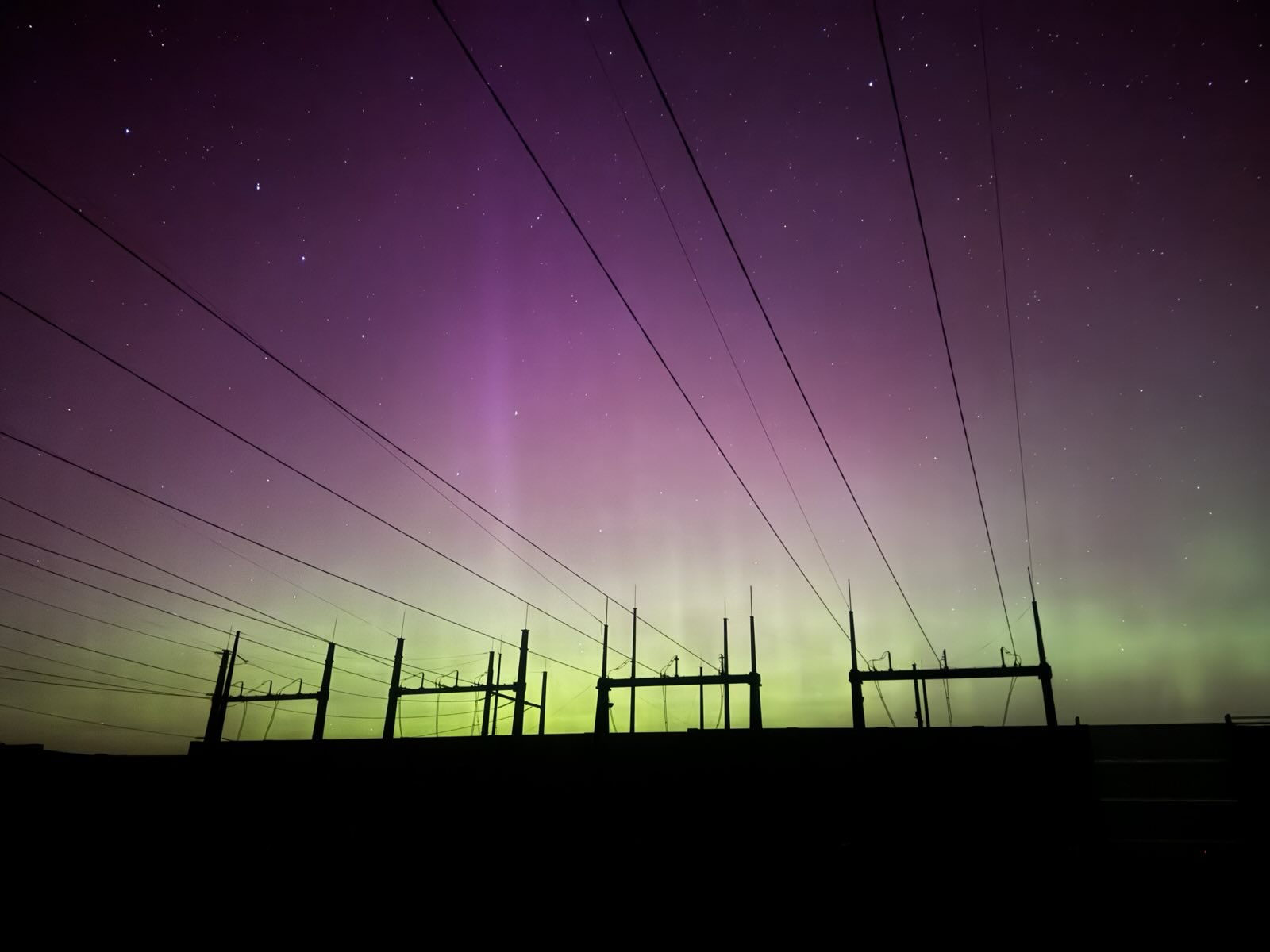
PHOTO: A utility manager drove out in the middle of the night to capture this photo of the aurora overhead while the GICs from the May 2024 “Gannon” solar storm were in full force — actively triggering SolidGround® over a dozen times at this substation – protecting a critical transformer behind those walls. Courtesy of the Secure the Grid Coalition.