Russia and China understand that industrial might, not ultra-efficient just-in-time supply chains, are the key to victory in a future great power war. Does the Pentagon?
In recent weeks, there has been a quiet civil war inside the Pentagon—and the future of America’s manufacturing base was hanging in the balance.
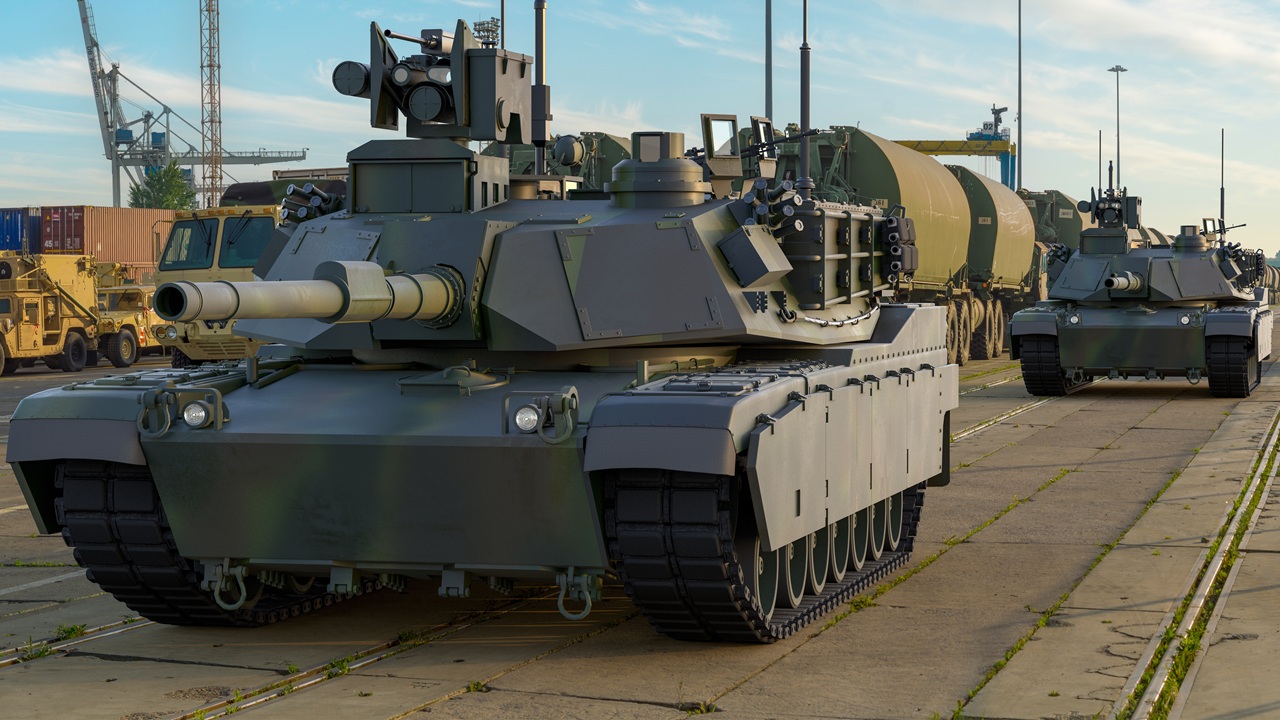
At the center of this fight is a place far from Washington: the Joint Systems Manufacturing Center in Lima, Ohio, the nation’s last remaining facility capable of building the M1 Abrams main battle tank. For decades, Lima has been the backbone of American armored vehicle production, a plant that not only produced the Army’s most powerful weapon but also sustained the skilled trades and precision manufacturing that make American defense second to none.
Why Is the Defense Department Scaling Back Tank Purchases?
For the past few years, production at Lima has been strong, making around a dozen tanks monthly, thanks in large part to funding provided by President Donald Trump in his first term. That surge kept welders, machinists, and engineers busy and the assembly lines warm. But a procurement request for only 30 tanks in the president’s budget request for FY 2026 would have cooled the line down just as we need it to heat up. Going down that cliff would have gutted the workforce and hollowed out a key part of the defense industrial base just when the world is getting more dangerous and allies are looking to America for deterrence and supply.
The irony? The Army does not want the cut. It wants the Lima plant in steady operation now so it is ready to produce the new M1E3 tank, the next-gen Abrams tank now in development. Protecting the Lima plant also was critical to aligning with the president’s manufacturing and “America First” agenda, preserves important industrial jobs in the Midwest and keeps the production line humming in keeping with the “peace through strength” doctrine. The push to slash output in Lima was coming instead from inside the Pentagon itself, from the same bureaucracy that has stifled new capabilities getting to the warfighter.
Once America’s Industrial Capacity Is Gone, It’s Gone
Their argument should be familiar by now: “We have enough tanks.” It’s the same refrain used every generation by those who mistake inventory for capability. But that misses the bigger picture. Tanks are not just hardware that last forever. Today, the M1E3 tank that is proposed is an AI-enabled, integrated warfighting machine. Keeping a hot production line represents the nation’s ability to respond to a crisis without delay, to surge manufacturing when deterrence fails, and to maintain the critical skills that no textbook can re-create. Once the welders, machinists, and quality engineers at Lima have gone, they don’t come back.
We’ve seen this movie before. A decade ago, under the Obama administration, armored vehicle production at BAE Systems’ plant in Pennsylvania dried up. When the Army tried to restart the line, welds failed inspection, costs ballooned and delivery schedules slipped by months. Skilled labor had drifted away, specialized tooling had rusted in storage, and the industrial knowledge that made the United States the global leader in armored vehicles had dissipated. America paid a premium to relearn lessons it once knew by heart. That’s the Ghost of Christmas Past haunting the Pentagon today.
If past is prologue, then the Lima cut amounts to a strategic warning. To their credit, the Congress, in the recently passed defense reconciliation bill, and now the President have come to the rescue. With the recent deal to sell 300 Abrams tanks to Saudi Arabia, the Department of Defense and the President are in real time revitalizing the American defense industrial base.
Wars Are Won with Industry—and America’s Adversaries Know This
Russia’s invasion of Ukraine, China’s rapid militarization and instability in the Middle East have all underscored that the era of industrial warfare is back. Nations that can build and sustain materiel win; those that rely on just-in-time supply chains and foreign parts lose. Every tank, shell and chip built in the United States contributes to deterrence—not only because of what it is, but because it proves that America can still make things in volume, with quality, and at speed.
Recall that while Washington was debating whether or not it should lay off skilled workers in Ohio, Beijing was accelerating in the opposite direction. China has launched the largest peacetime defense industrial expansion since World War II, doubling its output of armored vehicles, artillery and missiles in just the past five years. Its state-owned conglomerates, backed by government credit and five-year plans, are adding capacity, rather than cutting it. China’s defense industry now operates more like a wartime economy. Production lines for tanks and armored vehicles in Inner Mongolia and Heilongjiang run multiple shifts.
The message is unmistakable: China is preparing for the long haul, building the capacity to sustain high-intensity combat over time. The Trump administration has now signaled that it is going to follow suit, pivoting the defense industrial base from one built to fight one short term war to now being one that can fight any adversary over the long haul.
This budget battle is fundamentally about who controls America’s defense policy, elected leaders or the bureaucracy. The president has made “Made in America” the cornerstone of both his economic and national security agenda. He’s right. Manufacturing strength is military strength. Every Abrams tank built in Ohio strengthens not only the Army, but also the nation’s economic base. It signals to workers that defense dollars aren’t just for contractors clustered around Washington, but for the welders and fabricators in Lima, York, and Anniston who actually put steel together.
A Simple Solution: Buy and Build More Tanks
The solution isn’t complicated. Keep production going for the major combat systems.
Congress now has a critical role to play. Lawmakers from both parties have long recognized the Lima plant as a national asset, a capability, not just a facility. Now they have to prove this belief by quickly approving this arms sale so that production can begin nearly immediately. Time is of the essence because the workforce cannot go idle.
Critics will say that protecting industrial jobs is “pork.” But that misses the strategic logic of industrial readiness. A responsible city won’t shutter its firehouse just because there hasn’t been a fire in a while. It keeps its fire engines fueled and its firefighters trained. The same principle applies to Lima. Approving this and other sales to our allies, along with higher production levels for our own military keeps America ready for tomorrow and prevents the far higher cost of restarting cold production lines in a crisis.
The forge of American strength needs to stay lit. When the next war comes, we will discover, once again, that producing weapons for our military at scale is the key to victory.
About the Author: John Ferrari
Maj. Gen. John G. Ferrari is a nonresident senior fellow at the American Enterprise Institute. Over his 32-year US Army career, Ferrari, who is now retired, served as the director of program analysis and evaluation, the commanding general of the White Sands Missile Range, and a deputy commander for programs at the NATO Training Mission in Afghanistan. He has an MBA in finance and strategic management from the Wharton School at the University of Pennsylvania, an MA in national resource strategy and policy from the Industrial College of the Armed Forces (now called the Eisenhower School for National Security and Resource Strategy), and a BS in computer science from the United States Military Academy at West Point.
Image: Shutterstock / Mike Mareen.