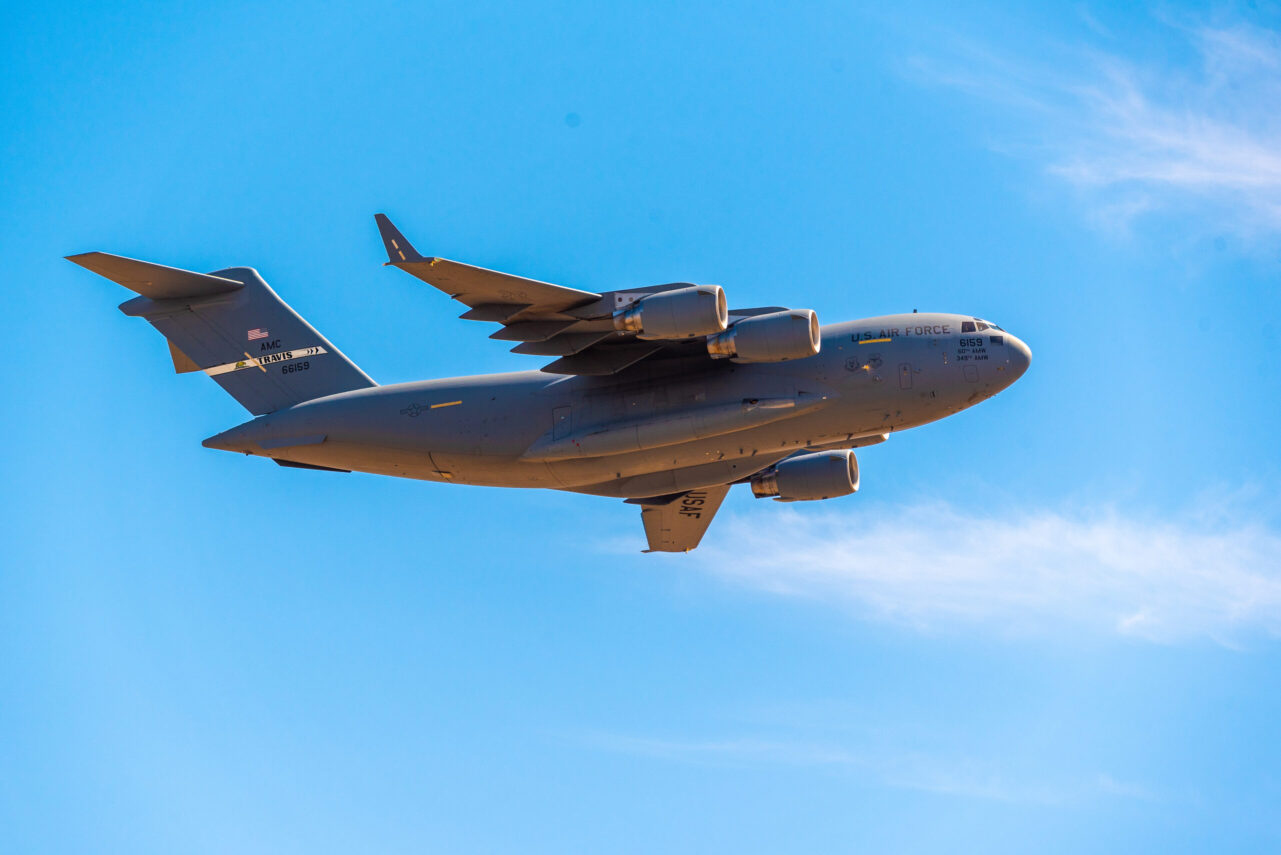
The service expects NGAL to enter service in fiscal year 2038 and become operational by fiscal year 2041.
The Air Force released a specific timeline for the Next Generation Airlift (NGAL) aircraft.
Transport aircraft are essential to global US military operations and the United States’ ability to project power across the globe.
When Will the Next Generation Airlift Aircraft Arrive?
Following years of supporting counterterrorism and counterinsurgency operations, the Air Force Air Mobility Command is now focused on how to support the wider military in a potential near-peer conflict with China or Russia. As part of that shift, the Air Mobility Command is looking to replace its C-5M Super Galaxy and C-17A Globemaster II transport aircraft fleets.
Last week, the Air Mobility Command released a solicitation titled “C-17 Air Mobility Command Airlift Recapitalization Strategy,” looking for proposals from the industry for the NGAL aircraft, as well as potential life-extension programs for the C-5 and C-17.
As part of the solicitation, the service included a memorandum outlining its strategy around the NGAL aircraft.
The service expects its next-generation transport aircraft to enter service in fiscal year 2038 and reach initial operating capability by fiscal year 2041. And then it would take several years before the C-5 and C-17 are completely retired.
The Air Force currently projects to keep the C-5 Galaxy in service until 2045 and the C-17 Globemaster until 2075.
“Uninterrupted inter-theater airlift capacity is paramount for global operations during fleet recapitalization,” Air Force brigadier general David Fazenbaker, the director of Strategy, Plans, Requirements, and Programs, said in his memorandum.
Fazenbaker also reaffirmed the Air Force’s plan for the NGAL aircraft to replace both the C-5M and C-17A fleets as the next inter-theater airlift platform.
In October, during a roundtable at the Air & Space Forces Association’s 2025 Air, Space, and Cyber Conference, Air Force gen. John Lamontagne, the head of Air Mobility Command (AMC), said that the service plans to replace the C-17 and C-5 with one NGAL aircraft.
Maintaining the C-5 and C-17 on the active fleet for 20 and 50 years, respectively, will not be easy. The C-5 first entered service in the 1980s. The C-17 followed about a decade later. The Air Force has upgraded both fleets, but the transport aircraft are out of production. Although there have been discussions about restarting the production line for the C-17, that remains a consideration for the time being.
“To mitigate risks associated with acquisition delays, funding uncertainties, or technological challenges, the existing C-5M and C-17A fleets’ operational viability must be maintained until a fully capable replacement is fielded, which may require extending the service life and associated Military Type Certificate (MTC) of each platform,” the senior Air Force officer stated in the memo.
The Plan for the NGAL
The Air Force plans to retire the C-5 Galaxy one aircraft at a time. As one Galaxy retires, one NGAL aircraft will enter the operational fleet until the entire C-5 fleet has retired. Thereafter, the Air Force plans to do a “one-for-one” swap between the C-17 Globemaster and the NGAL aircraft. If these plans continue in the next decades, the Air Force will purchase approximately 274 NGAL aircraft over the next 50 years. The Air Force currently operates approximately 222 C-17A Globemaster II and 52 C-5M Super Galaxy aircraft.
About the Author: Stavros Atlamazoglou
Stavros Atlamazoglou is a seasoned defense journalist specializing in special operations and a Hellenic Army veteran (national service with the 575th Marine Battalion and Army HQ). He holds a BA from the Johns Hopkins University and an MA from the Johns Hopkins’ School of Advanced International Studies (SAIS). His work has been featured in Business Insider, Sandboxx, and SOFREP.
Image: Shutterstock.