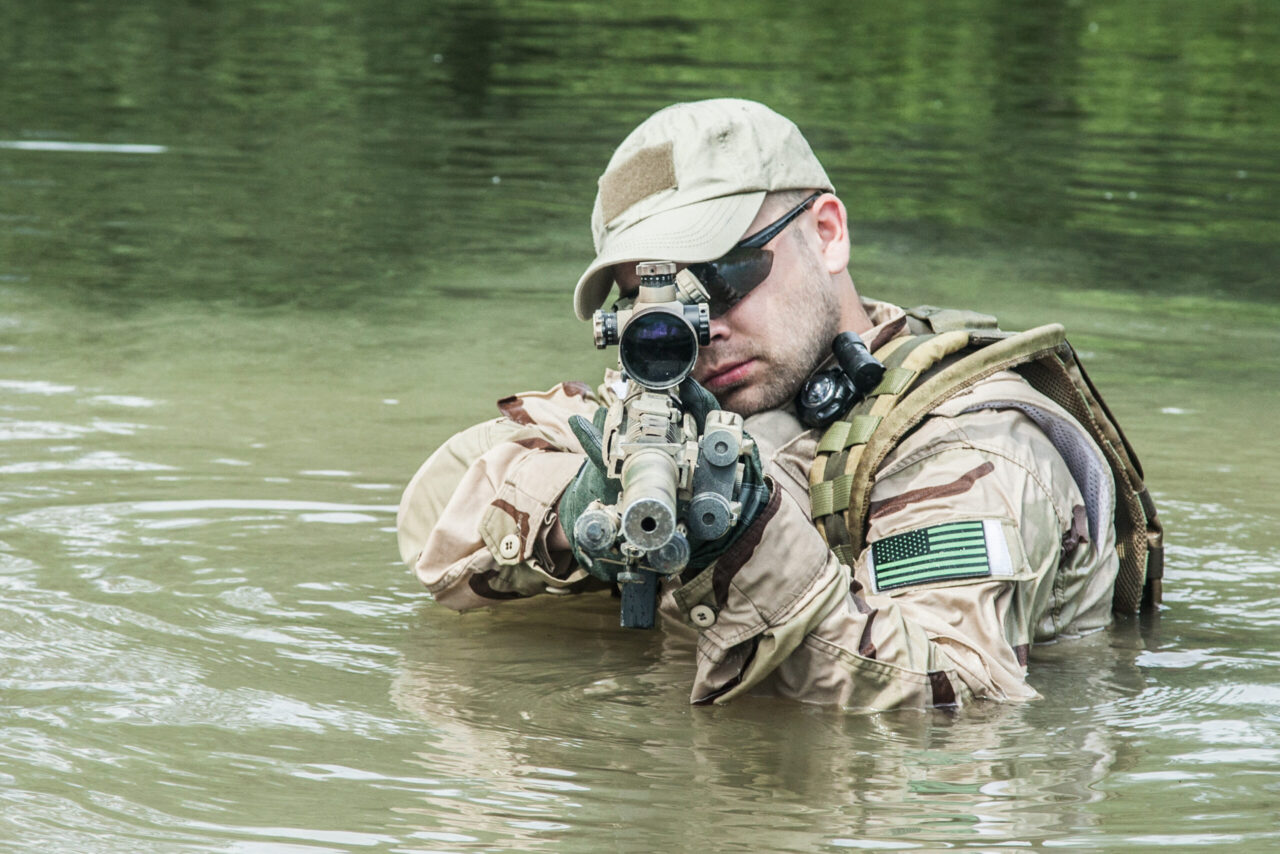
North Korea has capable special operations units that are disciplined and train hard.
Last week, the US Navy joined its South Korean counterpart in a maritime counter-special operations forces exercise off the Korean Peninsula.
From November 17 to 20, US and South Korean naval and air assets worked on how to counter North Korean special operations forces at sea.
Countering North Korean Frogmen, Boats, and Submarines
The USS Dewey (DDG 105), an Arleigh Burke-class guided-missile destroyer, represented the US Navy 7th Fleet in the exercise. The US military also contributed significant air assets in the exercise, including two Army AH-060E Apache attack helicopters, a Navy MH-60R Seahawk anti-submarine warfare helicopter, and a P-8A Poseidon maritime surveillance aircraft.
The South Korean navy participated with a guided-missile destroyer and frigate, as well as air assets.
“MCSOFEX is just a part of our continuous exercises with our ROK counterparts,” Navy Capt. Dave Huljack, commodore of Destroyer Squadron (DESRON) 15, said in a service press release.
“Through exercises like MCSOFEX, Freedom Edge, Ulchi Freedom Shield, and numerous others, we continue to enhance our shared interoperability between the U.S. and ROK navies and our allies and partners to ensure a free and open Indo-Pacific,” Huljack added.
South Korea and Japan are some of the most important US allies in the Indo-Pacific. In a potential conflict with North Korea or China, the United States would look for help from both countries.
As part of the exercise, US and South Korean warships and air assets conducted a wide range of training activities, including liaison officer exchanges, anti-submarine warfare training, anti-air warfare training, joint maritime interdiction operations, and dynamic formation sailing.
“Bilateral training activities like MCSOFEX provide valuable opportunities for the two navies to improve combined readiness, strengthen cooperation, and develop maritime capabilities,” the Navy added.
The USS Dewey is part of Destroyer Squadron 15, which is the largest unit of its type in the Navy and the principal surface combatant unit in the Navy’s 7th Fleet. The 7th Fleet is the largest forward-deployed unit and probably the most important fleet in the Navy, with an operational responsibility for the Indo-Pacific area of operations.
The North Korean Naval Threat
North Korea does not have a naval capability that could threaten US forces or hinder operations in the event of a conflict. It is expected that the Navy would quickly establish control of the seas around the Korean Peninsula as it did during the Korean War in the 1950s. However, the North Korean military has capable special operations units that train hard, have good discipline, and display a fanatical devotion to the regime in Pyongyang. These forces, combined with North Korean submarines, could present an actual threat to US and allied forces in the area.
Moreover, if China came into the conflict in support of North Korea, the threat calculus would be different. In such a scenario, the Navy would have to deal with the largest naval force in the world, and the waters around the Korean Peninsula could be disputed.
Joint training drills, like the one between the Navy and its South Korean counterpart, are important for preparing to fight a conflict.
About the Author: Stavros Atlamazoglou
Stavros Atlamazoglou is a seasoned defense journalist specializing in special operations and a Hellenic Army veteran (national service with the 575th Marine Battalion and Army HQ). He holds a BA from the Johns Hopkins University and an MA from the Johns Hopkins’ School of Advanced International Studies (SAIS). His work has been featured in Business Insider, Sandboxx, and SOFREP.
Image: Shutterstock.