Ironically, as soon as the F-35A is completed and enters service, it will be returned to the United States for pilot training.
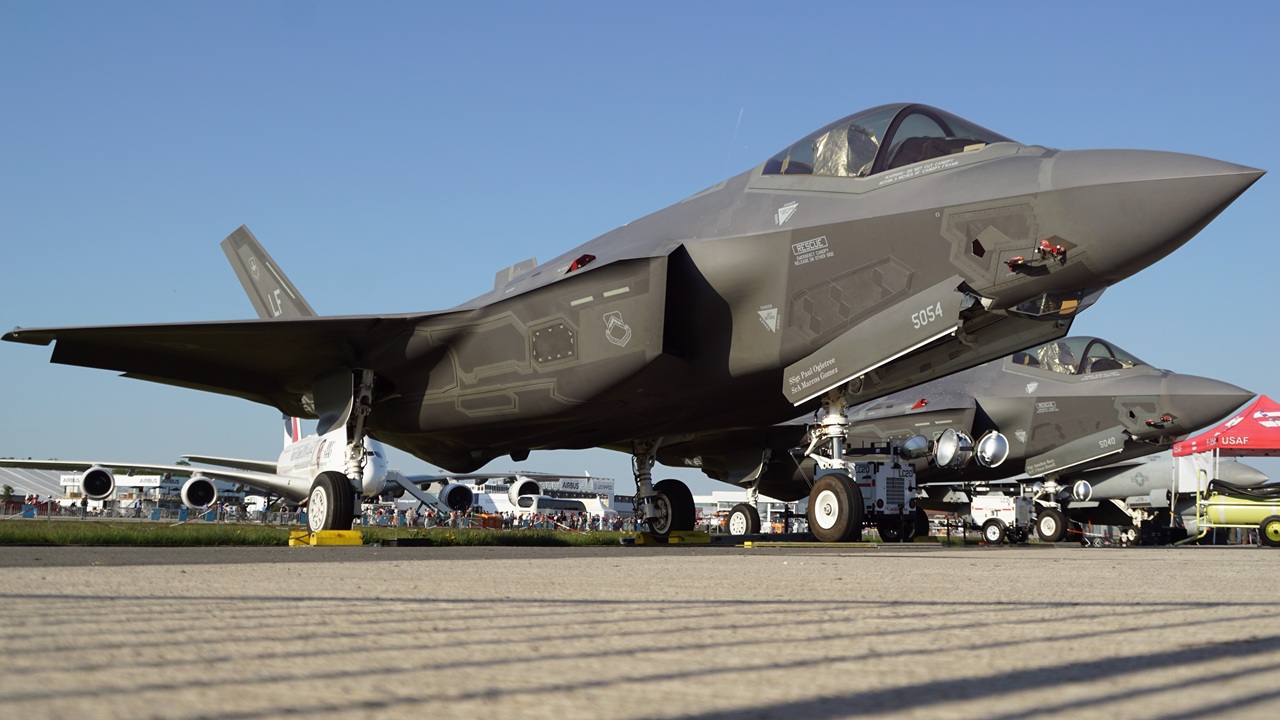
Construction has continued on NATO member Germany’s first Lockheed Martin F-35A Lightning II, the US-based aerospace firm confirmed. A ceremony marking the signing off on the center-fuselage bulkhead and start of final assembly at Lockheed Martin’s Fort Worth, Texas, facility was held last week.
In attendance was German State Secretary Nils Hilmer, who personally signed the bulkhead of the future MG-01 aircraft—the first of a planned 35 Lightning IIs for the German Luftwaffe. Berlin closed a foreign military sale (FMS) deal with Washington for the aircraft nearly three years ago in December 2022, with the $11.5 billion contract including weapons and related items.
The fifth-generation multirole F-35A, the conventional takeoff and landing (CTOL) variant of the Joint Strike Fighter, will eventually replace the German Luftwaffe’s Panavia Tornado and serve in the NATO shared nuclear deterrence mission, as well as in conventional air-to-air and ground attack roles.
German F-35 Pilots Are Training in America Anyway
The first German F-35A is expected to be completed by next year, when the aircraft will head to Ebbing Air National Guard Base in Arkansas for pilot and maintainer training. The first operational F-35As will then arrive at Büchel Air Base, home of the Taktisches Luftwaffengeschwader 33 tactical Air Force Wing 33 by the second half of 2027. Büchel is believed to be one of the six air bases in five European nations that store US nuclear weapons under NATO’s nuclear sharing policy, and upgrades to its facilities are now underway.
The F-35A is the only fifth-generation stealth fighter certified to carry the B61 nuclear bomb, the weapon stored at those bases.
Deliveries of Germany’s F-35s are set to run through 2029, with the Luftwaffe reaching initial operating capability (IOC) by the end of that year, followed by full operating capability (FOC) in 2030.
Germany Is Playing a Bigger Role in European Defense
Among NATO members, Germany was a late entrant into the F-35 program. It initially ruled out adopting the fifth-generation stealth fighter in 2019, but reversed course following Russia’s invasion of Ukraine in February 2022. Production of the first F-35 for the Luftwaffe began in 2024.
Moreover, in 2023, ground was broken on an F-35 Integrated Assembly Line (IAL) in Weeze, North Rhine-Westphalia. German defense conglomerate Rheinmetall began center fuselage production at the facility in July. Including German industry in the strategic partnership with Lockheed Martin and Northrop Grumman effectively ensured Berlin’s commitment to the program.
Last month, reports said Berlin would increase its order of multirole fighters by 15 aircraft, but the German Ministry of Defense has yet to finalize the deal.
Berlin has also committed to increasing the Luftwaffe’s Eurofighter Typhoon fleet. The air service currently operates approximately 138 Eurofighter Typhoons, which form the backbone of its combat aircraft fleet. The Luftwaffe has been upgrading its capabilities by replacing older Tranche 1 Eurofighters with newer Tranche 4 models as part of Project Quadriga, a military enhancement effort launched in 2020. It will also purchase at least 20 additional Typhoons, as part of a $4.36 billion deal.
However, even as Germany remains committed to the Future Combat Air System (FCAS) program, its key partner, France, may bail out. It is unclear whether Germany would continue developing a manned sixth-generation fighter with Spain, seek to join the British-led Global Combat Air Programme (GCAP), or even look to Sweden for its fighter effort.
In the short term, the Luftwaffe will continue to operate the Eurofighter Typhoon, supported in the coming years by the F-35A Lightning II.
About the Author: Peter Suciu
Peter Suciu has contributed over 3,200 published pieces to more than four dozen magazines and websites over a 30-year career in journalism. He regularly writes about military hardware, firearms history, cybersecurity, politics, and international affairs. Peter is also a contributing writer for Forbes and Clearance Jobs. He is based in Michigan. You can follow him on Twitter: @PeterSuciu. You can email the author: [email protected].
Image: Shutterstock / DenmenAviationPhotography.