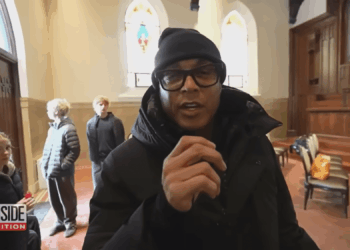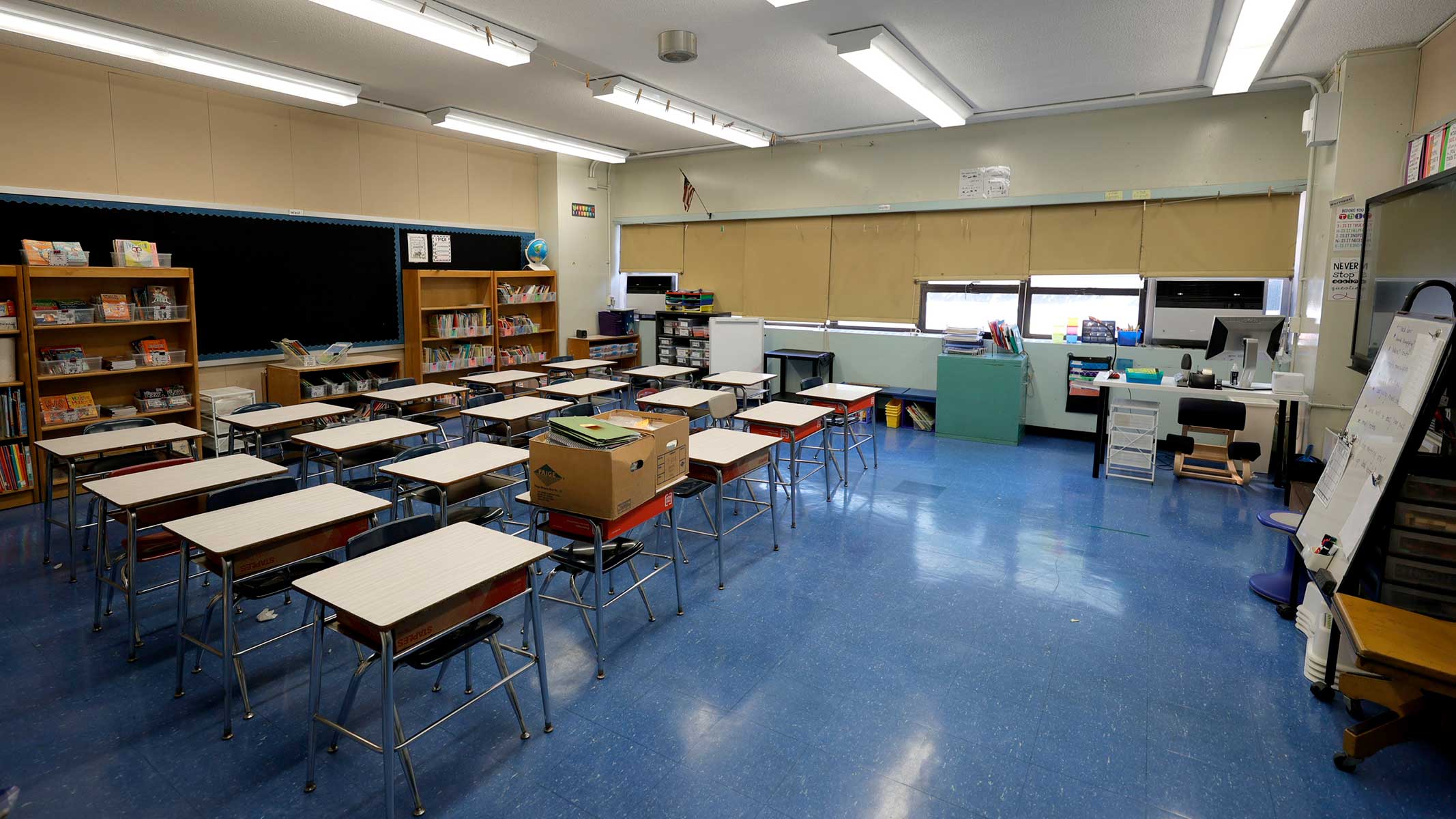
In children’s advocate Natalya Murakhver’s new documentary, 15 Days, the Covid-19-era school closures return to the spotlight. Though the pandemic has passed, the film reminds us that many of that era’s players, interests, and debates remain relevant today. It clarifies that the decision to close schools was not a costless choice but one made at the expense of children’s education.
In particular, 15 Days spotlights the advocacy of teachers’ union leaders, who considered the pandemic an opportunity to advance their conception of “justice.” By highlighting pandemic-era failures, it reminds parents and politicians that public education exists to serve families and children.
Finally, a reason to check your email.
Sign up for our free newsletter today.
Flash back to early 2020. Covid-19 was spreading quickly—first in China, then in Italy, and soon in the United States. Death tolls surged and ICUs were overwhelmed. The White House announced that it would take “15 days to slow the spread.” Schools and businesses closed in response.
“It was easy to have grace at that time. No one knew we were transitioning to virtual learning,” said Deidre Donovan, a New York parent featured in the documentary. “It’s not the teachers’ fault.”
But even in the pandemic’s early days, school closures were clearly affecting children’s learning. “It was really hard to focus,” said then–first grader Cate Bryce in an interview in the film. Auggie Burns, a then–third grader, added that he “had to make up a lot of the classes.”
Stephanie Edmonds, a former New York City teacher who co-produced 15 Days, said schools “more or less lost contact” with “some kids” when classes went virtual. “There were so many factors that made it an unsustainable way to teach,” she said.
Considered from the vantage of the pandemic’s early days, school closures seemed a reasonable public-health measure. The United States saw tens of thousands of Covid-19 fatalities in April 2020 alone.
But as spring turned to fall, the public-health justification for school closures weakened. The film features Jay Bhattacharya, now the head of the National Institutes for Health, who argued at the time that lockdowns were failing to reduce virus spread, despite their massive costs. It also cites the Hoover Institution’s Scott Atlas, who noted during the pandemic that half of all K-12 teachers were under 41 years old and 82 percent were under 55—age groups significantly less likely to die of Covid-19.
By the fall of 2020, schools had fully reopened in Sweden, England, and several states, including Florida. Evidence from the time suggested that reopenings were not correlated with Covid-19 fatalities.
Yet in New York City, though schools reopened briefly, they were forced to close whenever the community’s Covid-positivity rate exceeded 3 percent. It wasn’t until March 2021 that the city’s high schools reopened in the final phase.
15 Days reveals that what ultimately drove pandemic-era school policy was not “science,” but interest groups. Union leaders were one of the main proponents of stricter public school Covid measures. Their goal, in the words of American Federation of Teachers president Randi Weingarten, was “justice.”
“Justice is our middle name. It is the lens through which we do all of our work. Climate justice is racial justice. It is worker justice. It is gender justice,” said Weingarten in a clip included in the documentary. The actress Jane Fonda went further, saying “Covid is God’s gift to the Left.”
Many teachers—but not all—bought into the fear that union leaders were peddling. In another clip, Weingarten says that closures are “about safety and equity for our kids and for our members.”
Schools received over $189 billion in additional funding during the pandemic. Despite this, unions continued to fight for partial closures, citing “health and safety.” Murakhver said that she recalls schools reopening in New York in 2020 in a “hybrid manner,” where “middle schoolers were doing Zoom in a room.” In New York, schools implemented a “two-case rule” resulting in repeated closures when more than two positive cases were found in a school.
As Houman Hemmati put it in the film: “you [had] a great conflict between what the labor unions want and what is good for little children, and families, and ordinary citizens.” Dana Hensley, another parent who helped produce the documentary, explained that“ our tax dollars pay our state, which pay our teachers, [on] which the teachers’ unions skim their dues right off the top.” From Murakhver’s perspective, “teachers” and “public education” have become “vessels of transmission” for the ideological views of a select minority, compounded by the “billions in political donations” from unions.
Good governance requires carefully balancing competing goods—public health, yes, but also education and people’s livelihoods. 15 Days tells the stories of parents and families who bore the costs of politicians’ inability, or unwillingness, to do so. For parents who suffered during the pandemic, the film is worth viewing. It ends with a cautiously optimistic appeal: “You hold the keys to your children’s future. If you don’t fight for them, who will?”
Photo by Michael Loccisano/Getty Images
City Journal is a publication of the Manhattan Institute for Policy Research (MI), a leading free-market think tank. Are you interested in supporting the magazine? As a 501(c)(3) nonprofit, donations in support of MI and City Journal are fully tax-deductible as provided by law (EIN #13-2912529).
Source link