Yet another kidnapping of young Nigerian women by jihadis of the Islamic State West Africa Province (ISWAP) was reported on Sunday.
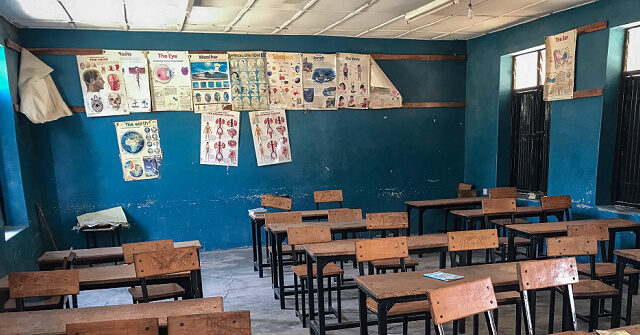
The wave of violence prompted the government of Bauchi state in Nigeria to close all schools as a precaution, including both government and private institutions.
The latest kidnapping victims were 13 girls, between the ages of 15 and 20, who were working on farms in the Askira-Uba area of Borno state. The girls were reportedly taken from the fields while they were harvesting crops. One of the victims escaped and returned to her family, but the whereabouts of the other victims were unknown as of Monday afternoon.
Different local officials said the kidnappers were either from Boko Haram or ISWAP, but the Borno state police admitted the “details are still sketchy.”
The Askira-Uba incident was the latest in a string of abductions and violent attacks over the past few weeks. The largest attack occurred in central Nigeria on Friday, when armed “bandits” kidnapped over 300 people from St. Mary’s Catholic School in the central state of Niger.
According to school officials, 50 of the students abducted from St. Mary’s were able to escape from their captors, some with the help of local farmers.
Five days before that, another swarm of “bandits” kidnapped 25 students from a girls’ boarding school in the state of Kebbi, and dozens of worshipers were taken from a church in the rural state of Kwara by violent masked gunmen who murdered the church pastor.
The government of Bauchi state on Monday announced the immediate shuttering of all primary, secondary, and tertiary schools, public and private. State officials said they were reluctant to take such drastic measures, but “the protection of our children remains our highest moral responsibility.”
“Every student in Bauchi State deserves to learn in an environment that is safe, stable, and free of fear. We, therefore, call on parents, guardians, school proprietors, and all concerned stakeholders not to panic, but to remain calm and cooperative,” the state government said.
“The government is working closely with security agencies to address the concerns swiftly and comprehensively, ensuring that normal academic activities resume as soon as it is safe to do so,” the statement added.
Several other states have reportedly followed suit, including Papiri state, where St. Mary’s Catholic School is located. In fact, Papiri state officials claimed they ordered St. Mary’s to suspend operations before the mass kidnapping, due to “credible” security threats, but the school had reopened without authorization.
The Nigerian federal government also ordered 47 federal colleges to be closed, most of them located in the northern part of the country. Other state governments have instructed boarding schools to send their students home.
Ahmed Usman, a special adviser to the governor of the northwestern state of Sokoto, strenuously objected to the school shutdown order on Sunday because it is a “serious setback” to education and could “encourage the perpetrators” by showing weakness.
“Instead, the government should rise to the occasion and address the insecurity in our region and country, perhaps by applying both kinetic and non-kinetic measures,” said Usman, a retired military officer.
Nigeria’s Business Day published an editorial on Sunday calling the school shutdowns a “grim new chapter” in the “long-running battle with insecurity.”
“State governments are closing school gates, instead of reinforcing them. This wave of deliberate shutdowns, sweeping across states, is a stark admission that authorities can no longer guarantee the safety of students,” Business Day wrote.