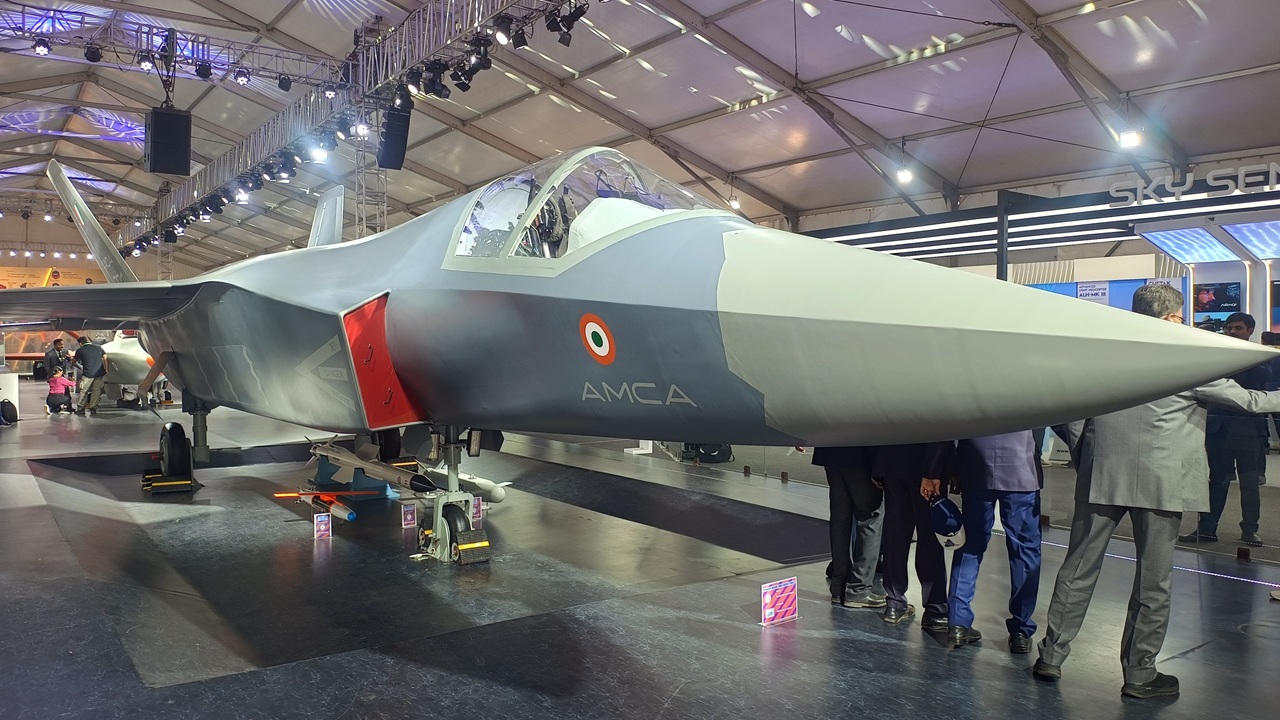
As India’s “Advanced Medium Combat Aircraft” fifth-gen fighter project has struggled, New Delhi has vacillated between buying the US F-35 and the Russian Su-57 to plug the gap.
There is an ongoing race between the United States, Russia, and domestic Indian defense firms to see which group can furnish the rising power of India with a fifth-generation warplane. For decades, New Delhi has disproportionately relied upon the Russian Federation (and before that, the Soviet Union) for weapons and warplanes.
Over time, India has recognized the drawbacks of reliance on foreign nations for its security needs, and has striven to develop a more independent defense industry. Until their domestic industry can meet demand, India does not want to be reliant on any single foreign power for its defense.
Hence, with the Indians looking for next-generation replacements for their aging Russian warplanes and with the Americans piling on sanctions and other inconveniences for daring to use Russian products at a time when the West is shunning Russia over their Ukraine War policies, New Delhi is looking beyond Russia.
Russia and America Are Competing for an India Fighter Deal
Of course, Russia very badly wants to see India purchase the Su-57 “Felon” (NATO designation) fifth-generation warplane. And, for the last several months, it appeared as though New Delhi had tacitly decided to lean toward the Su-57.
Now, however, things are changing. The Indians are also looking at the American F-35 Lightning II fifth-generation multirole warplane. Of course, the American plane comes with its own set of unique complexities that might end up being more trouble than it is worth for the Indians. After all, India still heavily relies upon Russian systems and training to support their military—notably their air force.
Is the Su-57 as good as the Russians say? Is the F-35 overrated? How does relying on either plane live up to India’s ultimate strategic goal of being self-reliant?
India Is Developing Its Own Fifth-Gen Stealth Fighter, Too
Enter the Advanced Medium Combat Aircraft (AMCA) being designed by India’s premier state-owned aerospace and defense manufacturer, Hindustan Aeronautics Limited (HAL). AMCA is India’s most ambitious aerospace project since the Light Combat Aircraft (LCA) Tejas.
If successful, it will make India only the fourth country—after the United States, China, and Russia—to field an indigenous fifth-generation warplane. It is India’s answer to China’s J-20 and future J-31 variants, and an eventual replacement for India’s Mirage 2000s, MiG-29s, and Su-30MKIs.
In terms of its profile, the AMCA being a fifth-generation bird means it is designed for stealth. As such, it has an internal weapons bay housing beyond-visual-range (BVR) missiles, precision-guided bombs, and future indigenous air-to-air systems. There will be serrated inlets, edge alignment, composites, and radar-absorbent materials involved in the construction of this plane. Indian outlets insist that the plane’s reduced cross-section (RCS) will be between 0.0001 and 0.002 square meters (though this is purely speculative, as the plane has not yet been built).
The Mk-1 is planned to utilize twin GE F414 engines, while the Mk-2 is intended to use an Indian-foreign co-developed 110-125kN engine (potentially jointly made by General Electric and the Indian Defense Research Development Organization, or DRDO). Indian engineers hope to have the Mk-2 supercruise-capable, too.
Keeping up with the other great powers, Indian designers intend for this proposed fifth-generation bird to possess a Loyal Wingman (Manned/Unmanned Teaming, or MUMT) capability. Currently, India is developing its own CATS UAV suite, which will serve as the bedrock of this capability.
Can the AMCA Deliver on These Promises? It’s Unclear
Cabinet approval for the AMCA project occurred last year. The first prototype is expected between 2026 and 2027, and a year thereafter, Indian projects the AMCA will enjoy its maiden flight. By 2035, New Delhi believes that some number of the Mk-1 AMCA planes can be inducted into its air force. By 2040 and beyond, the Mk-2—replete with new engines, more stealth, and sixth-generation warplane crossover tech—is expected to fly.
In essence, India is planning a 20-25 year-long journey in a decade.
Realistically, it seems highly unlikely that New Delhi will be able to achieve such lofty ambitions under current conditions. Just consider the bottlenecks and deficiencies in India’s domestic defense industrial base. A good example of this problem is in engine development. No country has ever built fifth-generation engines without at least 20 to 30 years of experience. Even China, nominally a behemoth of defense production, has struggled in this area. As a result, the Indians are planning for their Mk-1 to use exclusively American engines—but given the tense relationship between New Delhi and Washington over India’s ties to Russia, relying on America for this important element of the program seems like a worrisome risk to take.
Then there are material deficiencies the Indians must overcome. For instance, in order for the AMCA’s stealth technology to function, India must master RAM coatings, composite shaping, and precision machining. It cannot rush this process. What’s more, India’s defense procurement is legendary for its delays. During India’s previous major warplane project, the Tejas, there was a notorious development creep that long-delayed that aircraft and complicated India’s air strategy.
Can AMCA avoid such a replay? It seems uncertain.
Amid AMCA Struggles, India Keeps Looking at the F-35 and Su-57
The biggest issue in terms of actual production is in the manufacturing infrastructure of India. China’s production rate for their J-20 and J-31 are lightyears ahead of what HAL currently can do. Thus, AMCA’s success requires an entirely new factory setup for production, private-sector input, and greater levels of automation and robotics than what the Indians currently utilize.
AMCA has the potential to make India a truly dominant aerospace power—but only if the program stays on schedule, receives sustained funding, and cracks its engine and stealth manufacturing challenges. None of that is likely under present conditions.
That is probably why New Delhi keeps going back to the Su-57 and F-35 as potential investments.
Interestingly, to better compete with the Americans, the Russians have hinted heavily that their purchase of the export variant of the Su-57 need not replace New Delhi’s desire to build the AMCA. In fact, Moscow has intimated repeatedly that the Su-57E (“E” for “export”) could help to augment India’s design for the AMCA.
It remains to be seen as to whether New Delhi will go with the Su-57 or the F-35. Now that some of the sting from the burning of US-India relations by Trump over the trade war and sanctions because of India’s continued purchases of Russian energy has worn off, India is seriously looking at the F-35 over the Su-57—something considered unthinkable just a few months ago.
The real race, then, is not for the AMCA, which will remain something of a pipe dream in the near future. It is between Russia and America, and the Su-57 versus the F-35. Whichever nation wins, India will become inextricably linked to for the next half century. New Delhi had better choose wisely.
F-35 vs. Su-57 vs. AMCA: A Head-to-Head-to-Head Comparison
| Aircraft | Su-57 Felon (Russia) | F-35A Lightning II (USA) | AMCA (India; projected specifications only) |
| Year Introduced | 2020 | 2016 | Not yet introduced (serial production anticipated ~2035) |
| Number Built | ~32, including prototypes | 1,250+ (all variants) | 0 (design phase) |
| Length | 20.1 m (65 ft 11 in) | 15.7 m (51.4 ft) | 18 m (59 ft 1 in) |
| Wingspan | 14.1 m (46 ft 3 in) | 11 m (35 ft) | 11.13 m (36 ft 6 in) |
| Weight (MTOW) | 35,000 kg (77,162 lb) | 29,900 kg (65,918 lb) | 27,000 kg (59,525 lb) |
| Engine(s) | Two Saturn AL-41F1 afterburning turbofan (19,900 lbf thrust each) | One Pratt & Whitney F135-PW-100 afterburning turbofan, (28,000 lbf thrust) | Two modified GE F414 afterburning turbofan in initial production; domestic engine in later production |
| Top Speed | 2,135 km/h (1,327 mph) / Mach 2 | 1,976 km/h (1,228 mph) / Mach 1.6 | 2,600 km/h (1,600 mph) |
| Combat Radius | 1,250 km (780 mi) | ~1,239 km (770 mi) | 1,620 km (1,010 mi) |
| Service Ceiling | 20,000 m (66,000 ft) | 15,000 m (50,000 ft) | 20,000 m (65,000 ft) |
| Loadout | One 30mm Gryazev-Shipunov GSh-30-1 autocannon; 12 hardpoints; 7,500 kg (16,500 lb) payload capacity | One 25mm GAU-22/A 4-barrel rotary cannon; 10 hardpoints; 8,200 kg (18,000 lb) payload capacity | One 23mm GSh-23 cannon; 14 hardpoints; 7,000 kg (15,000 lb) payload capacity |
| Aircrew | 1 | 1 | 1 |
About the Author: Brandon J. Weichert
Brandon J. Weichert is a senior national security editor at The National Interest. Recently, Weichert became the host of The National Security Hour on America Outloud News and iHeartRadio, where he discusses national security policy every Wednesday at 8pm Eastern. Weichert hosts a companion book talk series on Rumble entitled “National Security Talk.” He is also a contributor at Popular Mechanics and has consulted regularly with various government institutions and private organizations on geopolitical issues. Weichert’s writings have appeared in multiple publications, including The Washington Times, National Review, The American Spectator, MSN, and the Asia Times. His books include Winning Space: How America Remains a Superpower, Biohacked: China’s Race to Control Life, and The Shadow War: Iran’s Quest for Supremacy. His newest book, A Disaster of Our Own Making: How the West Lost Ukraine is available for purchase wherever books are sold. He can be followed via Twitter @WeTheBrandon.
Image: Shutterstock / Aerospace Trek.