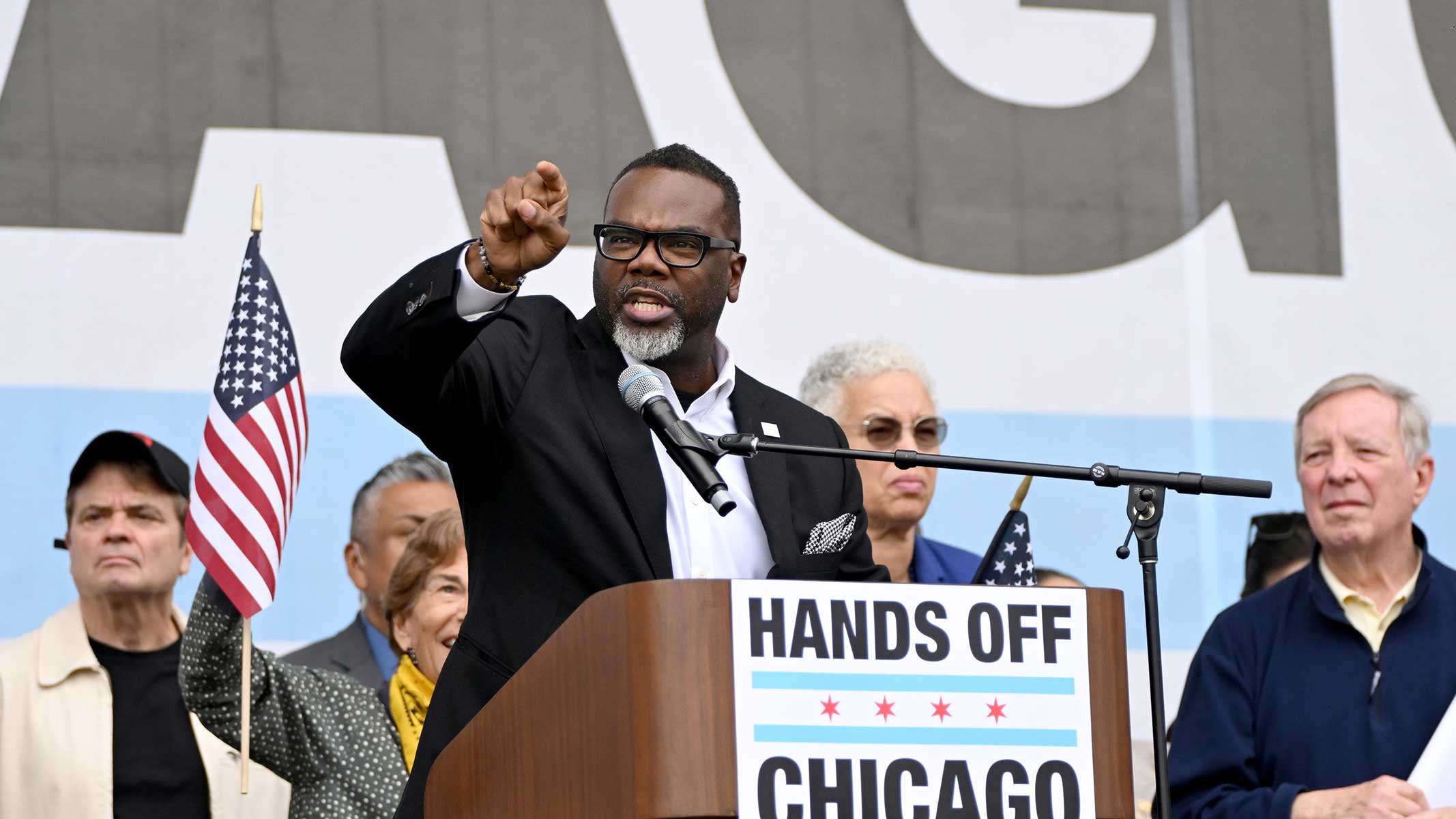
The Chicago city budget that Mayor Brandon Johnson has put forward for 2026 offers a clear window into his mayoralty. Beneath the technical language and spreadsheets lies a simple reality: it is fiscally irresponsible and driven by ideological commitments that harm many of the constituents whom Johnson claims to champion.
Yet there is a silver lining: this budget will make it harder for Johnson to win a second term. And because Johnson already occupies the left lane in Chicago’s ostensibly nonpartisan mayoral elections, his challenger is more likely to be interested in governing than in acting like a street-corner prophet of progressive politics. As the Romans have long observed, “after a fat pope, a thin pope.”
Finally, a reason to check your email.
Sign up for our free newsletter today.
Johnson’s challenge was to balance a city budget that is more than $1 billion out of whack. He blames the city’s plight on Donald Trump, though reduced federal grants constitute only a tiny portion of the deficit. In fact, the city’s red ink flows from the loss of federal subsidies designed to combat a pandemic that ended years ago, as well as from structural imbalances caused by a large workforce, whose pensions and wages are higher than necessary.
New taxes on business dominate Johnson’s proposals, showing that the mayor is indifferent to Chicago’s greatest need—attracting more businesses to increase economic growth. The most obnoxious is a $21 per employee per month “Community Safety Surcharge” on companies with more than 100 workers. Few other major cities impose such a tax. Of those that do, Chicago’s would be the highest.
Johnson touts his proposal as a tax on the “ultrawealthy,” but it will drive away new businesses and discourage existing ones from hiring more Chicagoans, including low-income workers. Mayor Rahm Emanuel’s elimination of the previous $4 per employee per month head tax was widely hailed as showing employers that the city was open for business. Johnson seems determined to send the opposite message.
The mayor’s budget also proposes raising the personal property lease tax on businesses from 11 percent to 14 percent. This tax hits any leased factors of production that a firm uses to provide its own products and services.
While other cities levy similar taxes, 11 percent is already higher than the rate in almost all of them; 14 percent is uniquely burdensome. Chicago services aren’t so great that the city can afford to price itself out of the market.
To balance a substantial portion of the budget, Johnson has also raided Tax Increment Financing funds. These funds accumulate over time from the city’s sales tax to support capital projects in specific districts. They’re designed to fund capital improvements; Johnson is using them for operational expenses.
He is not the first mayor to do this, but he is doing so at an unprecedented and unsustainable scale. This kind of revenue does little to solve the structural deficit. Indeed, it is likely to worsen that deficit in the years ahead if the capital projects work as intended and attract more business to their districts.
Johnson’s budget is also notable for what it does not contain: any sincere effort to make Chicago’s delivery of services leaner and more efficient. That is not because he was not given recommendations on how to do so. At a cost of more than $3 million, Ernst and Young offered detailed proposals.
The city could save hundreds of millions of dollars over time by reforming wasteful employee benefits and adopting procurement practices that ensure the city gets value for its money. Johnson has dismissed these ideas. Employee unions are the mainstays of his progressive support, and discretion in city contracting protects his patronage power. The mayor has no interest in good government reform.
Another cause of Chicago’s budget shortfall is the structural deficit of Chicago Public Schools. The city cannot fix its broader fiscal situation without addressing CPS’s fundamental financial misalignments, especially under-enrolled schools and excessive staffing levels, because both the city and school district depend on the same source of financing—property taxes. But Johnson, a former teachers’ union organizer, has even less interest in addressing teacher featherbedding and the underutilization of educational facilities than he does in right-sizing the rest of government.
Finally, Johnson has cut the amount Chicago is contributing in catch-up payments for its underfunded pension system. Predictably, rating agencies have responded to this decision and the anti-growth tone of his budget by placing Chicago’s credit rating on the watch list.
Just as Chicago’s fiscal plight exposes Johnson’s foolish ideology, it highlights Illinois governor J. B. Pritzker’s cynicism. Pritzker opposes the head tax—it threatens an immediate cost to businesses, and the last thing the governor needs as he eyes a potential 2028 presidential run is a story about companies leaving Chicago. On the other hand, he recently signed legislation that vandalizes the city’s long‑term economic prospects by fattening pensions for city employees by billions of dollars in a system already grossly underfunded. This windfall flows entirely outside the collective‑bargaining process; it is essentially a gratuity, not a concession traded for efficiencies or reforms elsewhere.
By the time most of the bills for Pritzker’s pension largesse come due, he will no longer be governor, but Chicagoans will still be paying. In opposing Johnson’s head tax while quietly loading new pension costs onto the city, the governor has tried to buy union goodwill today and stick future taxpayers with the tab. He has mortgaged Chicago’s future for his vanity presidential run.
Photo by Daniel Boczarski/Getty Images for No Kings
City Journal is a publication of the Manhattan Institute for Policy Research (MI), a leading free-market think tank. Are you interested in supporting the magazine? As a 501(c)(3) nonprofit, donations in support of MI and City Journal are fully tax-deductible as provided by law (EIN #13-2912529).
Source link