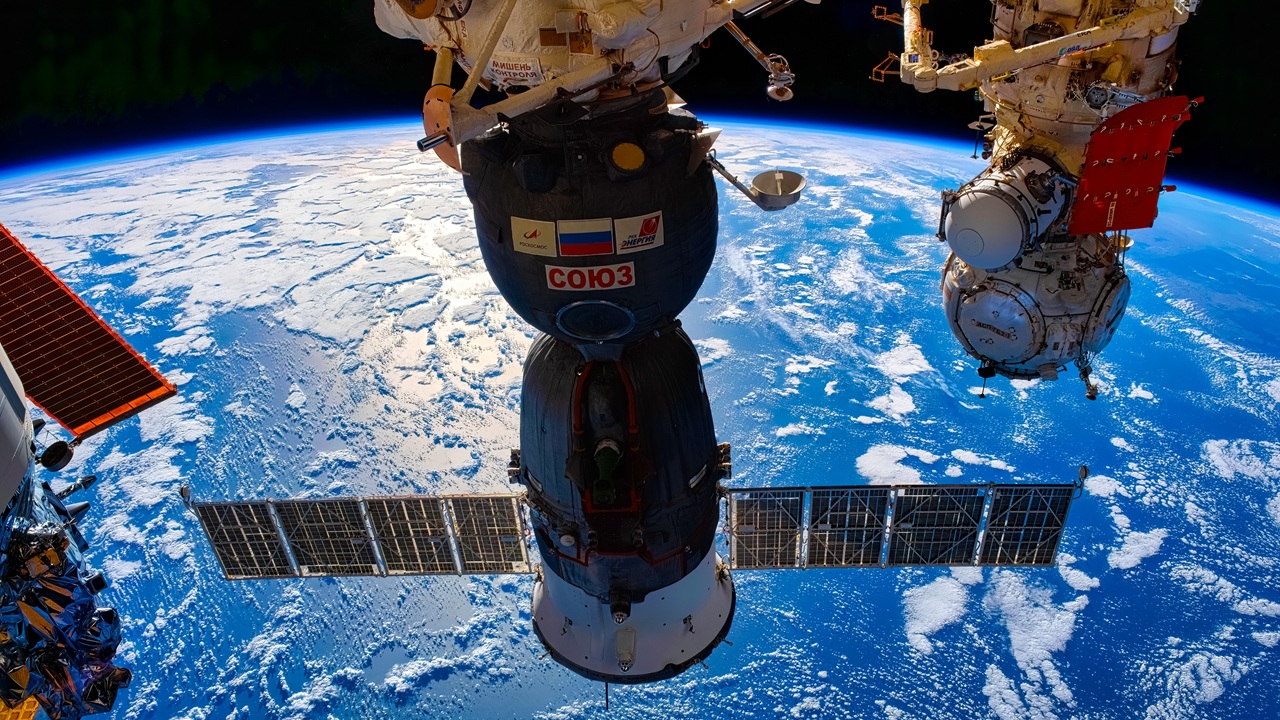
Russia intends to place a space station into polar orbit, giving it an unparalleled view over a vital strategic region.
The Russo-American divorce is not only impacting international relations on Earth, but it is affecting space policy, too. Recently, Roscosmos, the Russian space agency, announced that it would be launching and assembling the core four modules for its new space station by 2030.
Whenever one brings up the prospects of a new Russian space station, many Western observers chortle, given the Kremlin’s past struggles. But they shouldn’t. Not only has Russia long been a space station superpower, but the country has also weathered the harsh Western sanctions imposed upon them quite well.
Understanding Roscosmos’ Space Plan
The first module is designated a science and energy type that is planned for launch by 2027. After the core four-module set is assembled, additional “special-purpose” modules will be sent in the period between 2031 and 2033. This station will be separate from the International Space Station (ISS) as Russia intends to become more independent in space just as it has become more independent on Earth.
After all, Moscow doesn’t want to be dependent on anyone in the aftermath of the Ukraine War, which saw the West sanction Russia’s economy and squeeze them in every domain outside the war as part of a campaign to force Russia to stop the war (it didn’t work).
Interestingly, the design orbit is anticipated to be near-polar or high-inclination orbit (around 97 degrees) rather than the ISS’s orbital inclination, which is around 51.6 degrees. The selection of a polar orbit stands out. By placing a manned space station in orbit, Russia will have unprecedented coverage over every point on Earth over time. That, in turn, will provide unparalleled opportunities for reconnaissance and intelligence gathering missions.
And to be clear, unlike the ISS, the proposed Russian space station is unlikely to be exclusively civilian in nature.
Why a Polar Orbit Matters to the Kremlin
What’s more, placing their new modular space station in a polar orbit helps with Russia’s growing desire to strengthen its claim on both the Arctic and Antarctic regions. With the polar regions becoming areas of increasing strategic concern (due to the immense untapped resources there), the Polar orbits provide vital support for monitoring activities in these regions.
Satellites in other orbits, such as in geostationary (GEO) are limited due to line-of-sight issues. Having a station directly in a polar orbit will enhance Russia’s surveillance of these areas.
Placing a station in a polar orbit will also give the Russian station real advantages in the arena of scientific research—specifically for scientific studies on climate, weather patterns, and sea ice. Perhaps that is why the first module Moscow plans to place into orbit is the research/energy module. The overall budget is estimated to be around $6.7 billion (or 609 billion Russian rubles) for part of the project.
Russia’s segment of the ISS is aging and international cooperation between Russia and its ISS partners has diminished. So, continued Russian operations at the ISS are becoming problematic so long as those relations remain at their all-time low. Building a separate station gives Russia greater autonomy. The new Russian station is being pitched as enabling “scientific and technological development, the national economy and security” in ways that Russia’s ISS segment cannot.
While the timeline is ambitious, analysts at the Jamestown Foundation caution that those timelines may slip, or the scope might be scaled down over time. The station will require new launch vehicles, ground infrastructure, and spacecraft (crew/cargo) solutions that are still under development. Delays or budget constraints may impact the schedule.
What Will Russia Do Next in Space?
If successful, Russia will maintain independent human-spaceflight capability in low Earth orbit (LEO) rather than relying on the aging US-led ISS indefinitely. This contributes to a diversification of LEO infrastructure globally—alongside the ISS, China’s Tiangong space station, and emerging commercial stations. The proposed station’s high-inclination orbit and observation capabilities make it strategically significant for Russia.
Further, this station signals a serious shift in Russia’s space strategy toward greater national control and less reliance on international partners (or at least different partner configurations).
Still, this is not an easy undertaking for any country, even a country (like Russia) with significant space station experience—not while they are in an existential war on Earth. The mere fact that Moscow is talking about doing this so soon should, however, be a real wakeup call for Washington, which seems completely oblivious to the fact that it is in a new space race—let alone one that it is losing.
About the Author: Brandon J. Weichert
Brandon J. Weichert is a senior national security editor at The National Interest. Recently, Weichert became the host of The National Security Hour on America Outloud News and iHeartRadio, where he discusses national security policy every Wednesday at 8pm Eastern. He is also a contributor at Popular Mechanics and has consulted regularly with various government institutions and private organizations on geopolitical issues. Weichert’s writings have appeared in multiple publications, including The Washington Times, National Review, The American Spectator, MSN, and the Asia Times. His books include Winning Space: How America Remains a Superpower, Biohacked: China’s Race to Control Life, and The Shadow War: Iran’s Quest for Supremacy. His newest book, A Disaster of Our Own Making: How the West Lost Ukraine is available for purchase wherever books are sold. He can be followed via Twitter @WeTheBrandon.
Image: Shutterstock / BobNoah.
In Space – January 15, 2024: Exterior structure of the International Space Station. The beauty of planet Earth in the background. Digital enhancement of a NASA image