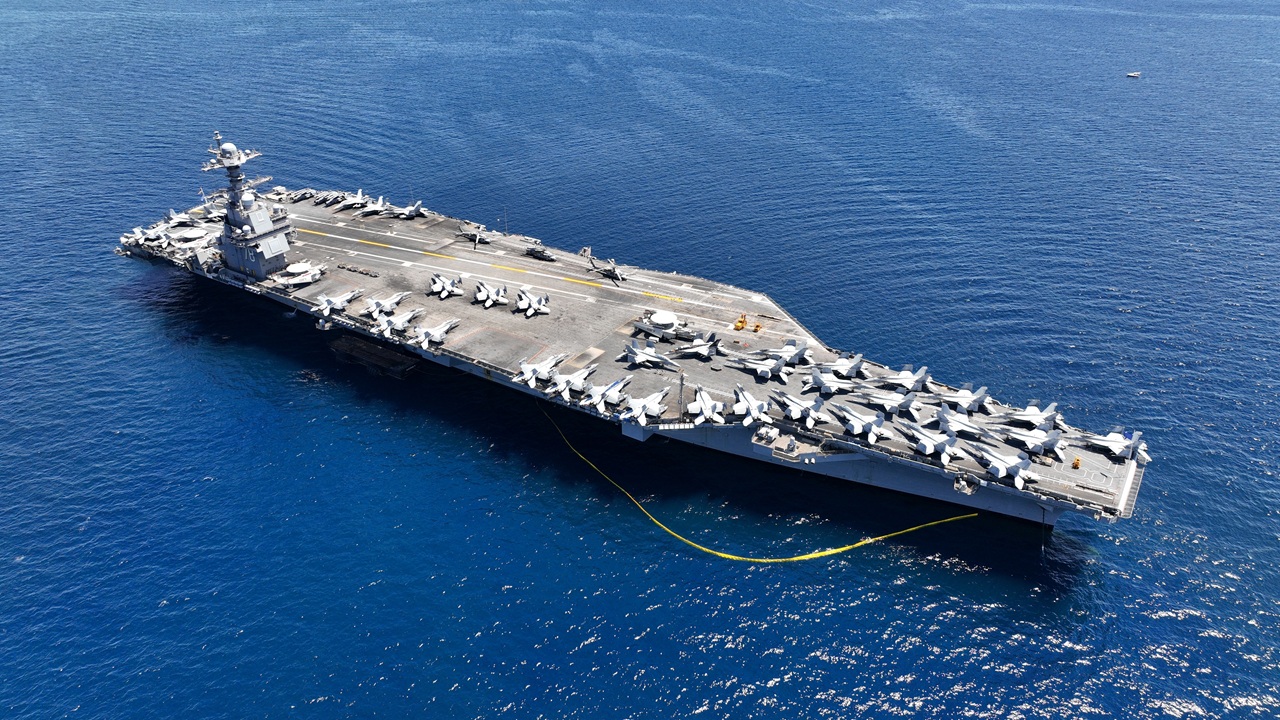
Though the Ford is a menacing foe for Venezuela, the recent war near Yemen has demonstrated that the US Navy’s warships are far from invincible.
In a shooting war with Venezuela, the USS Gerald R. Ford (CVN-78) would not be merely another carrier. Instead, it amounts to a massive force multiplier—turbocharging the US naval flotilla operating off the coast of the Latin American socialist state.
The Navy Should Still Be Wary of Venezuela’s Defenses
Of course, that’s if the Venezuelans have not fully integrated Russian Kh-31A and/or Kh-31AD anti-ship ballistic missiles—and if those anti-ship ballistic missiles are numerous enough to seriously threaten the safety of the Ford.
Given the United States Navy’s lackluster performance against the Houthis and their jury-rigged missiles, one shudders to think about how badly a proposed invasion of Venezuela could go if that invasion is built around a US aircraft carrier. No matter how advanced the Ford may be (or well protected), she could easily be damaged by an errant Russian-made missile fired from Venezuela.
The Trump administration has deployed the carrier as both a show of force and to ensure maximum success if the White House opts to launch their proposed attack on Venezuela. However, it should be noted that of the 23 new technologies the Pentagon insisted on incorporating into the Ford all at once, including the all-important Electromagnetic Aircraft Launch System (EMALS) and Advanced Arresting Gear (AAG), most have struggled to work properly.
Pentagon sources assert that they’ve got the EMALS working. Yet multiple defense publications highlight that, while the EMALS has improved since its initial installation, it is in no way fully reliable by the exacting standards of the United States Navy.
Has the Ford Finally Fixed Its EMALS Catapult System?
Still, the Ford has carried out successful full-flight operations with the EMALS in operational conditions, such as carrying out sustained flight operations in regions like the North Sea and the Mediterranean.
What’s more, in 2022, the Ford’s EMALS (along its AAG) achieved milestone numbers of “cats and traps” aboard the ship—indicating both significant usage and excellent adaptation of the technology by ship and crew in real world conditions.
Nevertheless, the Ford has not truly been in a combat situation of the kind that it would be spearheading if the Trump administration opted to attack the regime of Nicolas Maduro in Venezuela. The design goal with the EMALS is to be able to conduct around 25 percent more sorties per day than a Nimitz-class carrier with fewer crew. In practice, that means more strike packages, significantly more combat air patrols (CAPs), and more intelligence, surveillance, and reconnaissance (ISR) or electronic warfare (EW) on station at any given time.
When it’s working right, EMALS gives the carrier a vastly greater electrical power margin. The ship also relies upon dual band radar/integrated Ship Self-Defense System (SSDS) to give improved situational awareness and coordination of ship self-defense weapons (ESSM, RAM, CIWS). That should be of assistance if Venezuela manages to pull out some of the same tactics that the Houthis did against the US Navy. Of course, during that conflict, Washington did its level-best to keep the more advanced, expensive Ford on the periphery—and out of harm’s way.
Understanding the USS Gerald R. Ford’s Capabilities
- Year Commissioned: 2017
- Length: 1,106 ft (337 m)
- Beam (Width): 256 ft (78 m)
- Displacement: ~100,000 long tons (112,000 t)
- Engines: Two Bechtel A1B PWR nuclear reactors; four propeller shafts
- Top Speed: ~30 knots (35 mph, 56 km/h)
- Range: Unlimited; approx. 25 years before nuclear refueling
- Armaments: Two RIM-162 ESSM launchers; two RIM-116 RAM launchers; three Phalanx CIWS systems; four Mk 38 25mm machine guns; four .50 caliber machine guns
- Crew: 4,539, including air wing
The USS Gerald R. Ford possesses a potent air wing—F/A-18E/F Super Hornet fourth-generation warplanes for strike and air-to-air hits, EA-18G Growlers for electronic/Suppression of Enemy Air Defenses (SEAD) attacks, and E-2D Advanced Hawkeyes for long-range air and maritime surveillance and command-and-control functions. She also has MH-60R/S Seahawks for anti-submarine warfare (ASW), surface attack, and search-and-rescue (SAR). The Ford is also configured to handle the F-35C fifth-generation warplane.
Compared to the other warships involved with the current US Caribbean deployment off the coast of Venezuela, the Ford brings a much greater offensive capability. Again, that’s if the Venezuelans don’t manage to score a lucky shot or two on the carrier with their Russian-made anti-ship ballistic missiles.
Conventionally, Venezuela’s air force and integrated air defense network are limited in size and modernization compared to the Americans. A Ford-led carrier strike group should put the Americans over the edge. The Ford can deploy persistent CAPs over the Caribbean and near Venezuelan airspace, using its Super Hornets backed up by E-2Ds. Growlers plus precision munitions can be deployed to hit Venezuelan radars, surface-to-air missile (SAM) sites, and C2 nodes. Indeed, American forces on the carrier have spent days and days of their time locating, targeting, and planning to knock these sites out once the order were given.
Maduro Should Be Worried About the US Navy
If the carrier’s EMALS works properly, then she can cycle more jets through the fight without exhausting assets—important in a multi-day air campaign where the United States is trying to suppress and keep down Venezuelan air defenses.
Meanwhile, carrier-based aircraft armed with anti-ship missions and precision glide bombs will kill surface combatants and fast attack craft. MH-60R helicopters and escorts, like the Aegis destroyers and cruisers, will be key for providing additional cover for the carrier strike group.
Washington believes it can impose maritime quarantine or blockade conditions very quickly, interdicting Venezuelan naval movement and controlling the sea lanes from the Caribbean approaches to Venezuela’s northern coast.
In purely military terms, complicating factors of the kind listed earlier, the arrival of the USS Gerald R. Ford against a mid-tier regional rival, like Venezuela, fundamentally shifts the balance of military power from “very favorable” to “utterly overwhelming.” This is most especially true in the domains that truly matter in this instance—air superiority, sea control, and precision strike.
In all, it appears that the Trump administration intends to attack. It is just waiting for the moment of maximum opportunity. And that moment is fast approaching.
About the Author: Brandon J. Weichert
Brandon J. Weichert is a senior national security editor at The National Interest. Recently, Weichert became the host of The National Security Hour on America Outloud News and iHeartRadio, where he discusses national security policy every Wednesday at 8pm Eastern. He is also a contributor at Popular Mechanics and has consulted regularly with various government institutions and private organizations on geopolitical issues. Weichert’s writings have appeared in multiple publications, including The Washington Times, National Review, The American Spectator, MSN, and the Asia Times. His books include Winning Space: How America Remains a Superpower, Biohacked: China’s Race to Control Life, and The Shadow War: Iran’s Quest for Supremacy. His newest book, A Disaster of Our Own Making: How the West Lost Ukraine is available for purchase wherever books are sold. He can be followed via Twitter @WeTheBrandon.
Image: Shutterstock / Aerial-motion.