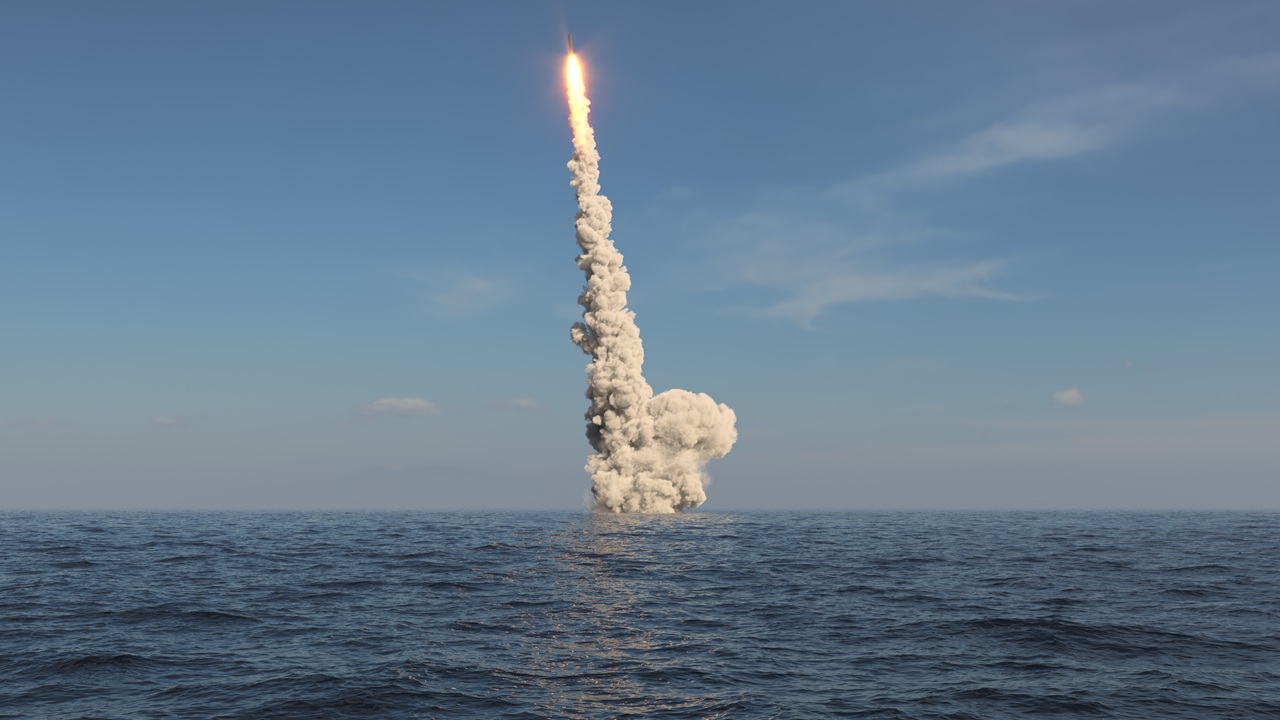
SLBMs can be launched from underwater nearly anywhere in the world—and are incredibly difficult to intercept, making them ideal second-strike nuclear weapons.
The submarine-launched ballistic missile (SLBM) represents one of the most consequential weapon systems ever developed, allowing nations to form the undersea leg of the modern nuclear triad alongside land-based intercontinental ballistic missiles (ICBMs) and strategic bombers. The SLBM’s purpose is straightforward yet profound: to ensure that a nuclear-armed state retains the ability to launch a second strike, or retaliatory strike, after absorbing a first strike that may disable land- and air-based nuclear options. By placing long-range nuclear missiles aboard stealth submarines, nations can achieve something like a guarantee of second-strike capability, which has come to serve as a foundation of modern deterrence theory.
How an SLBM Missile Works
The SLBM concept emerged in the 1950s, as missile range improved, and as submarines transitioned from diesel-electric power plants to nuclear power plants.
The United States was the first nation to deploy an SLBM in 1960, when it launched the Polaris A-1 missile from the USS George Washington. The Soviet Union followed shortly thereafter, initially with inferior technology—shorter-range missiles that required submarines to surface before firing—before progressing rapidly towards submerged launched systems with intercontinental range. Throughout the 20th and 21st century, SLBM technology has improved, with subsequent generations of missiles, including the Poseidon, Trident, R-29, Bulava, JL-2, and most recently the Columbia and JL-3 derivatives, offering extended range, accuracy, and yield.
From a technical standpoint, the SLBM is designed to be launched underwater from a vertical launch tube aboard a ballistic-missile submarine (SSBN). When the SLBM is fired, a gas generator ejects the missile from the tube, pushing the missile to the water’s surface where a rocket motor ignites. Once the missile is airborne, it follows a ballistic trajectory into space where it may deploy multiple MIRVs (multiple independently targetable reentry vehicles), each capable of striking separate targets with nuclear warheads. Modern SLBMs often have ranges exceeding 7,000 kilometers (4,300 mi), with precision comparable to ICBMs thanks to astro-inertial and GPS-aided guidance systems, and with speeds in excess of Mach 20.
Why SLBMs Are Nearly Impossible to Intercept
Strategically, the SLBM is valuable because submarines are extremely difficult to detect when submerged. Because nuclear-powered submarines are able to remain underwater for months at a time, SLBMs can offer nations a virtually undetectable nuclear option in perpetuity. The result is less pressure to launch preemptive strikes during a crisis, with adversaries aware that there is no way to preemptively knock out retaliatory forces (the SLBM-packed SSBNs). In effect, SLBMs have become the most survivable nuclear delivery system—far exceeding the survivability of a sprawling bomber base or a fixed-location ICBM silo.
Several nations have adopted SLBMs as part of their nuclear force structure. The United States, Russia, and China maintain the largest and most modern fleet of SSBNs armed with long-range SLBMs—naturally. The United Kingdom also fields Trident missiles on its Vanguard-class submarines (soon to be upgraded to the Dreadnought class) as their only form of nuclear deterrence. France operates a domestically developed M51 SLBM aboard the Triumphant-class submarine, while India has begun deploying indigenous SLBM systems to maintain a credible minimum deterrent.
Although SLBMs offer a stabilizing influence, they also raise concerns. Their stealthy deployment complicates arms control verification and introduces ambiguity during crises. For the moment, however, the SLBM is a cornerstone of global deterrence logic.
About the Author: Harrison Kass
Harrison Kass is a senior defense and national security writer at The National Interest. Kass is an attorney and former political candidate who joined the US Air Force as a pilot trainee before being medically discharged. He focuses on military strategy, aerospace, and global security affairs. He holds a JD from the University of Oregon and a master’s in Global Journalism and International Relations from NYU.
Image: Shutterstock / Alexyz3d.