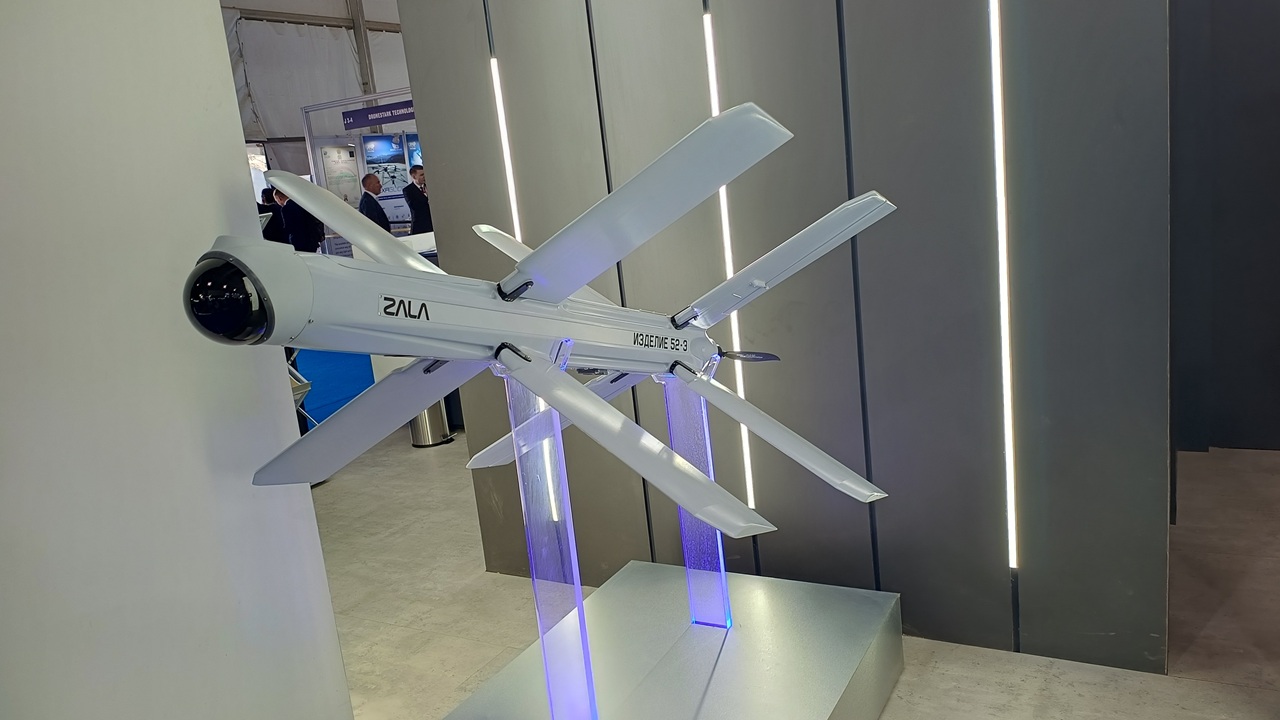
New upgrades to Russia’s “Lancet” loitering munitions effectively double their endurance in the air, significantly extending their range.
The Russian-made ZALA Lancet drone was first unveiled at the ARMY-2019 military exposition in Moscow in 2019. Developed by Kalashnikov Concern subsidiary ZALA Aero Group for the Russian Armed Forces, the Lancet unmanned aerial vehicle (UAV) and loitering munition was first used in combat in Syria before being employed in the ongoing war in Ukraine.
The ZALA Lancet has been one of the few successful domestically-built Russian platforms to see service in Russia’s so-called special military operation.
The Lancet Drone’s New Variant Offers Increased Range
In advance of this week’s Dubai Airshow 2025, ZALA announced the introduction of improved variants of its Item 51E, 51E-IK, 52E, and 52E-IK, each offering double the endurance of the base models.
“The range of our loitering munitions [has] increased,” ZALA stated, per Russian state news agency TASS. “But their flight time has also doubled. The Product 51E and Product 51E-IK now boast an operational range of up to 45 km and can stay aloft for up to 50 minutes. Meanwhile, the Product 52E and Product 52E-IK have seen their range grow to 35 km, with an endurance of 30 minutes.”
Russian Lancet-E Drones Are Ready for Export
The ZALA Lancet-E models will be among the items on display in the Russian pavilion at the Dubai Airshow 2025, which kicked off on Monday.
“Our foreign partners are indeed interested in the export version of the Lancet-E loitering munition,” Russian Federal Service for Military-Technical Cooperation Director Dmitry Shugayev told TASS on the sidelines of the Dubai Airshow—historically the largest air show and military aviation exhibition in the Middle East.
“This system demonstrated the highest effectiveness in combat conditions during the special military operation, making it famous worldwide. We can confidently say that the Lancet-E has great export potential,” added Shugayev. “I can confirm that we have received official requests from dozens of countries for this military product.”
The Lancet-E system was first presented to foreign buyers at the Army-2024 forum.
About Russia’s Lancet Drone
The Lancet is the successor to the Kub (“Cube”), an earlier flying-wing style loitering ordnance system that ZALA also developed. The Lancet was field-tested in Syria, where it was used by anti-government forces in Idlib from 2020 to 2021.
The loitering munition, or “kamikaze drone,” features two X-shaped wings at the front and rear of the fuselage, and is powered by an electric motor that drives a two-bladed propeller located at its rear. It is constructed of plastic and composite materials, weighing just 12 kg (26 pounds), including its 3 kg (6.6 pounds) of payload. The initial model had a maximum range of 40 km (25 miles) and an endurance of approximately 40 minutes.
The ZALA Lancet was developed to serve in both reconnaissance and attack roles, and during its flight, it can be directed by GPS coordinates or visual control. During the terminal part of a mission, it can be controlled manually to target via electro-optical guidance and a TV guidance unit.
Given its demonstrated success in Ukraine—where the Lancet has been employed to target Ukrainian vehicles, forward operating positions, and even critical infrastructure such as power plants and electrical stations—production of the deadly UAVs has increased significantly. The new variants, with increased range and endurance, will make the Lancet an even deadlier threat. As a low-cost solution, notably when compared to guided missiles and manned aircraft, the greatest danger is that the Lancet could be a force multiplier on the modern battlefield.
About the Author: Peter Suciu
Peter Suciu has contributed over 3,200 published pieces to more than four dozen magazines and websites over a 30-year career in journalism. He regularly writes about military hardware, firearms history, cybersecurity, politics, and international affairs. Peter is also a contributing writer for Forbes and Clearance Jobs. He is based in Michigan. You can follow him on Twitter: @PeterSuciu. You can email the author: [email protected].
Image: Shutterstock / Aerospace Trek.