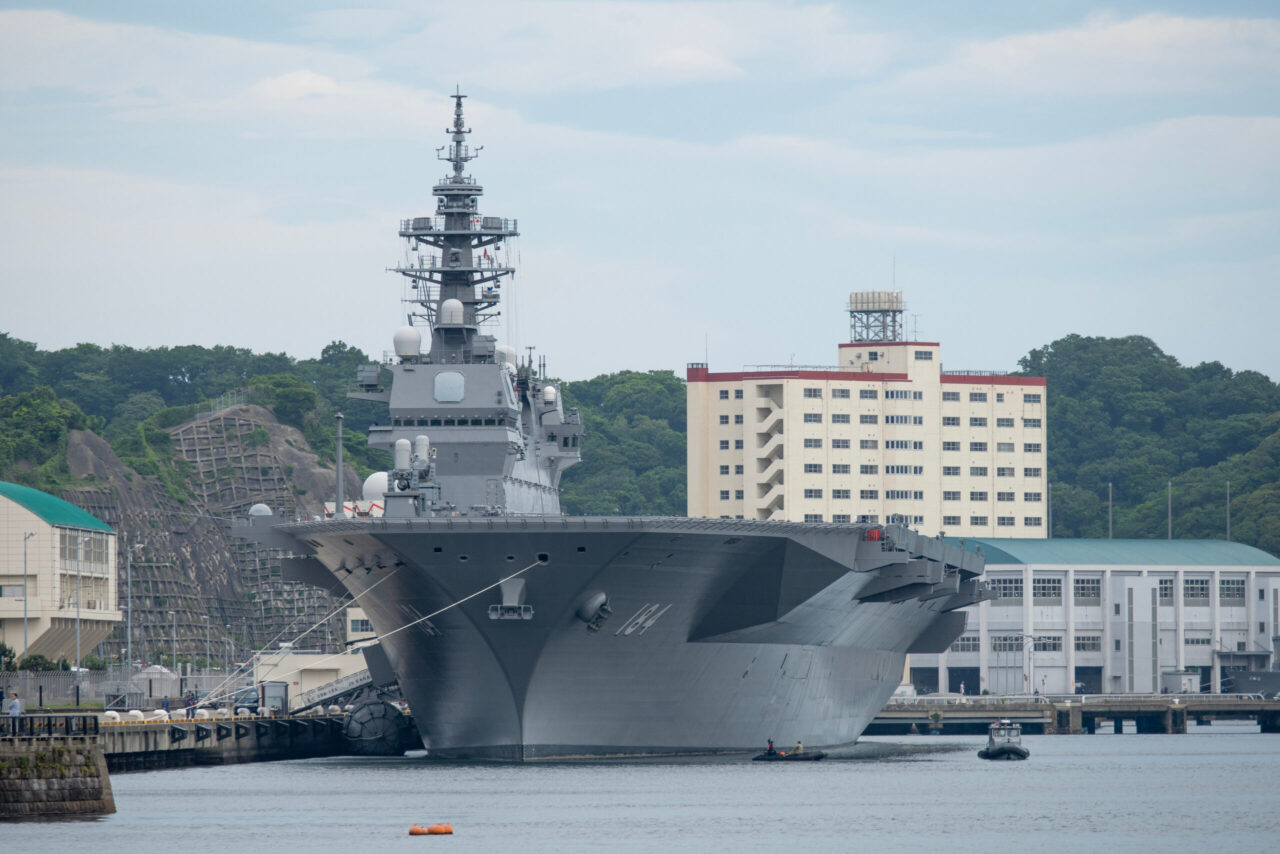
Despite the cruiser designation, the JS Kaga can serve as a light aircraft carrier.
Last month, US Marine Corps F-35 Lightning II stealth fighter jets operated from Japan’s largest carrier.
US Marine Corps F-35Bs on Japanese Carrier
Four F-35B Lightning II fighter jets conducted flight operations on the JS Kaga, the Japanese Maritime Self-Defense Force’s largest multirole cruiser. Despite the cruiser designation, the JS Kaga can serve as a light aircraft carrier.
Operating from Japanese light carriers is an important step toward increased interoperability between the US military and Japanese forces. In a potential conflict, having the ability to operate from each other’s aircraft carriers would offer commanders added operational flexibility.
A Navy CVM-22B Osprey tiltrotor transport aircraft also conducted flight operations alongside the stealth fighter jets.
The joint flight operations took place as part of Exercise Annualex, a biennial joint exercise under Japanese leadership. Several US and Japanese warships and aircraft drilled on anti-submarine warfare operations, air-defense warfare operations, underway replenishment, and maritime communications.
Specifically, the US Navy participated with the USS Robert Smalls, a Ticonderoga-class guided-missile cruiser; USS Shoup, an Arleigh Burke–class guided-missile destroyer; USNS Amelia Earhart and USNS Wally Schirra, two Lewis and Clark–class dry cargo/ammunition ships; and USNS Tippecanoe, a Henry J. Kaiser-class fleet oiler. The Japanese Navy participated with the JS Kaga and about 20 more ships.
In addition, the Royal Australian Navy and Royal Australian Air Force, the Royal Canadian Navy and Royal Canadian Air Force, the French Navy, and the Royal New Zealand Air Force also took part in the exercise.
The “B” version of the F-35 has short take-off, vertical landing (STOVL) capabilities, meaning that it can take off and land like a helicopter but still fly as a fighter jet. The US Marine Corps operates the F-35B, as does the Japanese military, in addition to the F-35A conventional take-off version of the stealth fighter. Japan has ordered 147 F-35s (105 F-35A and 42 F-35B).
Japan’s Role in the Indo-Pacific
Japan is an important US ally in the Indo-Pacific. Opposite of North Korea and near China, Japan houses US naval and air forces. In the event of a conflict with North Korea or China (or both), Japan would likely serve as a major hub for US military operations.
Japan has also cautiously reasserted its diplomatic and military presence in the region. Following decades of retreat from world and military affairs due to the stigma that came with Japan’s actions during World War II, Tokyo is feeling more confident in its position as a regional power. Although Japan has one of the strongest economies in the world, its international and military clout does not reflect that economic influence.
It is important for the United States that Japan feels confident in its military capabilities. US deterrence against China relies on a network of alliances and partnerships that would complement US military operations. China, for example, has the largest naval force in the world. The US Navy would struggle to defeat the People’s Liberation Army Navy on its own. However, with the addition of Australian, Japanese, South Korean, Filipino, and New Zealand naval and air forces, the US Navy would be in a much stronger position.
About the Author: Stavros Atlamazoglou
Stavros Atlamazoglou is a seasoned defense journalist specializing in special operations and a Hellenic Army veteran (national service with the 575th Marine Battalion and Army HQ). He holds a BA from the Johns Hopkins University and an MA from the Johns Hopkins’ School of Advanced International Studies (SAIS). His work has been featured in Business Insider, Sandboxx, and SOFREP.
Image: Shutterstock.