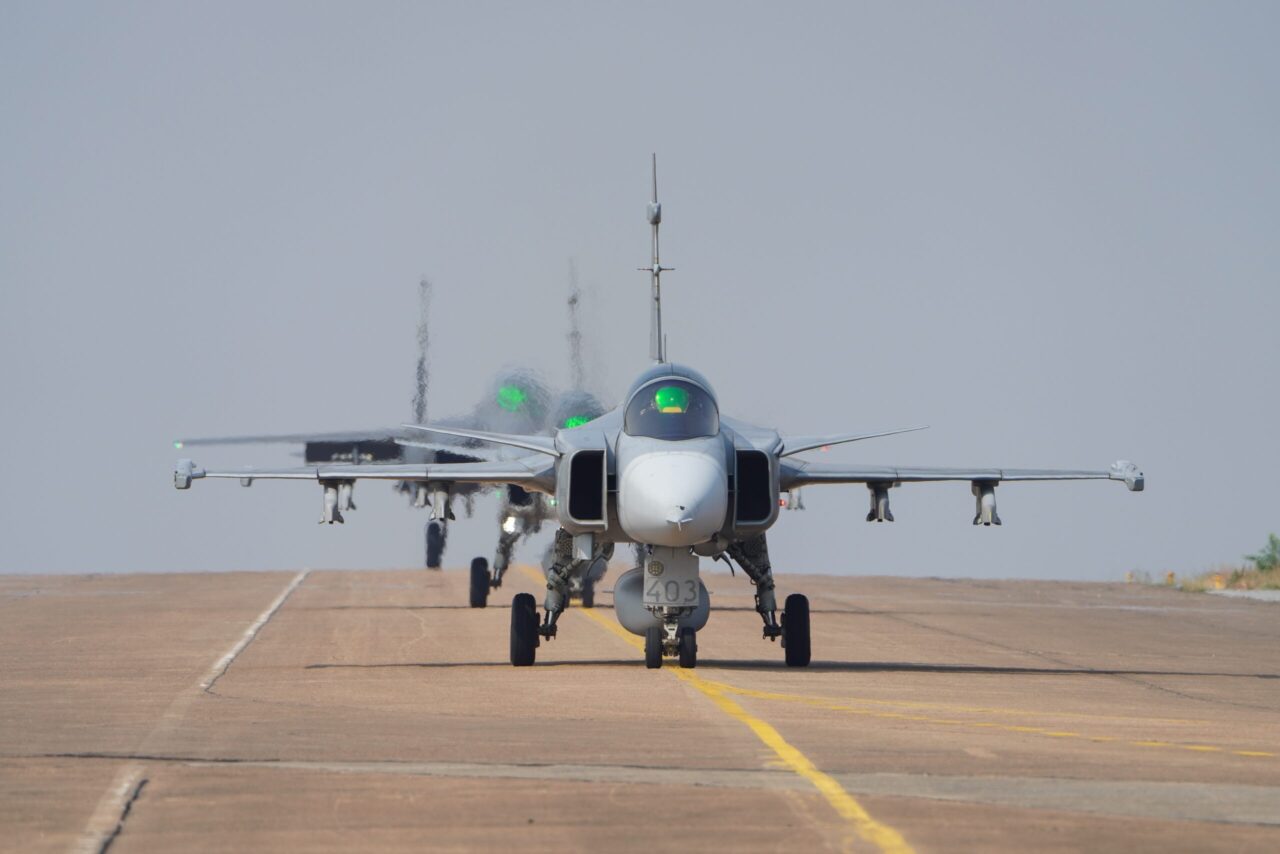
The incoming Gripens will replace Colombia’s aging Israeli Kfir fighter jets.
The Swedish-designed Gripen fighter series has been dominating the export market in recent months. Colombia is the latest country to pen a deal for these formidable fourth-generation jets.
On Friday, Bogota signed an agreement to procure 17 Gripen E/F fighters for a whopping $3.6 billion. In addition to the aircraft, Gripen manufacturer Saab and the Colombian government also signed two offset agreements for military and social projects, including cyber security, aeronautics, health, sustainable energy, and water purification technology. Saab president and CEO Micael Johansson said, “I am honored that Colombia has chosen Gripen E/F to enhance its air defence capabilities and delighted to welcome Colombia into the Gripen family. This marks the beginning of a strong and long-term partnership that will strengthen Colombia’s defence and security, benefit its people, and boost the nation’s innovation power.”
The incoming Gripens are set to replace Colombia’s existing fleet of aging Israeli Aerospace Industries-designed Kfir fighter jets.
JAS 39 Gripen E vs. IAI Kfir: A Direct Comparison
| Aircraft | JAS 39 Gripen E (Sweden) | Kfir C7 (Israel) |
| Year Introduced | 2025 | 1976 |
| Number Built | Unknown (60 ordered) | 220+ |
| Length | 15.2 m (49.8 ft) | 15.65 m (51 ft 4 in) |
| Wingspan | 8.6 m (28.2 ft) | 8.22 m (27 ft 0 in) |
| Weight (MTOW) | 16,500 kg (36,376 lb) | 16,500 kg (36,376 lb) |
| Engine(s) | One General Electric F414G afterburning turbofan (14,400 lbf) | One IAI Bedek-built General Electric J79-J1E turbojet engine (11,900 lbf) |
| Top Speed | ~2,037 km/h (1,266 mph) | 2,440 km/h (1,520 mph) |
| Combat Range | ~1,500 km (930 mi) | ~1,000 km (620 mi) in attack configuration |
| Service Ceiling | 15,850 m (52,000 ft) | 17,680 m (58,010 ft) |
| Loadout | One Mauser BK-27 27mm single-barrel revolver cannon; 10 hardpoints; ~7,200 kg (15,873 lb) payload capacity | Two Rafael 30 mm DEFA 553 cannon; nine external hardpoints; ~9,390 kg (20,701 lb) payload capacity |
| Aircrew | One | One |
About the Saab Gripen E Fighter
Saab developed the Gripen to embody versatility first and foremost. JAS stands for Jakt, Attack, och Spaning, Swedish for air-to-air, air-to-surface, and reconnaissance, which were the three functions envisioned for the Gripen by the Swedish government when the platform was first conceptualized. Additional considerations for the design were increasing its range and payload while decreasing its size from previous Saab jets. The supersonic, multirole fighter is widely considered to be on par with some of its more advanced fifth-generation counterparts like the F-35 Lightning II. Notably, the Swedish platform is far cheaper, making it a top export contender.
The Gripen E is the latest iteration of the Swedish jet series. Equipped with a host of enhancements, this model is quite dominant in the skies. Notably, this variant features the brand-new AESA (Active Electronically Scanned Array) radar, IRST (Infrared Search and Track) system, and electronic warfare systems. Like the Lockheed Martin F-35, the Gripen E is equipped with the capability of operating alongside allied joint forces in the air, at sea, and on the ground. As detailed by Saab, “The ease of weapon integration, the use of common communication systems and networked datalinks makes Gripen E a smart choice for an interoperable jet fighter.”
Colombia’s planned procurement of the Gripen will make the nation the seventh foreign client user of the jet. Sweden, Brazil, Hungary, the Czech Republic, South Africa, and Thailand have previously selected the platform to fly.
As more nations across the globe look to replenish their aerial defenses, the Gripen will likely continue to surge in popularity.
About the Author: Maya Carlin
Maya Carlin, national security writer with The National Interest, is an analyst with the Center for Security Policy and a former Anna Sobol Levy Fellow at IDC Herzliya in Israel. She has over 1,000 articles published over the last several years on various defense issues. Carlin has bylines in many publications, including The National Interest, Jerusalem Post, and Times of Israel. You can follow her on Twitter: @MayaCarlin.
Image: Shutterstock.