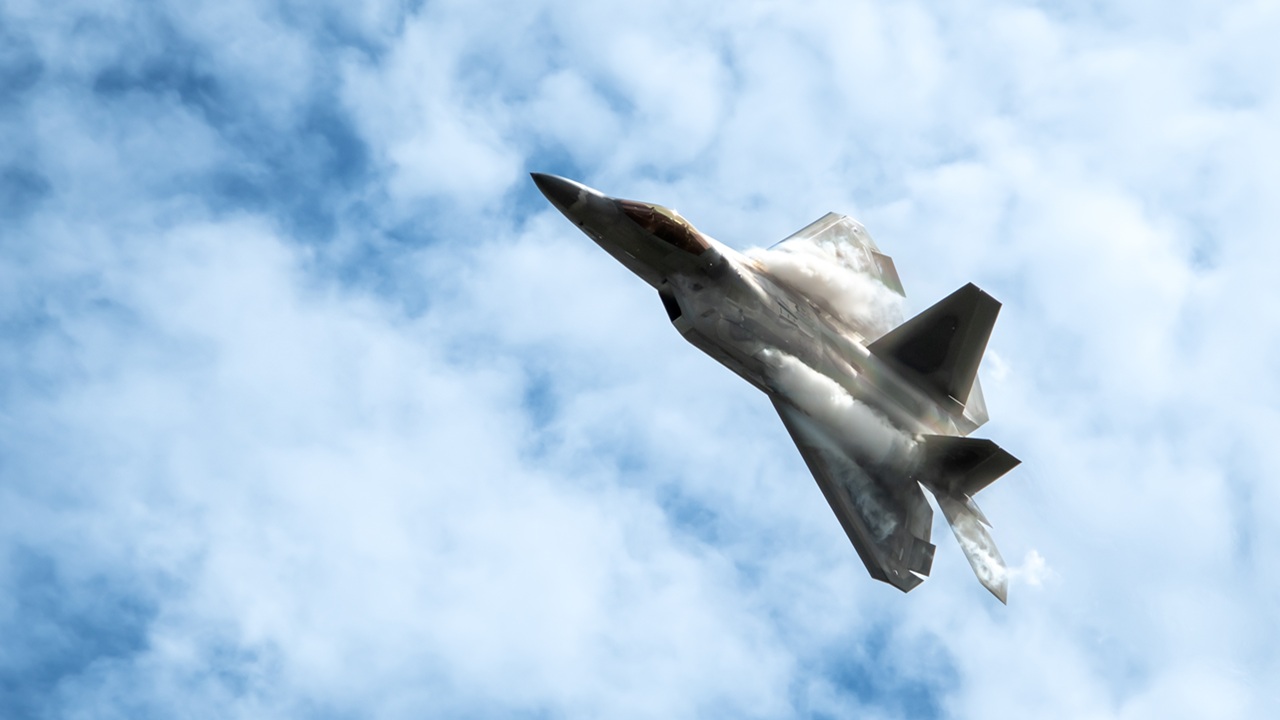
For now, the F-22 Raptor remains the greatest air superiority fighter ever built. But China is catching up.
The Chengdu J-20 and the Lockheed Martin F-22 Raptor represent the respective apexes of Chinese and American air power. Both planes are fifth-generation fighter aircraft built to express their respective military’s doctrines and priorities. Although both are stealthy twin-engine platforms with advanced sensors and long-range capabilities, they were designed for different missions, in different threat environments, to represent contrasting visions of air domination. Comparing the two jets offers insights into technical discrepancies, but also the deeper strategic competition between the United States and China.
Why Were the J-20 and F-22 Built Differently?
From a technical perspective, the F-22 remains the more impressive of the two—indeed, the most impressive air-to-air combat platform ever built. With its thrust-vectoring turbofan engines, the F-22 enjoys unrivaled acceleration, supercruise above Mach 1.7, and hyper-maneuverability. Its radar cross section (RCS) is among the lowest ever measured, thanks to internal weapons bays, serrated inlets, and composite material construction. An AN/APG-77 AESA radar, sensor fusion architecture, and electronic warfare suite give the F-22 high-fidelity situational awareness.
The J-20, in contrast, is a larger aircraft built for a different purpose—specifically for long-range, sensor-driven engagements. Accordingly, the J-20 excels in first-shot advantage scenarios from a distance. Early variants of the fighter relied on the Russian Al-31 engine, but China is now fielding the indigenous WS-10C (and testing the more advanced WS-15), threatening to close the gap with American supercruise ability.
The J-20’s canards make the jet’s frontal radar signature larger than the F-22’s—but to compensate, the J-20 incorporates larger internal fuel stores, long-range air-to-air missiles, and a sensor suite designed to operate in contested electromagnetic environments. The J-20’s type-1475 AESA radar, infrared search-and-track (IRST), and distributed aperture sensors provide wide-area detection suitable for long-range engagements.
J-20 Mighty Dragon vs. F-22 Raptor: A Talon-to-Talon Comparison
| Aircraft | J-20 Mighty Dragon (China) | F-35 Lightning II (USA) |
| Year Introduced | 2017 | 2005 |
| Number Built | 200+ (ongoing construction) | 195 (incl. 8 prototypes) |
| Length | 69 ft 7 in (21.2 m) | 62 ft 1 in (18.9 m) |
| Wingspan | 42 ft 9 in (13 m) | 44 ft 6 in (13.56 m) |
| Weight (MTOW) | ~80,000 lb (36,000 kg) | ~38,000 lb (83,500 kg) |
| Engine(s) | Two Shenyang WS-10C turbofans (27,000 lbf each with afterburner); future variants expected with WS-15 (~35,000 lbf) | Two Pratt & Whitney F119-PW-100 afterburning turbofans with thrust vectoring (~35,000 lbf each with afterburner) |
| Top Speed | ~1,500 mph (2,414 km/h) / Mach 2.0+ | ~1,500 mph (2,414 km/h) / Mach 2.0+ |
| Range | ~2,000 nmi ferry range | ~1,600 nmi ferry range |
| Service Ceiling | 65,000 ft (20,000 m) | 65,000 ft (20,000 m) |
| Loadout | Internal bays for long-range PL-15 and short-range PL-10 air-to-air missiles; precision-guided munitions in internal bays; external stores possible, at cost to stealth | Internal weapons bays (stealth configuration). 4 underwing pylons (non-stealth). Six AIM-120 AMRAAM and two AIM-9 Sidewinders! JDAM, SDBsOne 20 mm M61A2 Vulcan cannon |
| Aircrew | 1 | 1 |
The F-22 Has a Tremendous Advantage over the J-20
Operationally, the F-22 is an air-dominance fighter—built to clear the skies of enemy threats (ideally before they ever spot the F-22), and support joint force penetration into denied territory. The F-22 excels in offensive counter-air operations, escort, and high-end homeland defense.
The J-20 fills a different role: counter-intervention and anti-access. Basically, the J-20 is designed to deter US forces operating near China’s periphery—and the aircraft’s range and missile load out is calibrated accordingly. Missions profiles for the J-20 include intercepting US tankers and ISR aircraft at distance, protecting Chinese naval assets, and contesting airspace over the Taiwan Strait and South China Sea.
Essentially, the F-22 was designed to penetrate, while the J-20 was designed to prevent penetration—which underscores the jet’s respective nation’s strategic philosophies: the US seeks global air superiority while China pursues regional air denial.
If the two aircraft were to meet in combat, the consensus holds that the F-22 would hold a decisive advantage—especially respecting stealth, close-in maneuvering, pilot training and tactics, super cruise, and sensor fusion. The J-20 does hold some advantages, however; namely, the J-20 has an advantage at long-range, with respect to fleet quantity, and of course the support benefit of operating within China’s layered A2/AD umbrella. So, in a dogfight, the J-20 would likely attempt to keep the engagement long-range, while the F-22 would try to exploit its stealth and maneuverability to enter weapons range undetected. The odds would be evened out in an engagement close to China. But in a neutral environment, one-on-one, the F-22 remains the superior aircraft.
About the Author: Harrison Kass
Harrison Kass is a senior defense and national security writer at The National Interest. Kass is an attorney and former political candidate who joined the US Air Force as a pilot trainee before being medically discharged. He focuses on military strategy, aerospace, and global security affairs. He holds a JD from the University of Oregon and a master’s in Global Journalism and International Relations from NYU.
Image: Shutterstock / SaraChristine.